Showing posts with label Admiral Franklin Buchanan. Show all posts

Monday, August 4, 2014

Farragut At Mobile Bay 150 Years Ago: "Damn The Torpedoes!" - Fact or Legend?

Farragut At Mobile Bay 150 Years Ago: "Damn The Torpedoes!"  - Fact or Legend?


The ironclad monitor leading one column into Mobile Bay hit an underwater mine, exploded, and sank in under a minute.  The "unsinkable" wooden man-o-war leading the other column reduced speed to avoid striking similar "infernal machines" -  all while gunners in Fort Morgan and two other harbor forts began ranging in on the remaining 13 Union warships.  His ships being pounded, and the mighty Confederate ironclad ram CSS Tennessee and her consorts steaming toward the fleet, Admiral David Glasgow Farragut ordered his captains to "Damn the Torpedoes" and go "Full speed ahead."

That, at least, is how the legend goes.

Or maybe that is not exactly what happened, says Civil War historian, Pulitzer Prize-winning author and professor emeritus at Princeton James McPherson.

As he noted in his latest book, War Upon the Waters, and reiterated in a talk at the New York Historical Society two years ago,  Farragut might - or might not have said exactly those words.. Even if he did, says McPherson, the "damn" part might very well have been an exclamation of surprise (or a curse).   

Other source report that Farragut remained extraordinarily cool, and that "Damn the Torpedoes" Full speed ahead" is an abbreviated version of a a much longer statement, a clear set of orders to the captain of the USS Hartford (Captain Percival Drayton) and the commander of the gunboat USS Metacomet, James Edward Jouet, which was lashed to the far side of the larger warship to give it some protection from the Rebel shore batteries.

"Damn the Torpedoes! Four bells, Captain Drayton! Go ahead. Jouett, full speed!"
Again, there are conflicting reports about whether the "go ahead" was part of the command to Drayton or to Jouett, although it seems more likely that command was meant for the later, as it directed him to separate from the protective shield of the USS Hartford, thus freeing him for action.

Then, again, as McPherson muses, it might all just be a combination of what officers and men present on the deck THOUGHT they heard - and with mines exploding, ships sinking, shells blasting overhead, engines churning and guns roaring on both sides, who can be certain what anybody said?

Whatever he really did say, or how he phrased it, Farragut did get his fleet moving from underneath the batteries and into the bay, where they could engage the Rebel flotilla and direct their broadsides at the Confederate ships and forts.   The attack started out looking bad for the Union, but by the end of the day, Farragut had won the U.S. Navy's greatest victory of the American Civil War.

Rebel Raiders on the High Seas allows players to recreate this epic fight at the strategic level, with ships and cards and counters for the forts, ironclads, warships, admirals and even the "torpedoes" that Farragut allegedly damned that day 150 years ago.


Tuesday, July 29, 2014

150 Years Ago: Two Weeks That Doomed the Confederacy


Late July – Early August 1864:  Atlanta, The Crater and Mobile Bay

Historical Event:   If July 1863 was the turning point that showed the South could not win the Civil War, late July-early August 1864 was the turning point that showed it was doomed.  Hood’s incredibly wasteful offensives around Atlanta, the carnage of the Crater at Petersburg – where Lee’s army was finally immobilized by chaining itself to Richmond- and, finally, Mobile Bay, where a triumphant Union Navy damned the torpedoes, stormed past massive forts, battled a monster ironclad and brought a great port city to its knees.

Game Connection:  Rebel Raiders on the High Seas focuses on the naval aspect of the Civil War, but also represents the land campaign, albeit in a more abstract way.  Thus the battles around Atlanta and the siege of Richmond can be fought with cards and dice, and Mobile Bay can be played out in the game – complete with a card with Admiral David Glasgow Farragut’s famous phrase (which according to historian James McPherson he may or may not have actually said) and cards and counters representing the great sailor, his rival, Confederate Admiral Franklin Buchanan, and some of their mighty ships (Farragut’s flagship, USS Hartford; Buchanan’s own ironclad ram, CSS Tennessee;  the giant “unsinkable” screw sloop USS Brooklyn,  and the armored gunboat CSS Gaines but to name a few).


Many stories of those ships, and of Farragut, Buchanan, their encounter at Mobile Bay have appeared before in this blog over the last year, and more will appear again – especially on the date of the 150th anniversary of their epic contest of August 5, 1864.


Wednesday, October 9, 2013

A Rebel Raiders’ Happy Birthday to the USNA - & Its Rebel Admiral

  
On this date in 1845 Franklin Buchanan – who later became the first admiral of the Confederate navy – opened the doors of the United States Naval Academy at Annapolis.    “Old Buck” was the academy’s first superintendent, and many of the midshipmen who studied while he was at the helm of the academy would see him again through the smoke of battle during the Civil War.

 Buchanan did not stay long at Annapolis, as the old salt longed to go sea – which he did as second in command of Commodore Matthew Perry’s expedition that “opened” Japan. At the start of the Civil War he was commandant of the Navy Yard in Washington, but resigned his commission and went South after the Baltimore riots in 1861.  (Although when his native Maryland failed to secede, he tried to get his federal commission back, but Secretary of the Navy Gideon Welles would have none of that and sent him packing, with a curse).

Buchanan’s reputation and service, however, propelled him up the ranks of a grateful Confederacy, which named him its first admiral.  “Old Buck” was a fighting admiral, a combat sailor in the finest tradition of the USNA, personally taking charge of the South’s first ironclad, the CSS Virginia at Hampton Roads in 1862 and later the CSS Tennessee in the fateful battle at Mobile Bay in 1964.
 .

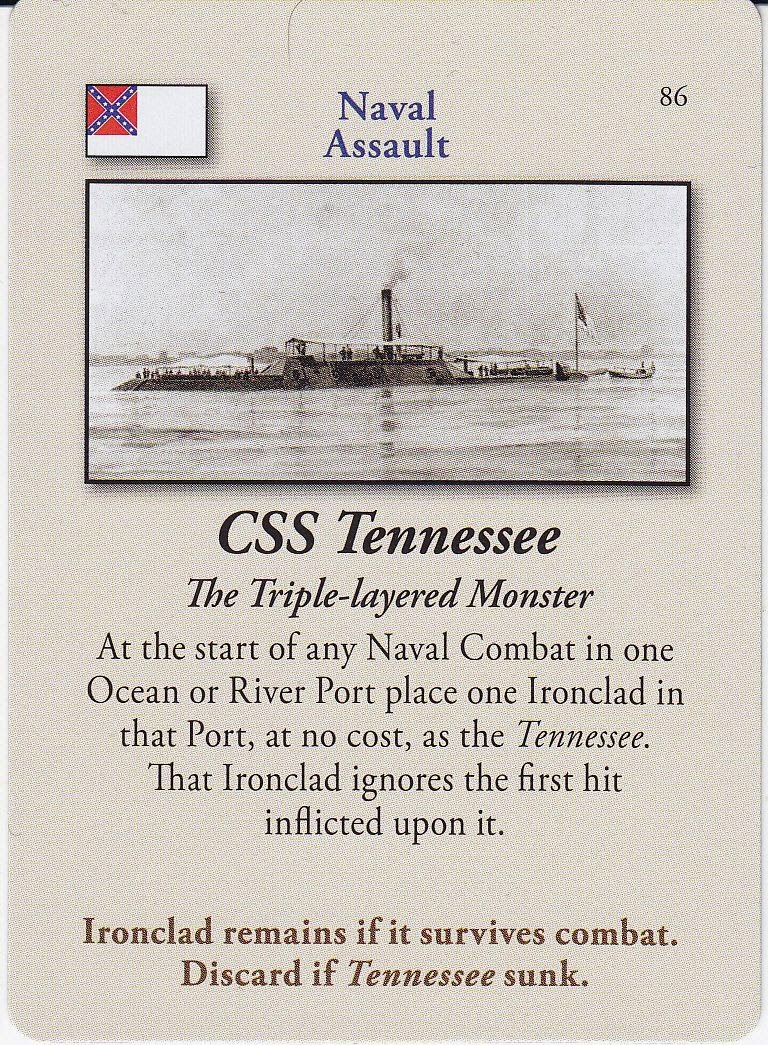
Buchanan is represented three ways in Rebel Raiders on the High Seas; first, as a leader counter for the South, and then twice more in the cards – for the two ironclads he commanded during their historic encounters with the Union navy.  Those ships are represented by CSN Cards 70 and 86.  Despite having “gone South,” Buchanan has not been forgotten by the Navy or the Academy: three U.S. Navy destroyers were named for him, as is the house that serves as the superintendent’s quarters at Annapolis.


Tuesday, September 3, 2013

A Rebel Raiders’ Happy (Almost) Birthday to the USNA - & Its Rebel Admiral


Sept 3, 1845 - Buchanan Takes command of the post at old Fort Severn, Annapolis


On this date in 1845 Franklin Buchanan – who later became the first admiral of the Confederate navy – took command of the post at old Fort Severn in Annapolis, with orders to prepare for the opening day of the United States Naval Academy.  That day came five weeks later on October 10, with “Old Buck” as its first superintendent.

Buchanan is represented three ways in Rebel Raiders on the High Seas; first, as a leader counter for the South, and then twice more in the cards – for the two ironclads he commanded during their historic encounters with the Union navy.


As James McPherson notes in his recent book, War Upon the Waters, Buchanan was a veteran of 45 years in the U.S. Navy. In addition to having been the first superintendent of Annapolis, he was also second in command of Commodore Matthew Perry’s expedition that “opened” Japan and was commandant of the Navy Yard in Washington when the Civil War began.   When mobs rioted in Baltimore, the native Marylander tendered his resignation from the service to Secretary of the Navy Gideon Welles.  Three days later, however, the hot-headed “Old Buck” realized as McPherson puts it that “he had acted rashly” and tried to withdraw the resignation.  Welles, however, explains McPherson “wanted no sunshine patriots in his navy.”  He refused Buchanan’s request, and told him rather “icily” as Mcpherson notes that “by direction of the President, your name has been stricken from the rolls of the Navy.”

Buchanan found a much warmer welcome when he went South – as did 258 other Southern-born naval officers.  In March of 1862 he personally took command of the CSS Virginia  (CSN Card 70 in Rebel Raiders) when it steamed out to attack Union warships in Hampton Roads.  During that action he became so incensed at Union snipers firing from the shore that he climbed OUT of the ironclad to fire a musket at the Yankees.  Wounded by the snipers, Buchanan had to turn over command of the ironclad – and thus missed out on the epic action the following day against the USS Monitor (USN Card 19).


Buchanan was promoted to admiral – the first (and until almost the very end of the war, the only) admiral in the Confederate Navy.   He helped organize the fleet and defenses of Mobile, and when Admiral David Glasgow Farragut (who also appears in Rebel Raiders as a leader and on three cards – USN Cards 1, 33 and 37 – Damn the Torpedoes, the Grand Fleet and USS Hartford)  steamed into the Bay, it was “Old Buck” who went  out to meet him in the ironclad ram CSS Tennessee (CSN Card 86).


That confrontation is dramatized in the classic painting by William Heysham Overrend (see below).

“Old Buck” survived the war – and outlived Farragut, who passed away on August 14, 1870 – by nearly four years. 

Despite having “gone South,” Buchanan has not been forgotten by the Navy or the Academy: three U.S. Navy destroyers were named for him, as is the house that serves as the superintendent’s quarters at Annapolis.


Saturday, July 20, 2013

The Ships of Rebel Raiders - The Ironclads

Rebel Raiders on the High Seas is a strategic game of the Civil War which focuses on the role of the navies on the rivers, along the coasts and on the oceans.  While most ships are represented by generic counters for Ironclads, Blockade Runners, Gunboats, Screw Sloops and, of course Raiders, there are cards and corresponding counters for many individual vessels.  This series presents those cards and offers a glimpse into the history of these storied ships.

Part III – The  Rebel Ironclads: CSS Virginia

…and why the iconic duel with the USS Monitor was such a “dud”


“The CSS Virginia was not the first ironclad warship in history, nor in the Civil War, nor even in the Confederacy,” notes historian James McPherson in his new book War Upon the Waters, but she is the most famous.  CSS Virginia, which is represented in Rebel Raiders by its own counter and card (CSN Card 70) is best known for being the Confederate side in the first duel of ironclad warships (her opponent being the USS Monitor – also represented in Rebel Raiders by a counter and card (USN Card 19).

Built up from the captured bones of the USS Merrimack in Norfolk, the CSS Virginia mounted six 9-inch Dahlgren smoothbores (three per side) and four Brooke rifles (a pair of 7-inchers forward, a pair of 6.4-inchers aft).  The iron casemate, which was rolled out in a single piece at Tredegar Iron Works (represented in Rebel Raiders by the production rules and CSN Card 95) was bolted onto the hull and then pierced to allow the placement of the guns. She also mounted a seven-foot iron ram (which nearly proved her undoing when it got stuck into the USS Cumberland whom she rammed in the Battle of Hampton Roads in March 1862).

“A novelty in naval construction,” as Confederate Secretary of the Navy Stephen R. Mallory called her (Mallory is also in Rebel Raiders as CSN Card 78) she took on the Union blockading fleet in Hampton Roads, sinking the USS Cumberland, compelling the USS Congress to strike her colors and forcing the USS Minnesota to run aground.  It was upon returning the next day to finish off the last of those when she met the USS Monitor. 

Unfortunately (or, rather, fortunately for the crews) neither ship was at her best in that fight.  The Union shells were charged with only 15 pounds of powder out of fear they would blow up in the guns (later tests showed they could handle three times that amount) and the Confederates brought only explosive shell, not solid shot or iron bolts, as they expected to face only wooden warships.  As a result although they battered away at each other, scoring hit after hit, neither could inflict any serious damage on the other.

Although technically a draw, CSS Virginia did retire to port – never to fight again.  She was burned by the Rebels to prevent her capture by Union forces advancing on Norfolk.


Tuesday, July 16, 2013

The Ships of Rebel Raiders - The Gunboats

  
Rebel Raiders on the High Seas is a strategic game of the Civil War which focuses on the role of the navies on the rivers, along the coasts and on the oceans.  While most ships are represented by generic counters for Ironclads, Blockade Runners, Gunboats, Screw Sloops and, of course Raiders, there are cards and corresponding counters for many individual vessels.  This series presents those cards and offers a glimpse into the history of these storied ships.
  

Part II – The Gunboats: The Mosquito Fleet (Continued):  “Old Buck” at Mobile Bay

“The Mosquito Fleet” (CSN Card 81) represents the rag-tag little squadrons the South cobbled together for the defense of Memphis and Mobile Bay.  Civilian vessels to which a gun or two and crew were hastily added, and to which bales of cotton, stacks of lumber or other makeshift defenses were added, these hopelessly outclassed and outgunned little ships and their brave crews performed far better than any could expect or demand. 

Commander James Montgomery led one of these rag-tag fleets at Memphis (see yesterday’s post), while Admiral Franklin Buchanan or “Old Buck” as he was known to his former comrades in the U.S. Navy, led a similarly cobbled-together fleet at Mobile Bay in August 1864.   In addition to three gunboats (one of which, CSS Gaines – CSN Card 72 is in the game) Buchanan at least had the mighty ironclad ram CSS Tennessee as his flagship  (also in the game as CSN Card 86). 

Unfortunately, just as Montgomery’s fleet was outmatched by Colonel Charles Ellet’s ironclads and rams at Memphis in June 1862, so was Buchanan’s force outnumbered and outclassed by the massive force Admiral David G. Farragut brought into Mobile Bay.


Farragut, like Buchanan, is represented by a stand-up Leader counter and Fleet Command Box – as well as three cards in the deck:   “Damn the Torpedoes…Full Speed Ahead” (USN Card 1),  The Grand Fleet (USN Card 33) and his flagship, USS Hartford (USN Card 37).    Another of Farragut’s ships that fought in the battle, USS Brooklyn (USN Card 13) also appears in the game.  All told, Farragut had a dozen big warships, four ironclads and a pair of gunboats to battle “Old Buck,” and to batter through the extensive harbor defenses (which, in Rebel Raiders, would be represented by three Battery counters for the Confederacy as well as such defensive cards as “Infernal Machines” (CSN Card 56)