Showing posts with label Rebel Raiders on the High Seas. Show all posts

Wednesday, August 12, 2015

150 Years Ago- "Undefeated" Rebel General Sinks His Battle Flag, Goes to Mexico

150 Years Ago - “Undefeated” Rebel General Sinks His Battle Flag, Goes to Mexico


Rather than surrender his command let alone give up his battle flag, 150 years ago General Joseph Orville Shelby sank his banner in the Rio Grande and took his men to Mexico, where he hoped to lead them as mercenaries serving the French-installed Emperor Maximilian.

Shelby made his career commanding cavalry, first in “Bleeding Kansas” and then at Wilson's Creek and Pea Ridge. The scourge of the Trans-Mississippi, in 1863 Shelby took his “Iron Brigade” of horsemen on a 1,500-mile rampage through Union territory, a feat for which he earned his promotion to brigadier general. He is also one of the few cavalrymen in history to be able to boast of having captured a warship – the Union tinclad river gunboat USS Queen City. Shelby raided and battled his way through Arkansas and Missouri which such distinction that in May 1865 his commanding officer General Kirby Smith, promoted him to major general. Unfortunately for Shelby, as Lee, Richmond and Davis by then had all surrendered, the war was over and the promotion was never confirmed. That did not stop Shelby, however, who convinced most of his brigade to march to Mexico rather than surrender – or go home.

Shelby's column paused as it reached the Rio Grande at Eagle Pass, Texas in July. There with great ceremony the general took the signature plume from his hat and the Confederate battle flag under which he had marched and ordered them sunk and buried “in the river's rushing tide,” or so one of his followers the military poet Brevet Colonel Alonzo W. Slayback immortalized in a poem dated July 4, 1865. The poem concludes with the farewell line: “The glorious flag of the vanquished brave, No more to rise from its watery grave.”

The poem is entitled “The Burial of Shelby's Flag” and the spot where the flag was sunk is known locally as “The Grave of the Confederacy.”

Shelby and his men crossed into Mexico – but Maximilian, though embattled, thought better of taking the ex-Confederates into his service as it might worsen his already strained relations with Washington. After all, Mexico had been a haven for blockade runners for four years. The French, however, did agree to allow Shelby and his men to settle around Vera Cruz, provided they would defend the land from the Mexican rebels. When Maximilian fell, however, Shelby and most of his men finally went home, with the general settling in Missouri in 1867. Twenty-six years later he was appointed as the U.S. Marshal for the Western District.

Not all of Shelby's men made it home. One group of Missouri cavaliers led by Brigadier General Monroe Parsons did join up with the Imperial forces and fought the Juaristas on the Chino River, where Parsons was killed 150 years ago - on August 15, 1865.

John Wayne drew inspiration from Shelby's Mexican expedition for the 1969 movie The Undefeated, where Rock Hudson played the Shelby-esque Colonel James Langdon.


The role played by Mexico and its French-installed emperor in the Civil War is represented in GMT's strategic naval game, Rebel Raiders on the High Seas by the Mexican port of Vera Cruz – where blockade runners can load cargo to smuggle into the Confederacy and by Confederate Card 61 – Maximilian.


Monday, June 22, 2015

150 Years Ago: One Rebel Raider Still Burning Yankee Ships


-June 22, 1865:  The clouds of thick smoke from two burning Yankee whalers darkened the sky over the Bering Sea on this day 150 years ago.  That was the handiwork of James I. Waddell of the CSS Shenandoah, the last of the Rebel Raiders still at sea - and still at war.  Although the captains of the vessels he caught showed him newspapers that reported General Robert E. Lee's surrender at Appomatox in April, Waddell refused to believe that the war was over.  He pointed to paragraphs in the newspapers that commented on how President Jefferson Davis had fled Richmond as proof that the war was not over. Waddell believed that Davis would try to set up a new base or at the very least wage a guerrilla war against the occupying Union armies - a war he and the CSS Shenandoah would support by continuing to raid Union commerce.

(Ironically, the day after these whalers were burned, President Andrew Johnson formally lifted the Union blockade of Southern ports.)

The two whalers Waddell set afire, the William Thompson and the Euphrates, were but the first of a fleet of whaling ships he would destroy in the coming week.  Another 22 whaling ships would be taken in the next six days - 21 of which he burned and one, the James Maury, he bonded and set free to take the crews of the whalers back home.  

As he left the Bering Sea, Waddell set course for San Francisco:  his goal, to take on the single Union warship guarding the harbor - a ship captained by an old friend - after which he planned to bombard and hold the city ransom, and then proceed on to hunt down the California gold ships.

The CSS Shenandoah is but one of the many Confederate commerce raiders that appear in GMT's strategic naval game of the Civil War - Rebel Raiders on the High Seas.  Her exploits can be repeated as she raids across the map - or can be put to an end by the Union warships sent to hunt her down.


Sunday, May 3, 2015

150 Years Ago: Confederate Armies Surrender, But the Rebel Raiders Fight On

150 Years Ago: Confederate Armies & Leaders Surrender, But the Rebel Raiders Fight On

May 3, 1865:  As President Abraham Lincoln's body arrived in Springfield, Illinois, the Confederate leadership continued their efforts to escape the Union dragnet.  Some sought to keep the Cause alive, while others, including Secretary of the Navy Stephen Mallory and Secretary of State Judah Benjamin realized that the end had come.  On May 3 Mallory tendered his resignation and Benjamin separated himself from President Jefferson Davis's party, telling the Confederate leader at their last meeting in Abbeville, South Carolina, that he would attempt to reach the Bahamas to send final instructions to Confederate representatives abroad.

What was left of the Confederate armies in the field also began to dissolve.   On May 4 the largest of those, some 42,000, were told to lay down their arms by their commander, General Richard Taylor, who surrendered his command to Union forces at Citronelle, Alabama.  Five days later a force of five infantry brigades around which President Davis tried to organize resistance during his retreat through South Carolina are told to go home by their colonels.  On May 10 the guerrilla leader William C. Quantrill was killed in a skirmish at Taylorsville, Kentucky - after which the remnants of his force (which included Frank and Jesse James and Cole Younger) dissolved.  General Kirby Smith remained in the field with his army in the Trans-Mississippi, but directed his delegate, General Peter Osterhaus, to go to New Orleans to seek terms of surrender.  On June 2 Smith surrendered the last Rebel army - although his deputy, Jo Shelby, refused to give up and headed for Mexico with a band of followers.

The Confederate Navy similarly began to fall apart.  The CSS Nashville and a few gunboats and blockade runners fell back from Mobile up the Tombighee River after the city's surrender, but when Rear Admiral Thater and his Union flotilla followed,  Captain Eben Farrand struck his colors, and surrendered the Rebel fleet on May 10.

On May 11, the ocean-going ironclad CSS Stonewall reached Havana, ready to take on coal and provisions for her planned foray to break the blockade.  When her commander Captain Page learned of the surrender at Appomattox, however, he went to the Spanish captain-general and on May 19 struck a deal to sell the warship to Spain. He divided the proceeds among his crew to pay their wages.

One last Rebel warship, however, kept up the fight.  The CSS Shenandoah steamed on from Australia and on to the Bering Strait, where in late June she decimated the Yankee whaling fleet.  Captain James Waddell was shown newspapers by the whaling ship captains that reported the fall of Richmond and the surrender of General Robert E. Lee, but Waddell believed that Davis would continue the war, at least as a guerrilla struggle, and kept on raiding.  It was not until August 2 that Waddell, en route to San Francisco to bombard the city, learned from an English ship that the war was truly over.  That same day, August 2, as Jo Shelby entered Mexico City to a offer his sword to the Emperor Maximillian, Waddel shipped his guns and set a course that would take the CSS Shenandoah to Liverpool, where he would surrender the last Confederate command in November.


The last two Confederate warships to surrender, the CSS Stonewall and the CSS Shenandoah, appear as counters and cards in GMT's strategic naval game of the Civil War, Rebel Raiders on the High Seas.


Friday, March 20, 2015

150 Years Ago: Union Warships Play Tag With Rebel Armored Raider CSS Stonewall

150 Years Ago:  Union Warships Play Tag With Rebel Armored Raider CSS Stonewall


On March 21, 1865 the Confederate armored raider CSS Stonewall and two wooden Union warships played a potentially deadly game of "tag" off the Spanish port of Ferrol.    The USS Niagara and USS Sacramento had been shadowing the powerful Confederate vessel since she had left France for the Azores.  Their orders, however, were not to engage - and with good reason. With her armored casemates and massive ship-breaking guns the CSS Stonewall was the most powerful and most modern warship in the world.  She was built with the hope of smashing through the Union blockade and reopening one or more ports to Confederate blockade runners.

A storm cut short this deadly dance, and the CSS Stonewall went into Ferrol to seek shelter and take on supplies.  She came out a few days later, and once again USS Niagara and USS Sacramento were waiting, and shadowed her as she steamed across the Atlantic toward her beleaguered homeland.  Among those ordered to make ready to confront her was Lt. Cdr. William B. Cushing, the man who in a daring naval commando raid had sunk the ironclad CSS Ablemarle. Admiral Porter instructed Cushing to mount a spar torpedo on the USS Monticello and make ready to charge the CSS Stonewall should she appear off Norfolk or Wilmington.


The CSS Stonewall is both a card and a counter in GMT's strategic naval game of the Civil War, and if she appears can pose a powerful challenge to the Union player.


For more on the story of how, where and why the CSS Stonewall was built, and what eventually became of her, see my earlier blog entry at:

http://markgmclaughlin.blogspot.com/2015/01/150-years-ago-css-stonewall-rides-waves.html

Wednesday, February 18, 2015

150 Years Ago: Charleston Surrenders & CSS Shenandoah Leaves Australia to Hunt Whalers

 150 Years Ago: Charleston Surrenders & CSS Shenandoah Leaves Australia to Hunt Whalers

Charleston Surrenders


February 18, 1865 was yet another dark and sour day for the Confederacy - and a very bright and sweet one for the Union, for on that day Charleston surrendered to Federal troops.  Northern politicians and newspapers had long put pressure on the Lincoln administration to take and punish the city which had fired the opening shots in the rebellion. The Navy had tried numerous times to batter down its defenses and did land troops on the outlying areas, but once the blockade had effectively shut down the port in late 1863, there seemed little military reason to expend so much blood and energy to attack the city, not when other more strategic targets (like Mobile and Fort Fisher) beckoned.

General Pierre Gustave Toutant Beauregard had been in command when the guns of Charleston opened the ball by shelling Fort Sumter in April 1861, and he was in charge of its defenses as Union forces approached in February 1865.  On February 15 he evacuated what remained of the garrison and left it to the city's mayor to surrender the city to Union General Alexander Schimmelfennig three days later.  To further prick the pride of Charlestonians, the Union general chose a regiment of Colored troops,  the 55th Massachusetts Volunteer Infantry, to lead the parade into the city.   Ironically, that same day Confederate General Robert E. Lee proposed recruiting and arming Blacks for service in the Confederate armed forces.

(The 55th was the sister regiment to the famous 54th, which had served so gallantly and suffered so greatly assaulting Battery Wagner - as depicted in the film Glory.  The 55th had spent much of the war  on Morris and Folly Islands outside Charleston harbor, and fought in the last engagement around the city, the battle of James Island on February 10.)

CSS Shenandoah Leaves Melbourne


Even as Charleston surrendered, the Confederate raider CSS Shenandoah began the final leg of her wartime voyage, leaving Melbourne, Australia. Having spent nearly a month making repairs, acquiring supplies (and, surreptitiously, recruiting 40 sailors) the raider left port on February 18.  Her mission was to seek out and destroy the New England whaling fleet - a mission she began to carry out in April, just as Richmond fell and Lee was surrendering.  The CSS Shenandoah sank four whalers in April, captured and burned a merchant vessel in May, and in June burned or destroyed another two dozen whaling ships - well after the war was over.  It was only after destroying those ships and while en route to bombard San Franciso that her captain, James Waddell, learned for certain that hostilities had ended.  He immediately disarmed his ship and set a course for Liverpool, where he surrendered in November.

Charleston is a key port in GMT's strategic naval game of the Civil War, Rebel Raiders on the High Seas.  Its blockade or, worse, capture, by the North can be devastating to the Southern player.  The CSS Shenandoah is one of the titular raiders in the game, and with its special abilities can wreak havoc on Union shipping - and give great solace to the Confederate player.   Generals Lee and Beauregard, along with many other leaders, North and South, are also present in the game, for while primarily focused on the ships and naval strategies of the era, Rebel Raiders is also a strategic game of the entire war.


Wednesday, January 14, 2015

150 Years Ago: The Navy Leads the Way at Fort Fisher

150 Years Ago: The Navy Leads the Way at Fort Fisher

On January 15, 1865 a column of sailors and Marines led the ground assault on the Confederate bastion at Fort Fisher.   Although their initial assault was thrown back and with heavy losses, their sacrifice was not entirely in vain;  it provided a bloody diversion that helped assist Union infantry under General Alfred Terry when they stormed the "Gibraltar of the South"later that afternoon.

The January 15 attack was the second major operation against the fort.  In December, Admiral David Dixon Porter and his fleet had pounded the sandy fortress which protected blockade runners as they dashed in and out of Wilmington, North Carolina.  General Benjamin Butler sent troops ashore to assault the fortress, but bad weather and reports that the Rebel defenses were still intact caused him to order a withdrawal back to the fleet.  A few weeks later, however, Porter was back, and with an even larger fleet, more troops and a more aggressive and more able commander for his ground forces.

Porter's fleet of more than 60 vessels began pounding the fort on January 13.  It was a steady bombardment that at times increased in tempo to where more than 180 rounds a minute were being fired into the fort.  Porter sent ironclads close in shore to bring near point-blank fire on the defenders, most of whom huddled in bombproofs, emerging only occasionally to return fire at the Union fleet.  Determined to "redeem the Navy's honor" after the December debacle, Porter asked for volunteers to form a naval column to aid the Army in its ground assault.  Over 2,000 sailors and Marines, including many captains and other officers from the ships, did so.  Unfortunately, except for the Marines, most were armed as if going on a boarding party - with cutlasses and pistols.   When the naval bombardment ceased in the early afternoon of January 15, the Navy led the way on land - only to be cut down and pinned down in the sandy ditches in front of the fort, too far away for their side arms to do much more than make noise.

Terry's troops fared better, in part because of close-in fire support from the Navy.  More than 8,000 Union infantry charged the fort, whose defenders numbered less than a quarter of that number.  Overwhelmed at the outer defenses, the Confederates fell back, fought on and even launched a brief counterattack before succumbing to overwhelming numbers.

Fighting the forts and other defenses raised by the Confederate player to protect the ports for blockade runners is a big part of my strategic naval game of the Civil War, Rebel Raiders on the High Seas. Admiral Porter and many of the warships that took part in the attack on Fort Fisher are included in the game, and are represented by cards and counters.   These include the mighty  "unsinkable" screw sloop USS Brooklyn, the armored steam frigate USS New Ironsides, the side-wheel frigate USS Powhattan, the double-ender wooden sidewheeler USS Osceola and the comparatively tiny "90-day gunboat" USS Unadilla.


Tuesday, December 30, 2014

The Rebel Raider and the Lady: 150 Years Ago

The Rebel Raider and the Lady: 150 Years Ago

or Captain Waddell meets his match...in a "tall, finely proportioned woman of twenty-six years..."

150 Years Ago on December 29 the Confederate raider CSS Shenandoah stopped, captured and burned the commercial bark Delphine.  Captain James Iredell Waddell, however, got more than he expected or bargained for, as among his captives as he wrote in a his private journal, was "a tall, finely proportioned woman of twenty-six years, in robust health, evidently possessing a will and a voice of her own." 

That woman was Lillias Lervene Nichols, and she was the young wife of William Green Nichols, captain of the Delphine.  The raider found their ship just west of St. Paul Island in the Indian Ocean,  The Delphine was en route from London in ballast to Aykab, Burma, where the ship was to pick up a cargo of rice to take back to her home port of Bangor, Maine.  Claiming that his wife was deathly ill, Captain Nichols pleaded with Waddell to spare his ship so that he could take her to the nearest port for much-needed medical attention.  Mrs. Nichols and her maid put on quite a little melodrama to try to convince the Confederates that she was on death's door - but Waddell saw through the ruse.  He was, however, apparently quite smitten with the young beauty, and gallantly offered her the comforts of the best quarters aboard the warship.   When she asked him what he intended to do with her, Waddell said he would put her and her family ashore on the little island of St. Paul, which they would reach on January 2.   

Lillias and James became quite the shipboard item over the next few days as the CSS Shenandoah made for Australia and much-needed repairs.  The two were often seen strolling on deck or deep in quiet conversation.  Other officers mumbled that she had become the captain's "confidante."  (Lt. William Conway Whittle apparently was also quite fond of her, noting that she was a "fine-looking person, rather pretty."  Whittle added that although initially a "little frightened," the officers were able to "soon drive fear away by providing kindness" and showing her that "we are gentlemen.")

Waddell and his officers fell under her charms and put on a special New Year's Eve party for Lillias and her little boy Phineas (or "Phinizy" as the crew came to call the playful lad).    When they reached the little French colony and whaling station at St. Paul, Waddell again offered to put her ashore.  Her response? "Oh, no, never. I would rather remain with you."

...and so she did for nearly a month, until the raider reached Melbourne on January 25.  

Captain Nichols was not entirely amused by his wife's flirtations with Waddell.  He wanted off the ship quite badly, and gladly signed a pledge not to reveal any information about the raider to the American consul ashore.  Lillias, however, balked when her husband demanded she also sign the document.  As the Shenandoah's ship's surgeon Charles Edward Lining reports, "she let loose with her tongue, pitching directly into her husband for telling her to sign it and say nothing, by telling him that she did not intend to hold her tongue, nor did she consider herself bound by what she was going to sign, that she would talk, for at least they could not stop her tongue."


When she finally did give in to her husband's demands, Lining says she asked the Confederate officer if he wanted her little boy  Phineas to sign as well.  "No, madame," Lt. Sidney Smith Lee replied, "we are much more afraid of you than we are of him."  Lining reports that she was not amused, and "went out in a towering rage."

Although Lillias Nichols had flirted with the Rebel captain, she was a Union lass through and through.  Once ashore she hurried to the offices of U.S. Consul William Blanchard, who reported to his superiors in Washington that while Capt. Nichols kept mostly silent in an attempt to honor the terms of his parole, that "Mrs. Nichols felt no such constraints."   Blanchard reports that Mrs. Nichols provided a great deal of information as to the layout and condition of the CSS Shenandoah,  These included reports on Waddell's difficulties with his crew and officers, and how that the vessel was so "leaky" and in such poor condition that she could not take the strain of firing all of her guns at once.

The CSS Shenandoah remain in Australia for a month to undergo badly needed repairs.  She set out again on February 26, and would take no prizes until April 1, when she captured and burned four ships.  On June 22, however, she reached the whaling grounds in the Bering Sea, and over the next week burned 20 ships and bonded four others, inflicting over $1 million in damages - and in the process dealing a death blow to the New England whaling industry.   Sadly, it was all for naught, as the war had been over for nearly two months....

Monday, December 22, 2014

Porter Unleashes Hell on Ft. Fisher, Xmas Eve 1864

Porter Unleashes Hell on Ft. Fisher, Xmas Eve 1864


The largest U.S. naval force yet assembled unleashed hell on Ft. Fisher on Christmas Eve, 1864.  Admiral David Dixon Porter's fleet of over 60 warships, including five ironclads, mounted 624 guns - and Porter intended to use every one of them to bury the Rebel fort under a torrent of iron.

Porter's ships fired over 8,100 rounds - with a combined weight of more than half a million tons - into the sandy bastions guarding the approaches to Wilmington, N.C.   Colonel William Lamb had only 44 guns inside the fort, and Porter hoped to so batter the defenses that General Benjamin Butler's troops could just walk into Fort Fisher unopposed.

Porter's massive bombardment was the greatest the Western Hemisphere had ever seen, yet it had minimal effect on the brilliantly designed fort.  Three guns were dismounted, and four defenders were killed and another 19 wounded.  Porter's fleet sustained heavier losses, with three ships forced to retire due to accurate fire from the fort.  Most of the 91 sailors killed or wounded in the action were victims of their own guns, a number of which exploded.

The Navy landed a portion of Butler's troops, but the assault never went in.   Reports from the advanced guard that the defenses were nearly intact convinced Butler, still offshore, to call off the attack. Much to Porter's fury, Butler re-embarked most of his men, except for about 700 who were forced to spend Christmas Day huddled on the beach, without food or water, due to a sudden storm.  Despite pleas to General Braxton Bragg for permission to attack and capture the remnants of the landing force, Bragg refused to give the order.  The last of Butler's men were pulled off by the Navy on the 26th, and the fleet retired to Beaufort.   

Less than a month later, Porter would return - and with troops commanded by the much more aggressive and competent General Terry.  Porter's fleet bested its own record, firing over 180 rounds a minute in a sustained and much more accurate bombardment that began on January 13 and continued through the day and night of the 14th and into the early hours of the 15th.  Porter's guns fired close support right up until Terry launched his assault - with ironclads and gunboats coming close in shore to rake the defenders when they came out of their bombproofs to battle Terry's infantry and a column of 2,000 sailors and marines that Porter had landed to support the assault.   Although the naval landing force was handily repulsed and with heavy losses, the infantry carried the fort - with help from the Navy's guns.

In GMT's strategic naval game of the Civil War, Rebel Raiders on the High Seas, the Union player can build powerful fleets of screw sloops, ironclads and gunboats and recruit key admirals, Porter among them, to wear down the Confederate player's coastal defenses, which, through card play and careful planning, can be every bit as resilient as those constructed by Col. Lamb at Ft. Fisher.

150 Years Ago Today: Savannah, Sherman's Christmas Gift to Lincoln

150 Years Ago Today:  Savannah, Sherman's Christmas Gift to Lincoln


On December 22, 1864  President Abraham Lincoln received an early Christmas present from General William Tecumseh Sherman - the city of Savannah.  He announced this in a now famous telegram which stated:

"I beg to present you, as a Christmas Gift, the city of Savannah, with one-hundred and fifty guns and plenty of ammunition, and also about twenty-five thousand bales of cotton."

Sherman's army reached the outskirts of the city on December 20.  Confederate General William Hardee could not hope to hold Savannah, as his small force of 10,000 was outnumbered six to one.  Hardee managed to save his army and their field artillery, but was forced to abandon the many guns in the harbor forts.  One of his final orders was to scuttle and burn the CSS Savannah, a powerful casemate ironclad that had been built to help defend the city and harbor. Union forces entered Savannah on December 21, just as the ironclad was blown up by her crew.  Sherman officially took possession of the city on the following day.


Confederate ironclads play a vital role in the defense of ports in GMT's strategic naval game of the Civil War - Rebel Raiders on the High Seas - at least when those ports are attacked from the sea by the Union Navy.  When city's such as Savannah are taken from the land side, as Sherman did, they are lost.  Although Rebel Raiders is primarily a game of naval strategy, the land war is represented, and the Union player has many cards at his disposal, including Sherman himself, to help replicate that general's famous March to Sea.

Tuesday, December 16, 2014

150 Years Ago Today: Death of a Rebel Army at Nashville

Oh, my heart is feeling weary
And my head is hanging low
I'm goin' back to Georgy
To find my Uncle Joe.
You may talk about your Beauregard
And sing of Bobby Lee
But the Gallant Hood of Texas
He raised Hell in Tennessee

-These lyrics from the third stanza of Yellow Rose of Texas tell only part of the story of General John Bell Hood and the disasters that befell his ill-fated Army of Tennessee.  When President Jefferson Davis replaced General Joseph Johnston (the "Uncle Joe" referred to in the tune) in mid-July 1864,  General Robert E. Lee warned in a telegram that although "Hood is a bold fighter.  I am doubtful as to other qualities necessary." Prophetically, Lee added that  "We may lose Atlanta and the army too. "  On December 16, 1864, the second part of that warning came true outside of Nashville.

Two months after Hood took command, Atlanta did fall as Lee predicted. Hood evacuated the city in September after four bloody, pointless and disastrous attempts to break General William Tecumseh Sherman's ever-tightening ring around that vital urban center.   Rather than fight a delaying action, as Joe Johnston had done earlier in the year, in mid-October Hood struck north and "raised Hell in Tennessee."  Although he won a victory of sorts at Franklin on November 30, it was a hollow and Pyrrhic one.  Sherman, rather than follow Hood whom he said could "twist like a fox," left General George Thomas to deal with the situation in Tennessee while he the struck out for his infamous March to the Sea.  Thomas gathered Union forces at Nashville, and Hood obligingly followed.

For two weeks Hood laid an ineffectual siege around Nashville.  Despite a flood of telegrams from President Lincoln and General Ulysses Grant urging him to attack or be replaced by someone who would, Thomas waited until he was ready, and on December 15 launched his first major attack.  Although bloodied, bested and outnumbered nearly two to one, Hood does not use the cover of night to retreat.  He stubbornly holds his ground.  In the morning Thomas renews his attack, and the Confederate Army of Tennessee disintegrates.   

Hood lost 6,000 men at Franklin, and another 6,000 at Nashville (including 4,500 taken prisoner).  The remaining 25,000 fell back over the barren winter landscape,  abandoning over 150 cannon to the victorious Yankees.  Although elements of it would fight again,  on December 16 Hood's army ceased to be an effective military force.

Ironically, December 16, 1864 would have been the one-year anniversary of the date when Joseph E. Johnston took command of the Army of Tennessee.

Hood's invasion of Tennessee can be recreated by the Southern player in Rebel Raiders on the High Seas.  Although primarily a naval strategy game of the Civil War, the land campaigns are replicated on an abstract scale through the use of cards, dice and point-to-point movement.   Hood, Johnston, Sherman and other generals and events relevant to the Western theater are represented by cards  (the one-armed, one-legged Hood is CSN Card 89,  and Sherman is USN Card 50).


Saturday, December 6, 2014

150 Years Ago Today: US Marines Fight Citadel Cadets Outside of Savannah

150 Years Ago Today: U.S. Marines Fight Citadel Cadets Outside of Savannah: Battle of Tulifinny

On December 6, 1864 warships of the mighty South Atlantic Blockading Squadron demonstrated against the Confederate batteries defending Charleston and Savannah.  These actions were meant to distract the Rebels from two other major operations being undertaken by the Navy.  The first was the assembly in Hampton Roads of a massive fleet for the amphibious attack on Ft. Fisher, the main defense work protecting the big blockade running port of Wilmington, N.C.  The second was the landing of United States Marines in support of General William Tecumseh Sherman's March to the Sea.  That landing resulted in the Battle of Tulifinny, and one of the very few occasions in which U.S. Marines fought in a land battle with Confederate infantry.

By late 1863 both Charleston and Savannah had effectively been shut down as blockade running ports by the Navy.  After the loss of Mobile Bay in August, Wilmington remained the last major haven for the runners, upon whose cargoes the Confederacy and especially General Robert E. Lee's Army of Northern Virginia depended for munitions and other staples.  Charleston and Savannah, however, remained key political objectives, and if taken would give the Navy a port to supply Sherman's army.   To help open the path for Sherman, the Navy landed 5,000 troops and a detachment of Marines on the banks of the Tulifinny River, not far from the town of Yemassee, about 45 miles from Savannah.  A dozen Union gunboats supported the landing on the swampy peninsula.  As the Yankees advanced they were met by 900 Confederate troops, among whom were the entire corps of cadets of the South Carolina Military Academy (now known as The Citadel).

The Cadets made up about a third of the defending force, and were deployed to defend the key railroad bridge over the river. Told that Union forces were encamped nearby, the Cadets moved out in the pre-dawn darkness of December 7 to participate in a surprise attack on the Yankee lines.  The attack succeeded in driving the Union infantry from their camps, and the Cadets and the men of the 5th and 47th Georgia infantry and a militia unit dug in to await the inevitable counterattack.  That came on the morning of December 9th. The right flank of that attack was spearheaded by Lieutenant  George G. Stoddard and his Marines - who ran right into the positions held by the Cadets.  The Marine attack stalled, and when the Union forces on the left flank fell back, so did the Marines.  The Union forces then retired to the fleet, which evacuated them.

The success of the Cadets and other Rebel forces was short lived, and although it bought time for the Confederates to evacuate war materials by rail, Savannah fell to Sherman on Christmas Day.

As for the Navy's assault on Ft. Fisher...that is a story for later.

Blockade Runners and the ports they dart in and out of are vital to the Southern player's hopes for victory in my strategic naval game of the Civil War, GMT's Rebel Raiders on the High Seas.

Monday, November 3, 2014

Tale of Two Raiders: Goodbye, CSS Chickamauga, Hello CSS Shenandoah

150 years ago: A Tale of Two Raiders: Goodbye, CSS Chickamauga, Hello CSS Shenandoah


150 Years Ago this week the storied Confederate blockade runner captain, John Wilkinson, went a-raiding aboard the mighty CSS Chickamauga.  In four days of raiding off Long Island, he burned, bonded or scuttled seven Union merchant ships - but as his raider burned coal at such a voracious rate, on November 3 he had to cut short the raid and go in search of coal.  The governor of Bermuda refused to sell Wilkinson a load, claiming he had new orders in regards to the neutrality acts.  Fortunately, Wilkinson, an old hand at this sort of thing, was able to bribe a lesser official (after first getting him roaring drunk), but while taking on coal nearly half his crew jumped ship.  The governor, moreover, got wind of all of this, and put a stop to the coaling.  Warned that four Union cruisers were converging on Bermuda,  Wilkinson upped anchor and set a course for Wilmington, the last major port still open to the raiders and runners.

As the CSS Chickamauga neared Wilmington, a Union squadron intercepted her.   Despite being heavily outgunned, Wilkinson refused to surrender, and fired shot and shell in an unequal duel with four Yankee warships, all while pouring on speed to seek safety under the guns of Fort Fisher.  Although he made it, his ship would never raid or go to sea again.  The CSS Chickamauga, however, did have one last fight left in her:  when the Union finally stormed Fisher, the Rebel raider was there, adding her guns to the fort's in defense.  When it was obvious that the fort would fall, the raider retreated to Wilmington, where she was scuttled and burned let she become a prize of war.

Just as CSS Chickamauga was ending her career as a raider, however, the last - and in may ways the greatest and also the most tragic of the raiders began hers.  CSS Shenandoah made her first capture on October 30  (the day as CSS Chickamauga also made her first capture).  The bark Alina was Captain James I. Waddell's first victory, and while there would be 37 more, 2/3s of those were taken after the end of the war - which Waddell did not know had concluded until reading newspapers found aboard his final prize, the bark Covington, which he burned on June 28, 1865.   Fearful of being held accountable for piracy, Waddell spent months seeking a harbor where he could safely retire his ship and crew, which he did on November 6, 1865....149 years ago this week.


While in my strategic naval game of the Civil War, Rebel Raiders on the High Seas,  the CSS Chickamauga is represented by a generic Raider counter, the CSS Shenandoah has her own counter and card, CSN Card 64:


Monday, October 27, 2014

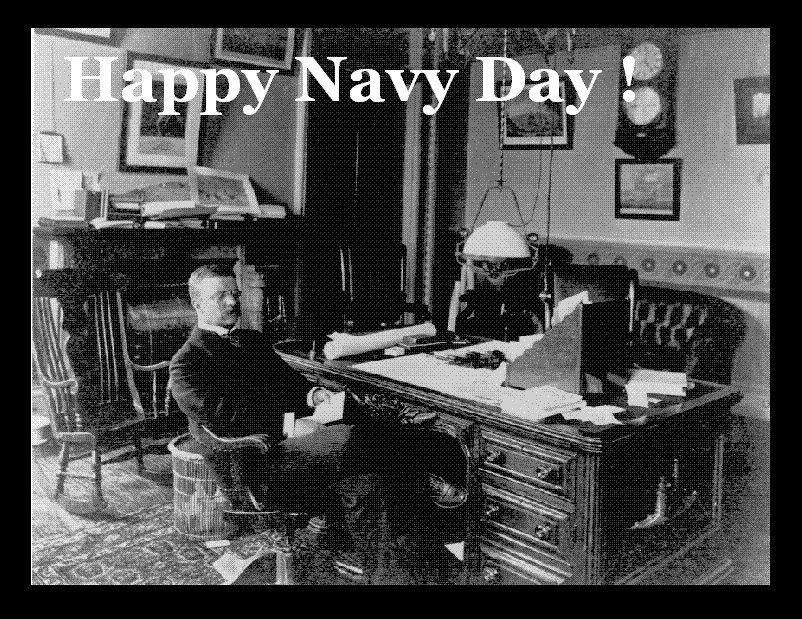
Happy Navy Day from Rebel Raiders on the High Seas!

October 27th is NAVY DAY!


In 1922 October 27th was designated "Navy Day" by the United States Government.  The date was chosen because October 27th was also the anniversary of Theodore Roosevelt's birthday.  As assistant secretary of the Navy in the last years of the 19th century, Teddy Roosevelt pushed for the modernization of the fleet and as such is considered by many to be the father of the modern Navy.

In 1949 the Department of Defense decided that it would no longer officially celebrate Navy Day, and that instead of having its own unique day, that the Navy would instead join with the other services to mark Armed Forces Day each May.   Navy Day, however, is still marked by the Navy League and many veterans groups, with parties, dances and other celebrations.


A hearty "Happy Navy Day"  from the designer of GMT's strategic naval game of the Civil War, Rebel Raiders on the High Seas.....

Monday, October 6, 2014

150 Years Ago: Rebel Raider CSS Florida Taken in Brazilian Port

150 Years Ago: Rebel Raider CSS Florida Taken in Brazilian Port 


Historical Event: In an illegal action that nearly sparked a shooting war with Brazil, in the early hours of October 7, 1864 a Union warship opened fire upon and then rammed a Confederate raider in a neutral port. With Capt. Charles Morris and most of his crew ashore, the CSS Florida was defenseless when Commander Napoleon Collins of the USS Wachusett defied international law and attacked the raider.

Collins had chased CSS Florida for many months. He caught up and berthed next to her in the Brazilian port of Bahia on October 4. Although U.S. Consul Thomas F. Wilson assured the president of Bahia Province, Joaquim da Silva Gomes, that the Union would respect his nation's neutrality, the president took no chances; he placed the raider under his personal protection – and that of a squadron of sloops, corvettes and other warships under Commander Gervasio Macebo. The governor granted the CSS Florida time to take on coal and provisions and make emergency repairs, but also demanded her guns be unloaded while in port.

Wilson and Collins had no intention of respecting Brazilian neutrality.  Together they planned a “cutting-out” expedition to capture the raider – knowing full well that if the CSS Florida left port the slower Union warship would be unlikely to catch her. Even worse, if the USS Wachusett did, she might lose the fight – as most of her guns were short range smoothbores, while the CSS Florida had a battery of long-range rifles. Those would have enabled Capt. Morris to stand off and pound away at the Yankee vessel while keeping out of the range of Collin's heavier but shorter-ranged guns. Wilson and Collins decided to damn international law and go after the raider, in port, while she slept.

Shortly before dawn on October 7, Collins built up steam and bulled his way past a sleeping line of Brazilian warships.  As he entered the harbor he opened fire upon, rammed and with pistols blazing, boarded the Rebel raider. The skeleton crew of Confederates aboard were surprised, outnumbered and overwhelmed. Collins put a prize crew aboard, tossed over a hawser and began towing the raider out to sea.

The Brazilians were enraged at this breach of international law – especially after having been assured   that Brazilian neutrality would be respected. The harbor fort opened fire.  Commander  Macebo raised sails and steam and ordered his squadron to fire upon the Union warship as it sped by. Macebo gave chase, but Collins even with his prize in tow, was able to outdistance the Brazilians.

Collins and Wilson were hailed by the press for their boldness, and were privately praised by Lincoln, Secretary of State Seward and Secretary of the Navy Welles. Unfortunately, to ameliorate the Brazilians they had to be made an example of. Wilson was dismissed from the foreign service and Collins was court-martialed, found guilty of violating the territory of a neutral government and similarly dismissed from the Navy.

Collins remained unrepentant, saying he would do it all again “for the public good.” None disputed that he had acted so, for in her two-year career the CSS Florida had sunk 46 ships and captured 14 others, inflicting damages that her victim's owners claimed had cost them over $4 million – ten times the cost of the Rebel raider.

Confederate commerce cruisers like CSS Florida play a key role in GMT's strategic naval game of the Civil War, as one would expect from a game entitled Rebel Raiders on the High Seas.


Thursday, September 25, 2014

150 Years Ago: CSS Florida Makes Her Last Capture At Sea

150 Years Ago: CSS Florida Makes Her Last Capture At Sea


On September 26, 1864, the Confederate raider CSS Florida, then under the command of her second captain, Charles M. Morris, made her 37th and final capture: the bark Mandamis. She was a commercial vessel out of Baltimore that was returning “in ballast” because of the difficulty in finding shippers who wanted to risk their cargo on American flag vessels – vessels which, like Mandamis, were the prey for CSS Florida and other Rebel Raiders on the High Seas.

After setting the bark afire, Morris made for Bahia to take on coal and provisions. He did not know that no fewer than 24 Union warships were after him – one of which, the USS Ticonderoga, was assited in that hunt by one of the CSS Florida's own men: A. L. Drayton. The sailor had been captured when the fishing schooner Archer, which when captured by the CSS Florida had been pressed into service to do some raiding of her own off the New England coast.  Rather than suffer imprisonment, Drayton piloted the Union warship throughout the chase, but always arrived at foreign ports of call just a week or so after the raider. Another of the hunters, however, USS Wachusett, was more timely in her search – catching up with and capturing the CSS Florida on October 7...but that is another story....

The Confederate commerce raiders play a key role in GMT's strategic naval game of the Civil War, Rebel Raiders on the High Seas. For more on the game visit the GMT website on the game at:


or read a review of the game inissue #27 of Rodger MacGowan's C3i magazine: http://www.gmtgames.com/p-462-c3i-magazine-issue-27.aspx


Friday, September 12, 2014

150 Years Ago: A Rebel Blockade Runner's Last Run

150 Years Ago: A Rebel Blockade Runner's Last Run

Few Confederate ships ran the blockade more often than the Advance.  The fast, Scottish-built 900-ton sidewheeler made more than 20 voyages - paying back her owners many times over as she brought in not only badly needed war supplies but also highly sought after luxuries.  Named in honor of North Carolina Governor Zebulon Vance, the sleek double-stack vessel originally designer as a fast passenger liner eluded capture over 40 times as she zipped in and out of Wilmington and other ports in the Tar Heel State.  Unfortunately, the 41st Union warship she encountered was one of the fastest ships in the Union navy: the USS Santiago de Cuba - which ended the blockade runner's storied 15-month career on the night of September 10, 1864.

The Advance, however, was not sunk by the USS Santiago de Cuba when the Yankee vessel caught up with her in Cape Fear Inlet; she was instead taken as a prize to New York  and then selected for service by the Navy.  Even with a 20-pounder rifled gun and four 24-pound howitzers aboard the now rechristened USS Advance could still make 12 knots, which made her suitable for service in tightening the blockade around the very ports she had been running in and out of under the Rebel flag.   Her capture, however, was a severe blow to Confederate captains, fewer and fewer of whom risked going out where even the Advance had been unable to escape.  

Although she never chased down any of her fellow blockade runners, as USS Advance the vessel did see action in the battle for Fort Fisher at the mouth of the Cape Fear River that Christmas.  Under the command of  Lt. Cmdr. John Upshur  she exchanged fire with the fort's Half-Moon Battery, reportedly silencing its 8-inch gun, then came closer inshore to help rescue and tow away the gunboat USS Osceola,   Upshur's vessel finished out the war as a dispatch and supply ship, and after war's end was renamed USS Frolic and, with Upshur still in command, was sent to the European Squadron.  The vessel was finally decomissioned in 1877 and sold to a private owner in Virginia in 1883.

As CSN Card 67, CSS Advance is one of the many blockade runners that appear in the strategic Civil War naval game, Rebel Raiders on the High Seas.  Successfully running the blockade is vital for Confederate victory in the game, as it was in the war.  Stopping such ships is equally vital for the North, which in attempting to do so makes use of such ships as the gunboat USS Osceola, which also appears in the game as USN Card 9 and which, ironically, as noted above, was saved by Advance when that former blockade runner was in Union service.


Monday, August 25, 2014

150 Years Ago: Guns Blazing, Rebel Raider Returns Home


150 years ago today, August 25, 1864CSS Tallahassee battles its way back home.


Historical Event:  On the night of August 25, 1864 CSS Tallahassee became one of the few Confederate raiders to exchange fire with Union warships – and one of the fewer to live to tell the tale.  Running the blockade back to Wilmington, she ran afoul of a pair of Yankee gunboats.   The raider easily outdistanced them – for the sleek, iron-hulled, two-stacker could make 14 knots, even weighed down by her three heavy guns.  Unfortunately, the gunboats were but the hounds, herding the raider to the hunter: USS Monticello.  As Captain John Taylor Wood heaved his ship about to avoid that mighty man of war, another pair of gunboats appeared – and opened fire, expecting that what they believed to be an unarmed blockade runner would heave to and strike her colors. 

Wood’s ship may have begun her career as a blockade runner, having made four highly profitable runs from Wilmington to Bermuda and back under the name Atlanta, but as the raider CSS Tallahassee she carried a potent battery:  a Parrott Rifle aft, a 32-pounder forward and a massive 100-pounder amidships.  Wood ordered his gunners to return fire – and then to reload and fire again.  The battle attracted the attention of Fort Fisher, whose guns added their booming voices to Wood’s own battery, which convinced the Yankee squadron to break off the chase. 

Returning to port after a three-week raid that captured or burned over 30 Union ships, many in sight of the coastal towns of New Jersey, New York and New England, the  CSS Tallahassee, and her captain and crew, were given a heroes’ welcome – and a 21-gun salute from Fort Fisher, an honor which the raider returned.  Those were the last shots she fired as CSS Tallahassee.

The rest of the story:  Wood was ordered to Richmond, and North Carolina Governor Zebulon Vance and his local officers agitated to have the coal-gobbling iron warship disarmed and her guns distributed to local forts.  They argued that while still active, the raider was only drawing more and more Yankee ships to Wilmington – making it even harder for other vessels to run the blockade. (The week after CSS Tallahassee battled her way back into port, seven blockade runners were intercepted by the now reinforced blockading squadron).   President Jefferson Davis and Secretary of the Navy Stephen Mallory intervened. They saved the ship, had her rechristened CSS Olustee, and sent her back out to sea for a brief raid in November, where the raider burned, bonded or scuttled six merchant ships.  Governor Vance, however, finally won out – as by 1865 the Confederacy needed food more than it needed to wreck Union commerce.  Disarmed and renamed (again) as the Chameleon, she ran out to Bermuda – but upon her return found that Wilmington and even Charleston had fallen.  Her captain, John Wilkinson, set course for Liverpool – arriving there the day Lee surrendered at Appomattox.


Game Connection:  Confederate raiders and blockade runners are vital to the Southern cause in GMT’s strategic naval game of the Civil War: Rebel Raiders on the High Seas.  Many of the more famous raiders appear by name on counters and cards, while others, like the CSS Tallahassee (in her many incarnations) are represented by generic ship counters of that type.


Thursday, August 21, 2014

150 Years Ago: "That Devil Forrest" Attacks Memphis

150 Years Ago: "That Devil Forrest" Attacks Memphis


On August 21, 1864 the daring Confederate cavalryman General Nathan Bedford Forrest attacked Memphis, which had been in Union hands for over two years.  The raid - which had it been just a little more successful might have turned into a full-scale counterattack to regain the Mississippi city for the South - was a major embarrassment to the North - and especially to the two generals in charge of the garrison, both of whom very narrowly escaped capture.  Major Generals Oren Hurlbut and especially his superior, Cadwallader C. Washburn (who fled his quarters barefoot and clad only in a thin nightshirt), were ridiculed and humiliated for the laxity of their defense. While "That Devil Forrest" and his 2,000 horsemen were too few to oust a defending force three times their size, the Rebels nevertheless "raised hell," riding down the main street at 4 AM firing their pistols, shouting taunts and, of course, letting loose a resounding "Rebel Yell" that echoed through the city - and was heard all the way back in Washington.

Forrest took over 500 prisoners and many wagon loads of supplies.  The Union high command drew troops from all over the theater to go hunting Forrest, but to no avail.  Hurlbut, who had only recently been superseded as commander of the garrison at least got the last laugh, quipping to reporters that while he had been reduced to second in command for his failure to keep Forrest out of Tennessee, at least he had done better than Washburn who "cannot keep him out of his own bedroom."

Rebel Raiders on the High Seas game connection:   Although principally a strategic naval game of the Civil War, Rebel Raiders on the High Seas  also has a strong land element.  The Confederacy can mount counterattacks to attempt to regain cities and forts it has lost, and can harass the Union with numerous actions, including play of CSN Card 85, subtitled  "That Devil Forrest."


Thursday, August 14, 2014

Developer and Designer, Reunited!

Fred Schachter and Mark McLaughlin at WBC in Lancaster - with our game, Rebel Raiders on the High Seas.

That is Fred in the tropical themed shirt, and me - wearing a Red Shirt  (my homage to all those Red Shirts on Star Trek)