Showing posts with label Atlanta. Show all posts

Monday, December 16, 2013

December 16, 1863 – Joseph E. Johnston Takes Command


This day 150 years ago in Rebel Raiders’ History

-Dedicated to Civil War episodes, battles, people and ships that also appear in my game, GMT’s Rebel Raiders on the High Seas.

December 16, 1863 – Joseph E. Johnston Takes Command


Historical Event:  With Confederate armies reeling from the twin defeats of Lookout Mountain and Missionary Ridge outside Chattanooga, President Jefferson Davis finally removed his friend General Braxton Bragg from command of the Department of the Tennessee, replacing him with General Joseph E. Johnston.

 “The Gray Cunctator,” as he came to be known for his Fabian tactics, fought smartly and fought well. Over the next eight months, grudgingly falling back before overwhelming Union forces, he made his opponent, William Tecumseh Sherman  expend a great deal of time, resources and blood while “marching through Georgia.”  Unfortunately, as with the Roman general whose tactics against Hannibal he emulated, Johnston was forced to step down and replaced with a more aggressive commander – General John Bell Hood, who promptly threw away the army in a series of poorly managed and bloody battles around Atlanta.


Game Connection:   Although primarily a naval game, the land war is represented in Rebel Raiders on the High Seas, and Confederate General Joseph E. Johnston has his own counter and card (CSN Card 91).  So, too, is his nemesis, Sherman represented in the game (by USN Card 50).  Johnston’s defensive advantages can help offset the growing Union might (and the play of Union cards, including that of Sherman).  The headstrong Hood (CSN Card 89) and the hapless Bragg (USN Card 7 – entitled “A Lack of Brains”) are also represented in the game.


Monday, August 19, 2013

How Patrick Kairns Won and Bob Kasabian ALMOST Won as the Union

Two Games, Two Condensed Replays of Rebel Raiders…and a compliment from Hong Kong.

“Rebel Raiders is a really great game” says Alfred Wong of Hong Kong.  “My friend and I enjoy every game we play.”

Bob Kasabian’s “Almost” Union Victory (“Both of us love this game”)
-This from Bob Kasbian:

Just finished our second game of Rebel Raiders. This time I had a much more coordinated Union strategy, and with the aid of the card that extends the game one turn, came within a whisker of winning. On the final turn, I took Atlanta and Richmond, despite there being three batteries in each, but Farragut, with an eight sloop Grand Fleet, could not defeat the Rebs in New Orleans. The CSA VP total was negative, but since I had only 12 CSA cities/ports, I needed all three of the above (already had Memphis and Vicksburg) to get the win. We used no optional rules. The one change in Union strategy I would make would be a wolfpack of Screw Sloops to hunt down Raiders. They roamed free much of the game, and earned lots of VPs. Both of us love this game.

Patrick Kairn’s “Emotional Rollercoaster” – or when the Union is down, the only way is back up…to victory

-This from Patrick Kairns in Montreal

An emotional roller-coaster
My nephew and I played Rebel Raiders last night for the first time face-to-face. We had played a couple of times using the Vassal module. We started with the 1862 scenario with no optional rules, although the play book advised using some optionals. We wanted to see how differently the 1862 scenario would play from the Basic Game (1861). Did we EVER find out!! I was the Union and he was the CSA.

The game was an amazing roller-coaster ride! All the way through 1862 and half way through 1863 the
Union could do NOTHING right and the CSA could do NOTHING wrong! My dice rolling was atrocious through that period or if I did get a good roll my nephew would get an exact same roll, therefore winning the assaults, speed rolls, etc. If I remember correctly I must have unsuccessfully assaulted New Orleans (the only city I needed to capture the Mississippi) about 5 times!! I had an amazingly difficult time (dice again) capturing coastal cities as well. So I turned my attention to destroying his Blockade Runners, and Raiders and was quite successful (at last). I had to. He topped-out many times at 50 VPs. He was on top of the world and I was about to burn the game...literally!

Then finally in mid-1863 the cards
AND dice finally turned. His inability to accumulate VPs by sea and my capturing of Atlanta started to bite into his VP total during the CSA supply phase (rolling two dice & subtracting that result from his VPs.) When I did capture New Orleans and he was to roll 3 negative dice in his supply phase, and I had him discard R.E. Lee from his hand hurting his chances of defending Richmond, he surrendered in April 1864. Now the roles reversed completely. I was elated and he was crushed.....emotionally.

The game play was very exciting, at times very frustrating, but immensely entertaining. As the
Union I learned to be patient, forget my bad dice rolling and concentrate on my plan, which was more or less trying to implement "The Anaconda Plan". To my relief it worked.

This was not a complete game, but very close to being one. As stated we played until April 1864 when we both agreed a Union victory was inevitable. I had whittled his VPs down to low 20's, and would have smashed through to
Richmond in the 3-4 turns we had remaining. I was building 2 extra Cannon Pawns/turn availing me of 4 assaults/turn plus his Supply rolls would have done the CSA in.

It was a tremendous game. An exciting time was had by all. If I may add a bit of advice, do not get too high or discouraged with your play. the tables can turn extremely quickly.

Have fun, and if you don't own Rebel Raiders on the High Seas, it is worth the price of admission and belongs in your game collection.

…and then he added:


Thanks to both you and Fred for creating such a great game!

Saturday, June 22, 2013

Musing on Victory – and the “immersive experience” of playing Rebel Raiders or

“ I Think Mahan Himself Would Have Heartily Approved”

By Brandon Musler

On the Design:  a “CFG” (Card Flavored Game) vs a CDG (Card Driven Game)

Overall, I was amazed by how immersive an experience playing Rebel Raiders could be. Normally, I do not favor CDG  (Cared Driven Game) designs, and I really like this new thing called a CFG  (Card Flavored Game) because it had its priorities in order: play mechanics informed and spiced up by cards.  I also liked that there were endless decisions to make, and you could recover from mistakes.

 I thought the whole brown water navy aspect to things was brilliantly conceived and designed -- it fascinated me how the designer encapsulated the entire western theater by blending a point to point subsystem with a CDG dynamic.  He really, really distilled a crucial dynamic of the land campaigns in the ACW...in a game primarily focusing on the naval war.  I think Mahan himself would have heartily approved...but more importantly I feel I gained some crucial insights into a subject that I've never really been able to get my arms around before, despite reading Shelby Foote et al! And of course there was learning about the whole mercantile war via the raiders and runners.   

Union Play

First time players really ought to take the Union side because although the choices seem a bit overwhelming in the first half of the war, the enormous power of the Union industrial base makes it relatively easy to recover from a myriad of mistakes and power to victory in 1863 and 1864...or once Grant is on the board.  In other words, in the basic game we played (or without any of the many optional rules) it is a lot harder for the CSA player to keep morale up and get it right...

In the first year of the war when the Feds are down a die,  (and maybe the second when the odds are even,) it's probably a good idea to use Union attacks to take undefended port cities via amphibious assault. (The designer hinted at this repeatedly during our play, I believe, but I didn't hear it at the time.)  The risk is relatively low and late in the game it will leave the door open to pursue the maximum territory approach to victory.
 
Late in the game the designer reminded me that  the
Union need not take Richmond to win, provided it has 16 other cities (including Atlanta and the three on the Mississippi, which I did have).  At that point, however,  I had only half of turn 11 and turn 12 ahead of me, and would have had to shoot a 100% from the foul line (6 for 6, I think it was) so I chose the "On To Richmond!" path four years late...and then I got really, really lucky with Jackson getting killed etc...
 
 Final Thought:  Great Fun to Play


It was great fun to play, and refreshingly enlightening...pretty much everything I could expect out of historical board game. 

Thursday, June 20, 2013

Rebel Raiders Replay  (Turn 11 –August 1864, Part II)

Designer Mark McLaughlin as CSA; Naval Historian Brandon Musler as USA

The South is being rendered to shreds by the North.  With their stunning and hard-fought naval victory at New Orleans, the Union has complete control of the Mississippi.  Atlanta is next....but first, one more strike at the Coast, as Brandon continues his efforts to sweep the seas of Rebel Raiders and Blockade Runners...

New Bern – and Coeur de Lion

Using the Coeur de Lion (Card 44) to tow a bunch of Ironclads, Brandon hits New Bern on the Atlantic Coast.  The “blizzard of fire” as one bystander watching over Brandon’s shoulder remarks, sweeps the city clean of all traces of the Secession.

For good measure, Brandon hunts down Raiders, sinking one in the chilly waters of the North Atlantic.

The Burning of Atlanta

The Navy done, now it is time for the Army.  Grant takes Atlanta with ease.  The Union plays War is Cruelty (Card 6) to attack out of Atlanta into Montgomery; even with having one fewer die (as the card notes), the city is an easy capture, as there is no Battery and the South has no card to help. The special VP penalty Atlanta's loss entails does not faze the staggering Confederacy from a Victory Points' perspective - as they can not be driven down below negative 5 VP.   

Brandon bought four Assaults and used three (War is Cruelty gave a bonus breakthrough attack).  Seeing Mark’s Counterattack sitting there on the turn record, Brandon takes that fourth and final Assault into Augusta.   This is not a city but a fort space, but by taking it (and Montgomery) he has built a cordon around Atlanta – Mark will not be able to Counterattack that jewel of the South, with its now permanently razed arsenal, as he will have no place from which to launch his assault.

Brandon plays Gideon Welles (Card 29) to draw the top three cards from his deck; he keeps one, discards two, reshuffles and then draws four cards (it is 1864). He buys two more Assaults, and yet another card to build his hand to its maximum size of six (Cards may be purchased at a cost of 2 builds per).
  
To be Continued….


Monday, June 17, 2013

This day 150 years ago in Rebel Raiders’ History

-Dedicated to Civil War episodes, battles, people and ships that also appear in my game, GMT’s Rebel Raiders on the High Seas,  

June 17, 1863 - Maiden voyage – and death ride – of the mighty CSS Atlanta.

            Historical Event:  The ladies of Savannah sold their family silver and jewels to pay for the transformation of the blockade runner Fingal into the mighty ironclad CSS Atlanta, (see picture below, courtesy Navy Historical Society) and they stood waving on the shore as she came down the Savannah River on her way to break the Yankee blockade.  The ironclad ram, fitted with a torpedo spar and four big guns looked imposing – but her engines, sadly, were not up to the task of navigating Wassaw Sound.  As she struggled to free herself from a sandbar, the Union monitors USS Weehawken and Nahant pounced.  The former’s 11-inch Dahlgren’s pounded the helpless Rebel warship, whose crew, though brave, proved no match for the Yankee Guns.


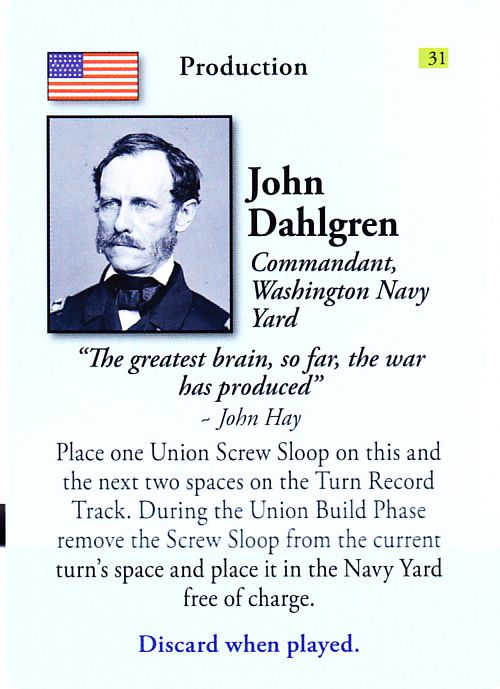
            Game Connection:  Confederate ironclads were notoriously underpowered, and that is reflected by USN Card 47 (Engine Breakdown).  Admiral Dahlgren, as commandant of the Navy Yard (which appears on the top right of center on the map) helped develop and produce powerful weapons which bore his name – as noted in USN Card 31 (John Dahlgren) and USN Card 3 (Yankee Guns).


Thursday, June 13, 2013

 Rebel Raiders Replay  (Turn 8 –August 1863; Part II - The Union Turn)

Designer Mark McLaughlin as CSA; Naval Historian Brandon Musler as USA

When we left off, Mark was lamenting that Brandon was sinking Blockade Runners as fast as the South could build them, yet thanks to Cotton is King (Card 87) the remaining Blockade Runners managed to deliver a dozen victory points, to which the Raiders contributed another four.  Mark placed batteries in Chattanooga and Atlanta, expecting Brandon to build on his success at Nashville and strike at the heart of the Confederacy.

Grant Heads South(east)

Piqued that the South managed to get as much Cargo through as it did, Brandon sends his Gulf Squadron roaring into Galveston – wanting the Blockade Runner sitting there as much as he wants the city itself; he gets both and knocks the South down twice in Victory Points  (VPs) (from the victorious assault and the bonus die roll for taking the city).

That little bit of administrative tidying up done with, he plays All the World’s A Stage (Card 39) which allows him to draw two cards at random from the Rebel hand; one of which he must return but discard the other – in this case, the powerful Rebel Yell (Card 98) which would have given Mark three bonus cards.

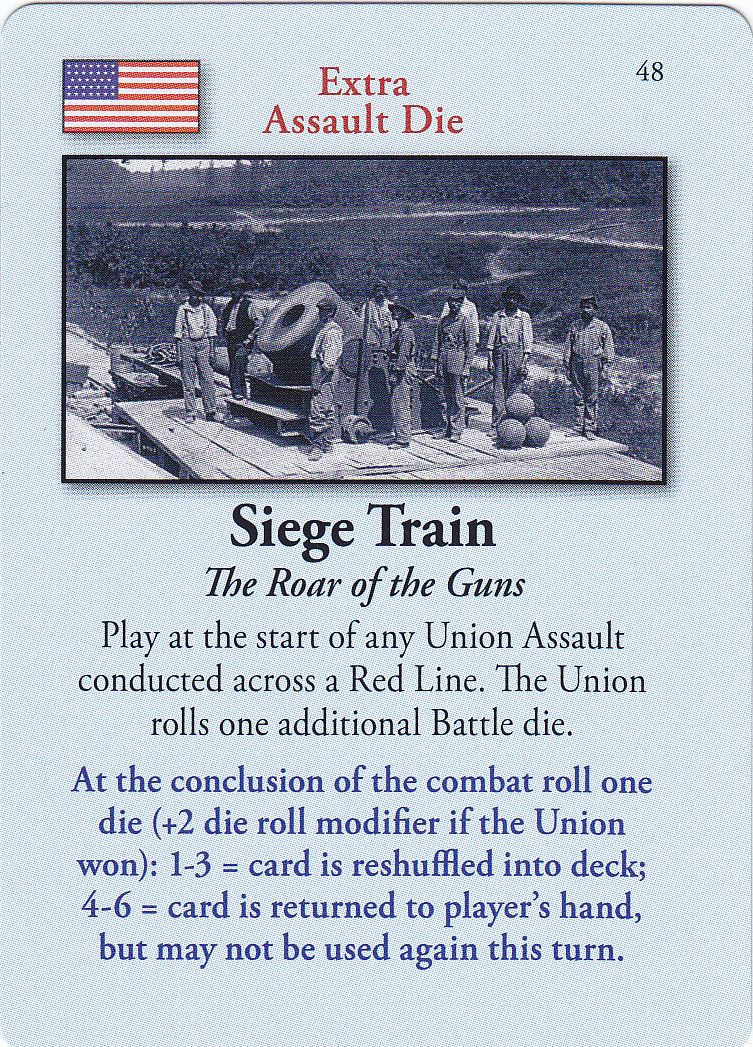
Chattanooga beckons, and using the Siege Train (Card 48) to add a fourth die and Union tactics (giving up two of those dice to gain a plus 2 advantage to his highest die) Brandon  attacks!  What would have been a tie (and thus a Union repulse) is saved by Grant (Card 8) who by virtue of his re-roll snatches victory from the jaws of defeat – and the city falls.  Again, the South loses precious VPs both from the battle and from the loss of the city.  

The South takes some (very) small Southern Comfort as the Union fails the die roll that would have allowed Brandon to keep the Siege Train card, and back into the deck it goes.

 Hardly pausing to shrug off this minor disappointment, Brandon presses on to attack the undefended space at Kennesaw Mountain, which easily falls – and this costs the South a pair of VPs due to the difference in battle dice.  This space is important, as it is adjacent to Atlanta – the jewel and iron foundry of the South.  Its loss would be dearly felt by the Confederacy, for so many reasons.

Brandon places the two Ironclads he built last turn in the Union river ports, along with the free gunboat the North gets there each turn, and places the two Screw Sloops he also built last turn, along with a free gunboat, in the Navy Yards.  He buys TWO extra Attack Pawns – meaning he will be able to conduct FOUR Assaults next turn.


To be Continued….


Wednesday, June 12, 2013

Rebel Raiders Replay  (Turn 8 –August 1863)

Designer Mark McLaughlin as CSA; Naval Historian Brandon Musler as USA

When we last left off, the South was reeling from the loss of Nashville – whose capture took no less than three assaults (two by river and one by land) in one turn to secure.  The capture of the city allowed the North to declare the Emancipation Proclamation, thus further hampering Southern efforts to bring in badly needed cargo from abroad...


Blockade Runners – We Few, We Happy Few…

While there are still at least a few (oh, how very few) Blockade Runners out there, Mark plays Cotton is King (Card 87) which increases the value of each Cargo counter brought home this turn by 1 extra VP.  Although three (fully loaded, of course) Blockade Runners go down, five get through – and thanks to King Cotton they unload 12 VP.   Raiders manage to scramble about for 4 more VP.

Of course one problem with being one of the “few” is that the band of brothers keeps getting fewer….

After losing 5 VP on the Supply roll (an attrition roll to reflect on the cost of maintaining the war effort) the South has 35 VP left – and Mark cashes in 20 of them to start another Ironclad.  Batteries go down in Chattanooga and Atlanta, to attempt to build up a line of defense against the now unleashed Grant, who may strike out of Nashville toward the Confederate heartland. Four Blockade Runners, bringing the total in play to eight, and a Raider are built.


The Rebel deck is reshuffled as per Cotton is King.

Tomorrow, the Union half of the turn....To be continued....