Showing posts with label civil war. Show all posts

Wednesday, April 30, 2014

April 30, 1864 – Union Fleet Escapes Red River Trap via “Bailey’s Dam”

This day 150 years ago in Rebel Raiders’ History

-Dedicated to Civil War episodes, battles, people and ships that also appear in my game, GMT’s Rebel Raiders on the High Seas.

April 30, 1864 – Union Fleet Escapes Red River Trap via “Bailey’s Dam”


Historical Event:   As if the Union campaign up the Red River had not been enough of a failure, falling waters trapped the fleet above the rapids at Alexandria.  Faced with the ignominious choice of either surrendering or scuttling the ships, Rear Admiral David Dixon Porter eagerly agreed to a scheme by a lieutenant colonel from the 4th Wisconsin, Joseph Bailey, to build a dam to raise the river.  Construction began on April 30. While Bailey built his dam and its attendant structures, Porter’s sailors lightened their vessels by unshipping many of their heavy guns and even removing some of the armor from the ironclads.  Two weeks later, with Confederate troops fast approaching, most of the fleet managed to ride the rapids to safety before the dam collapsed.   Porter, saying he was done with rivers, sought and took command of the North Atlantic Blockading Squadron.


Game Connection:  The Red River campaign is represented by a space on the map and a card played by the Confederates (CSN Card 76 – Red River Fiasco).  This is a design choice because few Union players would otherwise voluntarily commit such large forces, including their precious ironclads, to the complicated and highly problematic scheme concocted by Union General Henry Halleck.  Admiral Porter is also represented in the game, both as a stand-up leader and as a card (USN Card 2 – David Dixon Porter & His Little Mortar Boats).


Sunday, August 4, 2013

Hudson's Hideout Interviews Mark McLaughlin


10 Questions with game designer Mark McLaughlin

Want to know what goes into the game design process?  Jason F of the wargaming blog site Hudson's Hideout posted an interview with me  (see link).  I just got back from the WBC game convention in Lancaster, and tomorrow will resume regular/historical postings etc.


http://hudsonshideout.blogspot.com/2013/08/10-questions-with-game-designer-mark.html

Monday, July 29, 2013

The Ships of Rebel Raiders - The Ironclads

Rebel Raiders on the High Seas is a strategic game of the Civil War which focuses on the role of the navies on the rivers, along the coasts and on the oceans.  While most ships are represented by generic counters for Ironclads, Blockade Runners, Gunboats, Screw Sloops and, of course Raiders, there are cards and corresponding counters for many individual vessels.  This series presents those cards and offers a glimpse into the history of these storied ships.


Part IV– The Union Ironclads :   USS Roanoke  The “Acme” Ironclad – A great idea that worked – in theory


“Great ideas that work – in theory” is the motto emblazed on the crates of the Acme Company from which Wile E Coyote of Looney Tunes orders strange devices in his never-ending efforts to catch The Roadrunner.  If Acme made an ironclad, it would have been the USS Roanoke (USN Card 20 in Rebel Raiders on the High Seas).

Originally built as a steam frigate in 1855 and successful in catching blockade runners early in the war, she was chosen for a pilot conversion program and rebuilt not just as an ironclad but as a massive triple-turreted ocean-going ironclad.  The decision to do so was made by Secretary of the Navy Gideon Welles (USN Card 29), whom Chief of Steam Engineering Benjamin F. Isherwood convinced 10 days after the Monitor vs Virginia (USN Card 19 vs CSN Card 70) clash that reconstructing USS Roanoke into a seagoing ironclad would be faster and cheaper than designing a new vessel from the keel up.

USS Roanoke was the first ship to ever have a third turret.  Each had a pair of matching guns (Dahlgren 15 and 11 inch guns and 150-pounder Parrot rifles (Yankee Guns - USN Card 3 and John Dahlgren, USN Card 31). Each turret had 11 inches of armor.  She had belt armor as thick as 4.5 inches in some parts, plus 1.5 inches of deck armor.  This added so much weight, however, that she displaced about 6,400 tons – half again what she had displaced as steam frigate (and she was a big, modern frigate to begin with – and when initially launched sank and had to be refloated).

As the Brooklyn Navy Yard neared completion of the project, the Navy decided to add a ram – making it not only an ocean-going ironclad monitor, but one that could also ram its prey.   Unfortunately, all of this weight made her too slow to do so – and while she could briefly push ahead in good conditions at 8.5 knots, her best sustainable speed was only 7 knots – slower than she had been as a steam frigate.

In addition, the weight made the ship so unsteady that as her captain lamented in order to fire the guns he had to “secure them with pieces of timber to prevent them fetching away.” (Three of the six guns dismounted because of the recoil the first time they were fired). When the guns fired, moreover, the ship would roll so dangerously as to “preclude the possibility of firing her guns at sea.”

The turrets were also so heavy that, even with additional boilers added just to power them, they took five minutes to make a full rotation.


Having built a massive monster that was slow, unsteady, unsafe and useless in combat, the Navy sent her to Hampton Roads to defend the harbor, where she sat out the remainder of the war.


Saturday, July 27, 2013

The Ships of Rebel Raiders - The Ironclads

 Rebel Raiders on the High Seas is a strategic game of the Civil War which focuses on the role of the navies on the rivers, along the coasts and on the oceans.  While most ships are represented by generic counters for Ironclads, Blockade Runners, Gunboats, Screw Sloops and, of course Raiders, there are cards and corresponding counters for many individual vessels.  This series presents those cards and offers a glimpse into the history of these storied ships.

 Part IV– The Union Ironclads : USS Monitor – Pulling Its Punches vs. CSS Virginia

The ironclad USS Monitor is of course represented in Rebel Raiders  (by USN Card 19) as is its opponent in the classic duel at Hampton Roads, CSS Virginia (CSN Card 70).

So much has been written on those ships and their epic if inconclusive battle, but what is often lacking from accounts is WHY that duel was so inconclusive.  The answer, as historian James McPherson points out in his recent book, War Upon the Waters, is that neither ship was properly prepared to fight the other.

The Union Navy distrusted John Ericsson, who designed and built the USS Monitor, because in 1844 a gun he had invented exploded during a trial on the USS Princeton – killing the secretaries of BOTH the Army and the Navy.  When Ericsson told them the pair of 11-inch Dahlgrens aboard his new warship could handle a powder charge of 45 pounds they balked – and issued an order that no more than 15 pounds of powder be used.   As a result, the 170-pound projectiles fired by the USS Monitor’s guns hit with far less force – merely cracking the armor on the CSS Virginia, rather than punching through it  (as later tests with a full charge demonstrated).


The CSS Virginia, however, was equally unprepared for the fight – instead of iron bolts or solid shot, she loaded up with only explosive shell – the perfect weapon to blow apart and set afire the wooden warships of the type she had encountered the previous day.   When these shells struck the Union ironclad, they did only superficial damage (except for fragments that entered through viewing slits and other openings (one such fragment temporarily blinded  USS Monitor’s commander, Lt.  John Worden who was peering through the slit in the pilothouse when it hit).


Wednesday, July 24, 2013

What Gamers Are Saying about Rebel Raiders:


“Fun and pretty darn grounded historically;”  “what an ingenious game!” 

“Simple to play, very good for solitaire…thanks for taking the risk and breaking new ground.”

 Gamers continue to say good things about Rebel Raiders on the High Seas.  Here are just a few comments we have received this week:

Panzer Digest magazine: “Fun and pretty darn grounded historically;” 

-“Katie and I welcome Mark McLaughlin – designer of that truly awesome game at GMT: Rebel Raiders.  It’s both fun and pretty darn grounded historically considering the scale – and keeping it playable!”


Michael Syrett  (from Scotland):   “Simple to play, very good for solitaire…thanks for taking the risk and breaking new ground.”
  
“As a veteran board gamer and purchaser of GMT products (I have 30 of your games), I’d like to congratulate Mark McLaughlin and Fred Schachter on their excellent new offering Rebel Raiders on the High Seas.  The naval war between the States has been the one aspect of ACW gaming that has been sadly neglected.  This game, along with Iron & Oak, more than fills the gap.  It is simple to play, very good for solitaire – yet covers most of the key events.  It is right up there among my top five favourite games.  Many thanks for taking the risk and breaking new ground.”
  
Paul Pressler (on Consimworld):  “what an ingenious game!”  “We have had a really great time!”

 My brother and I just finished playing four straight games of Rebel Raiders starting in 1861 each time.  We have had a really great time!  What an ingenious game! It’s easy to play but really brings out a flavor for the war and covers aspects of the war never covered by other games on the war.  Covering the Blockade Running, Confederate Raiders aspects of the war lets the war be seen in its full international scope, which helps one to fully understand the conflict.  Good job on that!  The assortment of Confederate and Union cards was well thought out and guaranteed that each game was different from the other.”

Thursday, July 18, 2013

This day 150 years ago in Rebel Raiders’ History

-Dedicated to Civil War episodes, battles, people and ships that also appear in my game, GMT’s Rebel Raiders on the High Seas,  

July 18, 1863 – Glory: Admiral Dahlgren & the 54th Mass. at Battery Wagner

            Historical Event:  The gallant charge of the 54th Massachusetts, so poignantly portrayed in the movie Glory, took part on this day in 1863.  Rear Admiral John Dahlgren sent his ironclads and gunboats of the South Atlantic Blockading Squadron close in to support the attack on Battery Wagner on Morris Island in Charleston Harbor.  His ships  at times came as he notes in his memoirs within 300 yards of the fort.   

            To support the attack Dahlgren sent in ten ships:  six ironclads (USS Montauk, USS Ironsides, USS Kaatskill, USS Nantucket, USS Weehawken and USS Patapsco) and four gunboats (USS Paul Jones, USS Ottawa, USS Wissahickon and USS Seneca).

            Here, from his Memoirs, is Admiral Dahlgren’s account of what he witnessed that day:

            “The ironclads battered Wanger almost out of shape, and in the afternoon of that day the flag monitor ‘Montauk’ lay only three hundred yards from the sea-face of the work; not a gun was fired from it; not a head visible to my glass as I stood with other officers outside, watching the first symptom of renewed resistance.

            “Our column came up, but it was too dark to discern objects from the vessels, and after a fierce and resolute effort the column fell back with a loss of 1,500 men.

            “The assault could derive no aid from the fire of our guns, because it was impossible to distinguish our troops from the enemy.”   (Italics are Dahlgren’s).


            Game Connection:    John Dahlgren, one of the first admirals ever created for the U.S. Navy, has his own card (USN Card 31) in Rebel Raiders on the High Seas, and the revolutionary weapons he created (among them the Dahlgren gun) are also represented (USN Card 3 – Yankee Guns).  Both are important cards for a Union player who will need to send his fleets of ironclads and gunboats to destroy the batteries at Charleston to help clear the way for an assault – hopefully one that will end more fortuitously than the gallant but doomed charge made by the 54th on this day, 150 years ago.


The Ships of Rebel Raiders - The Gunboats

Rebel Raiders on the High Seas is a strategic game of the Civil War which focuses on the role of the navies on the rivers, along the coasts and on the oceans.  While most ships are represented by generic counters for Ironclads, Blockade Runners, Gunboats, Screw Sloops and, of course Raiders, there are cards and corresponding counters for many individual vessels.  This series presents those cards and offers a glimpse into the history of these storied ships.

Part II – The Gunboats: The Mosquito Fleet Rams at New Orleans

“The Mosquito Fleet” (CSN Card 81) represents the rag-tag little squadrons the South hastily cobbled together to defend their ports from the Union Navy.  One such force supported the ironclad CSS Manassas in the battle at Forts Jackson and St. Philip below New Orleans in late April 1862.

While the CSS Manassas is represented in the game (as CSN Card 71), the vessels that accompanied her are represented by the generic Gunboat counters, one or two of which may be added to a Confederate defense by play of The Mosquito Fleet (CSN Card 81).   General Mansfield Lowell had purchased and armed 14 civilian craft for his flotilla in the late winter of 1862 – but was ordered to send more than half of them upriver to Memphis to join Commander Montgomery’s river defense force (see my posting for July 15: http://markgmclaughlin.blogspot.com/2013/07/the-ships-of-rebel-raiders-gunboats_15.html)

When David G. Farragut and his massive Union fleet made their move on the forts below his city, Lowell had only six of his armed riverboats left, a force that even the Confederate secretary of war lamented was “a peculiar one.”  (Lowell himself admitted that his group had “little or no discipline” and was “too much ‘steamboat’ and too little of the man-of-war’ to be very effective.”  Still, when Farragut’s gunboats and screw sloops broke through the barrier of Hulks, Rafts and Chains (as represented in Rebel Raiders by CSN Card 110) Lowell and his makeshift flotilla were there to meet him.

While the turtle-shaped ironclad CSS Manassas   was the spearpoint of Lowell’s counterattack against the screw sloops (notably the massive USS Mississippi – represented in the game by USN Card 23), his gunboats closed with their Union counterparts.  The J.C. Breckinridge and Governor Moore worked together to each ram and sink the USS Varuna, then headed for the USS Cayuga – but were driven off by the fire of another Union gunboat, USS Oneida.  (USS Cayuga broke through the line of Rebel ships, surprised five companies of militia in their camp, who after taking a few rounds from the gunboat became the first Confederate regiment to surrender to a Union gunboat).


Lowell fought on, sending fireships down the river, but after the USS Mississippi’s guns pummeled and set afire the CSS Manassas, the fight was over.  Farragut  (USN Card 1) in the USS Hartford (USN Card 37), along with the USS Brooklyn (USN Card 13) and the rest of the fleet steamed forward, the forts already partially silenced by David Dixon Porter and his Little Mortar Boats (USN Card 2).   From there, it was on to New Orleans for the Union fleet.   As for Lowell, all but one ship in his Mosquito Fleet was lost.


Sunday, July 14, 2013

This day 150 years ago in Rebel Raiders’ History


-Dedicated to Civil War episodes, battles, people and ships that also appear in my game, GMT’s Rebel Raiders on the High Seas.  

July 13, 1863 merits a second entry (in addition to yesterday's post noting the start of the New York draft riots)...and ps: Happy Bastille Day!

July 13, 1863 – (Part II) – “Infernal Machines” Sink Union Ironclad

            Historical Event:    The ironclad USS Baron de Kalb was sunk this day 150 years ago by a Confederate “infernal machine” (a “torpedo” as they called it but what we today would dub a naval mine).   The ironclad was part of the Union force that captured Yazoo City  (on the river of the same name) during the mopping up operations that followed the surrender of Vicksburg and Port Hudson (see my blog entries for July 3 and July 8, respectively:    http://markgmclaughlin.blogspot.com/2013/07/this-day-150-years-ago-in-rebel-raiders.html   and http://markgmclaughlin.blogspot.com/2013/07/dedicated-to-civil-war-episodes-battles.html

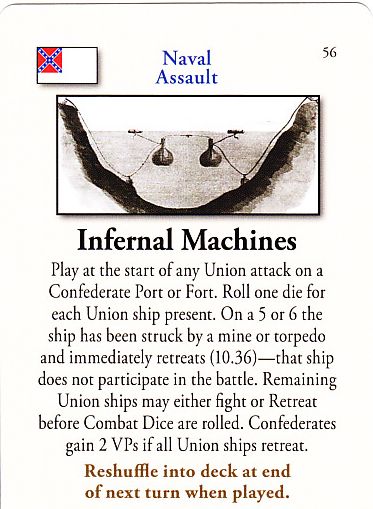
            Game Connection:    Ironclads are vital to the Confederacy to defend its ports and for the Union to battle through the batteries, sink Rebel ships and clear the way for the Army to land during an assault in Rebel Raiders on the High Seas.   Whether fighting into an ocean port or up or down the Mississippi or Yazoo, the Union player does have to take into account that the Rebel player can play many cards to impede his progress.  One of those is Infernal Machines (CSN Card 56). 


Tuesday, July 9, 2013

The Ships of Rebel Raiders - The Gunboats


Rebel Raiders on the High Seas is a strategic game of the Civil War which focuses on the role of the navies on the rivers, along the coasts and on the oceans.  While most ships are represented by generic counters for Ironclads, Blockade Runners, Gunboats, Screw Sloops and, of course Raiders, there are cards and corresponding counters for many individual vessels.  This series presents those cards and offers a glimpse into the history of these storied ships.

Part II – The Gunboats: USS Hatteras, The gunboat that took on the CSS Alabama


USS Hatteras (USN Card 16) was a civilian steamer outfitted as a gunboat and sent to blockade Key West and later Galveston.  There she was surprised and sunk by Raphael Semmes and his storied raider, CSS Alabama (CSN Card 63).    Prior to that fatal engagement, however, USS Hatteras captured seven blockade runners (hence her speed advantage as noted on the card).

USS Hatteras died well that day in January 1863.  She was chasing down a vessel that had identified itself as HBMS Petrel – but when Commander Blake brought his ship in close, Semmes showed his true colors and declared by signal “We are the CSS Alabama.”  The duel was fought at under 200 yards, with the USS Hatteras at first giving as good as she got with her 32-pounders…but after being holed and set afire, the Union warship was forced to strike.

Battle on the board: USS Hatteras vs CSS Alabama combat in Rebel Raiders

USS Hatteras is a Gunboat.  In a battle in Rebel Raiders she fires one die.  As her target is a Raider, she needs a 5 or 6 to hit and sink CSS Alabama.   (Her card does not give her any advantage in combat, only in searching for Raiders and Blockade Runners.)

CSS Alabama is a Raider.  In a battle a Raider also fires a single die – but her chances to hit and sink a gunboat are slightly better – a 4,5 or 6.   CSS Alabama, however, being a singularly epic man of war (her commander, Raphael Semmes, bridled at being labeled a “pirate” and sought out the USS Hatteras in part to prove that he was not afraid to take on an armed opponent) adds a plus to her die in combat (as per the bonuses listed on (CSN Card 63) - so, CSS Alabama thus rolls one dice, and with that bonus now needing a 3, 4, 5 or 6 ;  which apparently in the real war she rolled, and down went the USS Hatteras, which rolled her single die – but missed.


Monday, July 8, 2013

This Day 150 Years Ago in Rebel Raiders' History

 -Dedicated to Civil War episodes, battles, people and ships that also appear in my game, GMT’s Rebel Raiders on the High Seas,  

July 8, 1863 – The Surrender of Port Hudson:  The Father of Waters Runs Free

            Historical Event:   The fall of Vicksburg greatly impacted the morale of the defenders of Port Hudson, the last major Confederate fortification on the Mississippi.  After months of siege by General Nathaniel Banks’ Union forces, Confederate General Franklin Gardner finally agreed to surrender his hungry, beleaguered garrison of 6,000 – less than half of whom were deemed fit to hold a rifle. 
            Gardner and his men had fought well – repulsing numerous attempts by the Union Navy to pass the batteries.   They scored a signal success on March 14, 1863 when they sank the USS Mississippi (which appears in the game as USN Card 23).  She was lost when Admiral Farragut (who appears as a leader in the game as well as on USN Card 1- Damn the Torpedoes- and USN Card 33 – The Grand Fleet) tried to fight his way past the batteries, lashing ironclads to one side of his big ships for their protection, and transports and supply ships to the far side for theirs.  Only the USS Hartford  (his flagship, which appears in the game as USN Card 37) made it past the guns on the bluffs.

            (See the illustration below: Color depiction of the Seige of Port Hudson during the Civil War entitled, "Battle of Port Hudson" published by L. Prang & Co., Boston, c.1887)

            The fall of Port Hudson opened the last 40 miles of river to the Union, thus allowing Lincoln to proclaim that as of this date “The Father of Waters Flows Unvexed to the Sea.”

            Game Connection:   Although due to the scale of the map Port Hudson itself is not in the game (it is represented along with its sister fortress of Baton Rouge, which lies 25 miles downriver, by a space named for the later) the capture of the Mississippi in its entirety is represented.  Opening up the river not only fulfills one of the key Union conditions for victory, it also greatly increases the supply attrition roll for the South – a phase that bleeds the Confederacy of Victory Points earned through running the blockade and raiding.  As those Victory Points may also be traded in for additional forces (ironclads, batteries, counterattacks, more ships, cards), losing those additional points each turn due to the Union capture of the river makes it noticeably more difficult for the South – whose interior is now open to attack from Union armies marching east from the Mississippi ports.


Saturday, July 6, 2013

The Ships of Rebel Raiders - The Gunboats


Rebel Raiders on the High Seas is a strategic game of the Civil War which focuses on the role of the navies on the rivers, along the coasts and on the oceans.  While most ships are represented by generic counters for Ironclads, Blockade Runners, Gunboats, Screw Sloops and, of course Raiders, there are cards and corresponding counters for many individual vessels.  This series presents those cards and offers a glimpse into the history of these storied ships.

Part II – The Gunboats: USS Osceola

The USS Osceola  (USN Card 9).  Built in Boston as a “fighting tow,” she took part in operations on the James River and against Fort Fisher in 1864.  Capable of speeds of up to 15 knots, the heavily armed (nine guns) warship also helped clear a minefield and supported the landing of Union troops at Bermuda Hundred.


As part of the North Atlantic Squadron the ship was also part of the inshore blockade, and had many an encounter with enemy vessels, one such instant Commander Clitz, then officer commanding, describes in a report he send to Admiral David Dixon Porter on November 1, 1864.

“I have to inform you that yesterday at 11 o’clock a.m., when in latitude 33 55’ N., longitude 75 45’ W.,  discovered black smoke bearing N.W., distant about 15 miles.  Gave chase immediately and continued to do so until about 8:45 p.m. The chase was a side wheel steamer, painted white, with two masts and two smokestacks.  She was either a blockade runner or a privateer, I think the later, as her decks were crowded with men.   When first discovered she was steering towards Wilmington (N.C.) but we pressed her so hard she was compelled to change her course to every point of the compass.  At sunset we were about 4 miles from said steamer, opened fire with the forward 100-pounder Parrot rifle, firing five shots; finding that they fell short, discontinued the firing, but continued to follow until the time above mentioned, when we lost her in a fog bank.
            “We kept up a uniform speed of 13 ½ knots during the entire chase.

            “I think that I can safely say but for the darkness and fog it would have been our good fortune to have captured her.”


Thursday, July 4, 2013

The Ships of Rebel Raiders - The Douglas


Rebel Raiders on the High Seas is a strategic game of the Civil War which focuses on the role of the navies on the rivers, along the coasts and on the oceans.  While most ships are represented by generic counters for Ironclads, Blockade Runners, Gunboats, Screw Sloops and, of course Raiders, there are cards and corresponding counters for many individual vessels.  This series presents those cards and offers a glimpse into the history of these storied ships.

The Blockade Runners – The  Douglas


  The Douglas (CSN Card 84)  was a little steamer that ran in and out of the Isle of Man before being purchased by Confederate agents for use as a blockade runner.  After making her first crossing to Charleston in January 1863 she was renamed The Margaret & Jessie.  The little 726-ton iron side-wheel steamer made five more runs in and out of that port and three in and out of Wilmington.  On her fourth attempt to run into the North Carolina den, however, she was caught by an armed transport of the U.S. Army – The Fulton, and a navy warship, USS Nansemond.   The Douglas/Margaret & Jessie was taken into service as USS Gettysburg, and later took part in the assault on the Wilmington forts.   She ended her career as a U.S. Navy survey vessel and was sold off in Italy in 1879.


Monday, July 1, 2013

This day 150 Years Ago in Rebel Raiders's History

 This day 150 years ago in Rebel Raiders’ History
Gettysburg, Vicksburg and the Ships of Rebel Raiders.

 -Dedicated to Civil War episodes, battles, people and ships that also appear in my game, GMT’s Rebel Raiders on the High Seas,  Gettysburg, Vicksburg and the Ships of Rebel Raiders.

On this, the 150th anniversary of the First Day of Gettysburg, it is easy to forget that at Vicksburg an equally vicious and vital struggle was also reaching its climax.  

As a strategic naval game, Rebel Raiders on the High Seas focuses far more on the epic siege of the fortress on the Mississippi than on the titanic contest that was played out on the fields of Pennsylvania.   The later is represented by the Lee Moves North card (CSN Card 77), while many of the leaders and great ships who fought at Vicksburg are also represented, notably: 

 -David Dixon Porter & His Little Mortar Boats (USN Card 2),
 -Grant Takes Command (USN Card 8),
-the tinclad gunboat USS Black Hawk (USN Card 10), 
-the "Pook's Turtle" ironclad USS Carondelet (USN Card 15), 
-the timberclad gunboat USS Tyler (USN Card 18),
-the phony ironclad Black Terror (USN Card 25)
-the big guns of the Siege Train (USN Card 48),

-and, for the South:

-the mines, torpedoes and other Infernal Machines (CSN Card 56),
-the general who tried to relieve the city, J.E. Johnston (CSN Card 91)
-the hidden batteries on the bluffs of Ring of Fire (CSN Card 101),


--and the only ship to see action on BOTH sides at Vicksburg:
--“Ellet’s Ram” USS Queen of the West (USN Card 38)– which was captured and put into service by the Confederacy as CSS Queen of the West


Friday, June 28, 2013

The Ships of Rebel Raiders   -  The Banshee

Rebel Raiders on the High Seas is a strategic game of the Civil War which focuses on the role of the navies on the rivers, along the coasts and on the oceans.  While most ships are represented by generic counters for Ironclads, Blockade Runners, Gunboats, Screw Sloops and, of course Raiders, there are cards and corresponding counters for many individual vessels.  This series presents those cards and offers a glimpse into the history of these storied ships.

The Blockade Runners – The Banshee


The Banshee (CSN Card 68) was one of the first ships built specifically to run the Union blockade.  She was also one of the first commercial vessels to build of steel.

 Under Joseph W. Steele the ship made eight successful runs, giving her owners their investment seven times over.  After a transatlantic maiden voyage in April 1863, most of her runs were from Bermuda or the Bahamas into Wilmington, where she was caught later that year on her ninth and final run by the USS Grand Gulf.  Taken to New York as a prize, she was purchased, armed and rechristened by the U.S. Navy as the gunboat USS Banshee, under which name she joined the blockade in Chesapeake Bay.


Thursday, June 27, 2013

The Ships of Rebel Raiders   -  The CSS Advance

Rebel Raiders on the High Seas is a strategic game of the Civil War which focuses on the role of the navies on the rivers, along the coasts and on the oceans.  While most ships are represented by generic counters for Ironclads, Blockade Runners, Gunboats, Screw Sloops and, of course Raiders, there are cards and corresponding counters for many individual vessels.  This series presents those cards and offers a glimpse into the history of these storied ships.

The Blockade Runners – The CSS Advance


Most blockade runners made a profit by their second voyage; the CSS Advance (CSN Card 67) made 20 such successful runs, making her one of if not the most profitable of all of those ships that ran the Union blockade.   A side-wheel steamer built in Scotland as the Lord Clyde in 1862, she was purchased by the state of North Carolina and renamed in honor of its governor, Zebulan Vance.   She eluded capture on over 40 occasions before her luck ran out on September 10, 1864 off Wilmington, where she was caught by the gunboat USS Santiago de Cuba.  The Union impressed the ship into service, refitting and rechristening her as the gunboat USS Frolic.  She finished out the war, ironically, enforcing the blockade.


Wednesday, June 26, 2013

The Ships of Rebel Raiders   -  The Don

Rebel Raiders on the High Seas is a strategic game of the Civil War which focuses on the role of the navies on the rivers, along the coasts and on the oceans.  While most ships are represented by generic counters for Ironclads, Blockade Runners, Gunboats, Screw Sloops and, of course Raiders, there are cards and corresponding counters for many individual vessels.  This series presents those cards and offers a glimpse into the history of these storied ships.

The Blockade Runners -  The Don

With few arsenals or factories of its own, the Confederacy relied upon European manufacturers for much of its war material as well as other vital supplies.  As European vessels would not cross the Union naval blockade to deliver those goods into Southern ports, the South relied upon a fleet of swift merchantmen to “run” the blockade.  

The Don (CSN Card 66) was a particularly fast twin-screw, two-stacker Blockade Runner.   Capable of 14 knots and drawing only six feet, The Don was hard to run down and could slip into coastal inlets to hide.  The vessel cost $115,000 to build, but made back that and more for her owners, who included the State of North Carolina and Francis Muir of Pudding Lane in London and on her first trip from England via Nassau in 1863.  Her 32-year-old captain, Fred Cory, made a second similarly successful voyage, but on his third trip his ship was caught off Beauport, on March 4, 1864, by the wooden screw gunboat USS Pequot.


On that final voyage the ship was packed not with weapons and munitions, but with uniforms, blankets and shoes, a cargo valued at over $200,000 – or twice what it cost to build The Don.


Tuesday, June 25, 2013

This day 150 years ago in Rebel Raiders’ History  - Custer and Rebel Raiders

-Dedicated to Civil War episodes, battles, people and ships that also appear in GMT’s Rebel Raiders on the High Seas.


Custer and Rebel Raiders 

Today, June 25, is the 137th anniversary of the Battle of the Little Bighorn.  While neither Custer's Last Stand in 1876 nor the flamboyant boy general himself are represented exactly in Rebel Raiders on the High Seas, the link to the Civil War is undeniable.   Custer was Gen. Phil Sheridan's favorite, his "go to" for bold action, and in that sense when any Union gamer plays US Card 11 - Sheridan ...they are in effect playing Custer.


Sheridan (standing, left) and Custer (seated, right)


Sheridan on horseback (the illustration used for Rebel Raiders Card 11)


Custer, wearing the stars of a brevet major general of volunteers on a uniform of his own design - complete with the distinctive red scarf tie that, as much as his perfumed yellow hair, would be his trademark.

Custer, of course, made his name 150 years ago next week, leading the Michigan Brigade in a series of desperate charges that brought to a halt J.E.B Stuart's attack on the rear of the Union lines at Gettysburg.  That battle is represented in Rebel Raiders by CSN Card 77 - Lee Moves North....


Monday, June 24, 2013

Rebel Raiders Rocks –
What Gamers Are Saying About Rebel Raiders on the High Seas – June 24, 2013

Good reports, congratulations and recommendations continue to flow in for Rebel Raiders on the High Seas;  here are some of the latest:

Rebel Raiders Rocks!
“Kudos Fred and Mark on this gem. Really captures the feel of the naval war, with lots of flavor and definitely a player’s game.”
-Darin Leviloff, Foster City CA (and designer of Soviet Dawn, Israeli Independence and Ottoman Sunset)

That Game Really Rocks!
“Charles and I just played about 2/3 of a game of Rebel Raiders (it’s set up on my table until we can finish it). That game really rocks! I’ll write more later, I just wanted to let you know I really enjoy it....I really enjoyed the game, can't wait to finish it. 
Chris Buhl, Pittsfield, MA


A Very Entertaining Game..Oodles of choices to make...
“A very entertaining game.  Oodles of choices to make and opportunities for variation.  I’ve started a second.”
-John Bolash, Consimworld


A Nail Biter Down to the Wire and We Had a Great Time With It
“Got to play our first full game of RR last Wednesday and had a great time with it.”
“A nail biter down to the wire and we had a great time with it.”
-Chuck Parrot, Winnabow, NC


This is a Game I Would Recommend to Anyone
“This is a game I would recommend to anyone. It is fairly simple to learn and understand, but it does not suffer from insufficient strategy and AP. You are constantly second guessing yourself and wondering what you could have done differently with each play.  Really well done game and one I think will hit the table a few more times.”
- Erich Vereen, Leland NC


And Cheers for the AAR too….


….and on the just-completed After Action Report of the game between the designer and naval historian Brandon Musler:

-“I must say this was one of the most exciting AARs I’ve ever read. It reinforces my desire to play RR to death.”
-Pat Kairns, Montreal, Canada

-“I think it says a lot (in a good way) that the designer wants to play his game after all the toil to produce it. I hear sometimes/often that is not the case”

-Steve Duke, Georgetown, Texas

Saturday, June 22, 2013

Musing on Victory – and the “immersive experience” of playing Rebel Raiders or

“ I Think Mahan Himself Would Have Heartily Approved”

By Brandon Musler

On the Design:  a “CFG” (Card Flavored Game) vs a CDG (Card Driven Game)

Overall, I was amazed by how immersive an experience playing Rebel Raiders could be. Normally, I do not favor CDG  (Cared Driven Game) designs, and I really like this new thing called a CFG  (Card Flavored Game) because it had its priorities in order: play mechanics informed and spiced up by cards.  I also liked that there were endless decisions to make, and you could recover from mistakes.

 I thought the whole brown water navy aspect to things was brilliantly conceived and designed -- it fascinated me how the designer encapsulated the entire western theater by blending a point to point subsystem with a CDG dynamic.  He really, really distilled a crucial dynamic of the land campaigns in the ACW...in a game primarily focusing on the naval war.  I think Mahan himself would have heartily approved...but more importantly I feel I gained some crucial insights into a subject that I've never really been able to get my arms around before, despite reading Shelby Foote et al! And of course there was learning about the whole mercantile war via the raiders and runners.   

Union Play

First time players really ought to take the Union side because although the choices seem a bit overwhelming in the first half of the war, the enormous power of the Union industrial base makes it relatively easy to recover from a myriad of mistakes and power to victory in 1863 and 1864...or once Grant is on the board.  In other words, in the basic game we played (or without any of the many optional rules) it is a lot harder for the CSA player to keep morale up and get it right...

In the first year of the war when the Feds are down a die,  (and maybe the second when the odds are even,) it's probably a good idea to use Union attacks to take undefended port cities via amphibious assault. (The designer hinted at this repeatedly during our play, I believe, but I didn't hear it at the time.)  The risk is relatively low and late in the game it will leave the door open to pursue the maximum territory approach to victory.
 
Late in the game the designer reminded me that  the
Union need not take Richmond to win, provided it has 16 other cities (including Atlanta and the three on the Mississippi, which I did have).  At that point, however,  I had only half of turn 11 and turn 12 ahead of me, and would have had to shoot a 100% from the foul line (6 for 6, I think it was) so I chose the "On To Richmond!" path four years late...and then I got really, really lucky with Jackson getting killed etc...
 
 Final Thought:  Great Fun to Play


It was great fun to play, and refreshingly enlightening...pretty much everything I could expect out of historical board game. 

Friday, June 21, 2013

Rebel Raiders Replay  (Turn 12 –December 1864)

Designer Mark McLaughlin as CSA; Naval Historian Brandon Musler as USA

When we left off, the South was burning.  Two Rebel attempts to retake Vicksburg failed. New Bern, Atlanta, Montgomery  and New Orleans fell to the Union, completing the Northern conquest of "The Father of Waters." It is, hopefully, the final turn, and if the South, in the negative victory point range, can manage to hold on to Richmond it can still squeeze out a win.

The Albemarle Sallies Forth!

Just to show the South can still fight at sea, Mark plays the CSS Albemarle (Card 75).  The only Southern Ironclad that can go beyond Blockade Stations and into Coastal Waters, it stands a chance of breaking a hole in the Blockade.  Brandon tries to stop her coming out of Charleston with Engine Breakdown (Card 47) but the plucky iron devil keeps coming, sinks the Union Gunboat on the Blockade Station and engages the single Screw Sloop offshore – which sinks her.   Perhaps Albemarle, too, was built by Acme – Charleston Branch.  (That same Sloop catches the Blockade Runner that was trying to get into Charleston).


Once More On To Vicksburg…

The Rebel Counterattack is launched once again at Vicksburg.  Should this counter-attack fail, Baton Rouge, Corinth and Meridan will “wither on the vine” as they have no cities to supply them…and with them will go the Ironclad CSS Virginia, which retreated from New Orleans to Baton Rouge.

Third time, it seems, IS a charm – and the South regains Vicksburg!  Virginia promptly works up steam and goes in to help defend the regained city – which in the Build Phase gets the one Battery the South can still build (losing Atlanta reduces Battery builds from two to one; loss of Richmond would cost the other).

The South is still in negative VPs  but is not dead yet.

One More Push

The North is in a pickle.  It has two ways to win:

-1.  Take 16 of the 20 Rebel cities, which MUST include all three key Mississippi cities (Vicksburg, Memphis, New Orleans), PLUS EITHER Richmond OR Atlanta, and have the South at negative VP.  OR

-2. Take the three key Mississippi cities (Vicksburg, Memphis, New Orleans), PLUS Richmond AND Atlanta – and if the South is at negative VP at that moment the game ends immediately.

Ten cities are in Yankee control, so to get the first it would need Six Assaults – Brandon shows that he has the Sea to Shining Sea (Card 24) that would give him two assaults in ADDITION to the Four he bought – however, the two extras are only good for attacking Ocean Ports in bonus Amphibious Attacks.     It is a great card, but he would need to win ALL SIX battles (one of them Vicksburg) to meet the first victory condition.

Brandon does not bother; he announces he will go for Vicksburg and Richmond – although getting there means he has to take a space adjacent to the Southern Capital.  That means he must win THREE out of FOUR Combats.    Fortunately, however, Brandon has Loose the Fateful Lightning (Card 34), which gives him a FIFTH Assault where he needs it.


Five Battles  - and Bobby Lee

With his powerful Ironclad fleet on the river, Vicksburg, even with Virginia and a Battery, is no match.  It falls in one Assault.

Brandon takes his second attack on Fredericksburg – and runs into BOTH  Bobby Lee (Card 60) and Stonewall Jackson (Card 104).  The dice and re-rolls are too much for the North, and Brandon is repulsed….unfortunately for the South, however, Jackson is killed!


Assault number three is Fredericksburg again – this time, the Union takes it.

Assault number four is Richmond – and Lee holds!

The Union, however, has that fifth and final assault left thanks to Loose the Fateful Lightning….  the Union dice total is higher by ONE than the South…Can Lee pull off one last miracle re-roll to change the outcome.

Sadly, for the South, the answer is no….

On the very last die roll of the very last turn, the South Falls – victory to Brandon and the Union, which holds 12 cities – including the five all-important ones of New Orleans, Vicksburg, Memphis, Atlanta and, finally, Richmond.

 ....The Union is restored....