Showing posts with label War upon the Waters. Show all posts

Monday, May 26, 2014

McPherson, MacGowan, McLaughlin & Memorial Day

 Happy Memorial Day to All!....My friend Rodger MacGowan - who did the cover for Rebel Raiders on the High Seas and many other games of mine not only followed my lead in honoring Civil War historian James McPherson - but also did me one better (as any artist of Rodger's caliber should) by putting up this tribute. For more from Rodger on Memorial Day, games and his magazine, please visit his C3i magazine ops site:  http://www.c3iopscenter.com/currentops/


Thursday, May 22, 2014

Civil War historian McPherson wins lifetime award

Congratulations to author James McPherson, whose book on the Civil War at sea and on the rivers was one of the favorites of all of those I read while doing research for Rebel Raiders on the High Seas.  Prof. McPherson has just been awarded the Arthur M. Schlesinger, Jr. Award for distinguished writing in American history.

I have been fortunate to meet and talk face-to-face with McPherson three times, most recently at the New York Historical Society in 2012, when I not only was able to go to the microphone to ask him a question about Confederate Admiral James Buchanan and Commander James Montgomery (both of whom appear in my game) but also afterward, as we were leaving the building. (See below for a link to the video of his talk - I am on camera at the 39 minute mark).

http://www.c-spanvideo.org/program/309606-1

 Two years before that I met him at the Hotchkiss School, where he gave a talk on Lincoln as a commander - and I was able to have a brief one-on-one conversation over a drink with him afterward.  Many years before that I met him after he did his signature work on Antietam.  Grand, great historian and wordsmith of the old school;  a master of easy to read yet elegant prose.   Congratulations, Professor McPherson, couldn't happen to a nicer and more deserving guy!

Here are the details of the award, as reported by the Associated Press (for whom I used to work many years ago)

Civil War historian McPherson wins lifetime award


NEW YORK — One the country’s greatest Civil War historians has won a lifetime achievement award.
James M. McPherson is best known for the Pulitzer Prize-winning “Battle Cry of Freedom.” He received the seventh annual Arthur M. Schlesinger Jr. Award for distinguished writing in American history. The award is named for the late Pulitzer-winning historian and was announced Monday by the Society of American Historians.


Wednesday, December 11, 2013

December 11, 1863 – “Pook’s Turtle” Saves the Day: USS Carondelet vs. Rebel Artillery

This day 150 years ago in Rebel Raiders’ History

-Dedicated to Civil War episodes, battles, people and ships that also appear in my game, GMT’s Rebel Raiders on the High Seas.

 Historical Event:  On December 11, 1863 the captain and crew of the river ironclad USS Carondelet  engaged  Confederate infantry and artillery and drove off the Rebel crews attempting to salvage guns from the wreck of another Federal ironclad, USS Indianola.  The USS Indianola had been run aground in February during a duel with a Rebel flotilla led by the CSS Queen of the West (a Union ship of the same name that had been captured and pressed into Confederate service).   This action was a routine part of USS Carondelet’s patrol duties along the Mississippi, Yazoo and Red Rivers.  

The USS Carondelet was one of seven City-Class vessels designed by Samuel Pook (hence the nickname for her and her sisters as Pook Turtles), and was built by James Buchanan Eads at his Carondelet Marine Way shipyard outside St. Louis.  The ship fought in the battles at Forts Henry and Donelson, Island Number 10, Memphis and Vicksburg, and participated in the ill-fated expedition up the Red River in early 1864.  Pook’s Turtle survived the war – as did the USS Indianola, which was finally in January of 1865 – thanks to having been rescued from the clutches of Rebel salvage crews by the USS Carondelet on December 11, 1863.


Game Connection:  Union ironclads play a vital role in Rebel Raiders on the High Seas, reducing Confederate batteries and battling Rebel ironclads and gunboats in ocean and river ports and forts – including those the Southern player is bound to place in the sites on the map where USS Carondelet fought.   The ironclad herself is represented in the game by a counter and a card (USN 15), as is her maker, James Buchanan Eads, whose card (USN Card 35 – Ead’s Ironclads) provides the Union with three ironclads over as many turns, free of charge, in Cairo or St. Louis.     (The Queen of West, mentioned above, is also represented in her Union colors in USN Card 38, and the Red River Fiasco in which USS Carondelet took part, as noted above, is induced by the play of a Confederate card, CSN Card 76).


Sunday, October 13, 2013

A Happy Rebel Raiders Birthday to the U.S. Navy!

Today is the day the U.S. Navy celebrates its birthday...238 years young!   It is a much happier birthday than the one it celebrated 150 years ago today - when the Navy, like the country, was so divided.

When the Civil War broke out, the U.S. Navy was a proud but almost pitifully small force, and one made much smaller by the defection of 259 of its officers to the Confederacy.  These 259 included 13 captains, 33 commanders and 94 lieutenants.  They helped build a small but potent and technologically forward fighting navy for the South.  Meanwhile, the North, to which 40 Southern and the great majority of Northern-born officers remained loyal, grew to become the largest and most powerful fleet in the world - one which if needed could have taken on the Royal Navy (which is represented in Rebel Raiders by CSN Card No. 62)

At war's end, the Union had 671 warships, notes James McPherson in his War Upon the Waters.  Of these "all but 112 were steamers, and 71 of them were ironclads."  They mounted over 4,600 guns - many of them powerful Columbiads, Parrot Rifles and Dahlgrens  (as represented in the Yankee Guns card in Rebel Raiders - USN Card No. 3)    (This does NOT include the large number of river warships run by the U.S. Army).   The Navy built over 200 ships and purchased or pressed into service another 400-plus  (many of them Blockade Runners, such as  CSS Advance (CSN Card 67) which was caught off Wilmington in September 1864 while attempting her 21st run, and recommissioned as the gunboat USS Frolic - and then sent back South on blockade duty.

According to McPherson, the North spent over $6.8 billion on the war effort - of which less than 8 percent ($587 million) went to the Navy.   "By any measure of cost-effectiveness," however, says McPherson "the nation got more than its money's worth."

That assessment holds true today - as it has in two world wars and many other conflicts large and small in which the Navy played a signature roll.

Happy Birthday, U.S. Navy....and many more.


Saturday, August 10, 2013

USS Iroquois: Ship of War, Ship of Mercy - 50 Years of Service

The Ships of Rebel Raiders    - The Men o’War

Rebel Raiders on the High Seas is a strategic game of the Civil War which focuses on the role of the navies on the rivers, along the coasts and on the oceans.  While most ships are represented by generic counters for Ironclads, Blockade Runners, Gunboats, Screw Sloops and, of course Raiders, there are cards and corresponding counters for many individual vessels.  This series presents those cards and offers a glimpse into the history of these storied ships.


Part IV – The Union Screw Sloops: USS Iroquois: Ship of War, Ship of Mercy - 50 Years of Service

Few ships serve their country for 50 years – and fewer still serve as both men o’ war and ships of mercy.  Such, however, is the legacy of USS Iroquois  (USN Card 12 -  “Sloop of War ” in Rebel Raiders on the High Seas).

USS Iroquois was commissioned in 1859 and sent the Mediterranean – where it hosted no less a figure than the renowned Italian freedom-fighter Giuseppe Garibaldi.  Recalled home as war loomed, she was sent to the Caribbean to seek out commerce raiders  (those very ships for whom Rebel Raiders on the High Seas is named).  She found the first of those, the CSS Sumter (the Raider counter that starts the game in New Orleans) but its wily captain, Raphael Semmes (who would later command the CSS Alabama – CSN Card 63 – and which also appears on the game box cover) gave the mighty Union warship the slip. 

USS Iroquois also later intercepted a British sloop, aboard which were the Confederate ministers James M. Mason and John Slidell (of the Trent Affair – CSN Card 83 fame).  Commander James S. Palmer, however, wisely and diplomatically let them proceed.

USS Iroquois finally got into the shooting war as part of Farragut’s (USN Card 1) squadron during the attacks on Forts Jackson and St. Philip (which appear in the game as well).  She also took part in the shelling of Vicksburg before being recalled downriver for service hunting blockade runners in the Gulf of Mexico (a key role for Union sloops in the game).  USS Iroquois performed that same task in 1863 as part of the North Atlantic Blockading Squadron, catching several blockade runners, notably the Kate and the Merrimac.  After repairs, she was dispatched to the Pacific to hunt the raider CSS Shenandoah (CSN Card 64).

After the war, she became part of the Asiatic Squadron and later the Pacific Squadron, landing her Marines to protect U.S. interests in Panama in 1885.  In 1892 this antique man of war became a hospital ship, a role she performed until finally retired and struck from the Navy List in 1910.


Wednesday, August 7, 2013

Kentucky in the Civil War: Speed Bump or Trap Play?

Rebel Raiders Strategy Question #1:

Kentucky in the Civil War:  Speed Bump or Trap Play?

At the WBC (World Boardgaming Championships) convention in Lancaster last week, I got into an interesting discussion about the role of Kentucky, most notably Louisville, in Rebel Raiders on the High Seas (as well as in other Civil War games and in history).   It began with this comment from my friend Evan:


“Why would any Rebel player in their right mind NOT invade Kentucky on turn one?”

In Rebel Raiders as in many Civil War games the South goes first.  That means it can get into Kentucky and take Louisville before the North, presenting the Union with a fait d’accompli.   In Rebel Raiders the South takes it by simply placing in Louisville one of the two batteries they can build in a turn.  The South then rolls two dice, and loses the difference in Victory Points.

Evan put forth the notion that this is a no-brainer move.  It is an “in-your-face” challenge to the Union to take this initially neutral city, and it blocks the Ohio – which means any Union warships built in Cincinnati cannot join the Union fleet on the Mississippi unless and until Louisville is taken.  In addition, he pointed out, it protects Nashville.

“What Rebel player in his right mind doesn’t take Louisville on turn one?” He reiterated.  I answered: “me.”

While Evan is not WRONG, I see Louisville not as a speed bump but as a trap play. 

First, the Union never has to take Louisville back from the South – not to win, not even to attack Nashville – which can be assaulted by hitting Forts Henry and Donelson out of Cairo.  So that means the battery may never fire a shot, and that he Victory Points lost will never be recovered.

Second, if the South does not take Louisville, the North might just be tempted to grab it – and that uses up one of their attacks (although in 1861 their attack odds are poor, they can still get lucky in a fight in an undefended port or fort space).  It also means the North has to roll two dice, and give the South the difference in the roll as Victory Points.  The maximum difference is only FIVE – but that is enough to build a Blockade Runner or Gunboat for the South.  It is as much as five Blockade Runners can bring home in a turn from going to any ports other than the two big European ones.

Third, the battery that is used to take Louisville for the South is better used anywhere else:  at Nashville or Forts Henry and Donelson, for example, or at Island No. 10 or Memphis – and that is just in that same theater of operations.  In addition, compensating for the Victory Points expended to take Louisville, as noted above, means extra work for the Blockade Runners – or, if the difference between the dice is the full Five, it means it cost the South a ship it could have built – either a gunboat for defense or a Runner to make points.

The Yankee Case: Louisville is an easy victory and a jumping off point.

There are, of course, those who see Louisville in a different light.  A Union Louisville does open up Cincinnati as an extra shipyard to build up the Mississippi Squadron more quickly.  It does threaten Nashville from the land side – which means the South has to worry about Tennessee being invaded from another direction, and if Nashville falls the North can immediately strike either Memphis or Chattanooga before the South can react (assuming the North took Nashville on its first attack of the two it gets each turn, or that the Union purchased or has cards that give it additional attacks).

Bottom Line:  Both Sides are Right

As in many games (and many wars) both sides make a good argument for why Louisville is or is not important.  Next time you play Rebel Raiders, which way will you jump?

(Photo below shows a Union Louisville - top center, yellow square with round blue marker with white star - and a Union controlled Island No. 10, with a fleet at Cairo.)


Saturday, July 27, 2013

The Ships of Rebel Raiders - The Ironclads

 Rebel Raiders on the High Seas is a strategic game of the Civil War which focuses on the role of the navies on the rivers, along the coasts and on the oceans.  While most ships are represented by generic counters for Ironclads, Blockade Runners, Gunboats, Screw Sloops and, of course Raiders, there are cards and corresponding counters for many individual vessels.  This series presents those cards and offers a glimpse into the history of these storied ships.

 Part IV– The Union Ironclads : USS Monitor – Pulling Its Punches vs. CSS Virginia

The ironclad USS Monitor is of course represented in Rebel Raiders  (by USN Card 19) as is its opponent in the classic duel at Hampton Roads, CSS Virginia (CSN Card 70).

So much has been written on those ships and their epic if inconclusive battle, but what is often lacking from accounts is WHY that duel was so inconclusive.  The answer, as historian James McPherson points out in his recent book, War Upon the Waters, is that neither ship was properly prepared to fight the other.

The Union Navy distrusted John Ericsson, who designed and built the USS Monitor, because in 1844 a gun he had invented exploded during a trial on the USS Princeton – killing the secretaries of BOTH the Army and the Navy.  When Ericsson told them the pair of 11-inch Dahlgrens aboard his new warship could handle a powder charge of 45 pounds they balked – and issued an order that no more than 15 pounds of powder be used.   As a result, the 170-pound projectiles fired by the USS Monitor’s guns hit with far less force – merely cracking the armor on the CSS Virginia, rather than punching through it  (as later tests with a full charge demonstrated).


The CSS Virginia, however, was equally unprepared for the fight – instead of iron bolts or solid shot, she loaded up with only explosive shell – the perfect weapon to blow apart and set afire the wooden warships of the type she had encountered the previous day.   When these shells struck the Union ironclad, they did only superficial damage (except for fragments that entered through viewing slits and other openings (one such fragment temporarily blinded  USS Monitor’s commander, Lt.  John Worden who was peering through the slit in the pilothouse when it hit).


Friday, July 26, 2013

The Ships of Rebel Raiders - The Ironclads

Rebel Raiders on the High Seas is a strategic game of the Civil War which focuses on the role of the navies on the rivers, along the coasts and on the oceans.  While most ships are represented by generic counters for Ironclads, Blockade Runners, Gunboats, Screw Sloops and, of course Raiders, there are cards and corresponding counters for many individual vessels.  This series presents those cards and offers a glimpse into the history of these storied ships.

Part IV– The Union Ironclads : USS Carondelet  “Pook’s Turtle” vs. Hood
  
USS Carondelet (USN Card 15) was a City-Class ironclad built in the Missouri city for which it was named.  One of the shallow-draft “Pook’s Turtles” designed by Samuel Pook, she was commissioned at Cairo in January 1862 and was one of the first and most powerful ships in the Western Gunboat Flotilla of Flag Officer Andrew Foote (who is one of the Union leaders in Rebel Raiders).

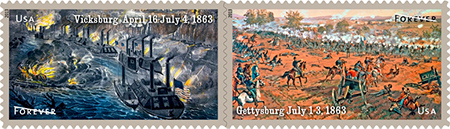
The ironclad fought at Forts Henry and Donelson , Island No. 10, and Memphis, and was badly damaged in a close action duel with the Confederate ironclad CSS Arkansas on the Yazoo River.  She was repaired in time to run the guns at Vicksburg in April 1863 (see U.S. Postage stamp shown below), and was also part of the Red River Fiasco (represented in the game by CSN Card 76).


USS Carondelet survived that disaster, and went back up the Cumberland in December 1864 to duel with Rebel artillery during the Nashville campaign – and later pouring heavy fire into the flank of John Bell Hood’s army when General Thomas counterattacked.  (Hood and his last, desperate effort to turn the tide are represented by CSN Card 89, which bear’s the luckless general’s name).


Thursday, July 25, 2013

The Ships of Rebel Raiders - The Ironclads

 Rebel Raiders on the High Seas is a strategic game of the Civil War which focuses on the role of the navies on the rivers, along the coasts and on the oceans.  While most ships are represented by generic counters for Ironclads, Blockade Runners, Gunboats, Screw Sloops and, of course Raiders, there are cards and corresponding counters for many individual vessels.  This series presents those cards and offers a glimpse into the history of these storied ships.

Part III – The  Rebel Ironclads: CSS Tennessee – “Old Buck” vs. Farragut

The CSS Tennessee (CSN Card 86 in Rebel Raiders) features in perhaps the most famous naval action painting of the Civil War:  the “Damn the Torpedoes” by William Heysham Overrend, or as it is formally known “An August Morning with Farragut: the Battle of Mobile Bay, August 5, 1864.

David Glasgow Farragut (a leader in Rebel Raiders and USN Card 1) is in the rigging of the USS Hartford (USN Card 37) as she fires a broadside into the CSS Tennessee, aboard which is Confederate Flag Officer Franklin “Old Buck” Buchanan (also a leader in Rebel Raiders).    Historians Craig Symonds, who wrote a biography of Buchanan, and James McPherson, who chose the Overrend painting as the cover for his new War Upon the Waters,  told an audience in New York last October that they believe Farragut and Buchanan actually saw one another through the smoke at that moment as depicted in the painting….and that Farragut’s “damn” comment (if he indeed said it) was directed as much at his Rebel nemesis as the naval mines (torpedoes) in the bay.

This was not the first time “Old Buck” had led a force into battle aboard an ironclad – he was aboard the CSS Virginia (CSN Card 70) the first day of the Battle of Hampton Roads (he was wounded, however, and was not aboard her the next day when his ship faced the USS Monitor (USN Card 19).  Buchanan climbed out of the safety of the ironclad to stand on her deck firing a musket at Union snipers – and was himself hit in the process. 

CSS Tennessee, like CSS Virginia, was designed to ram as well as to duel with Union warships.  Unfortunately, like so many Rebel ironclads, she had weak engines (as represented in the game by USN Card 47 – Engine Breakdown).  When “Old Buck” tried to ram USS Hartford at Mobile Bay, Captain Percival Drayton was able to maneuver out of the way – yet it was a close miss, for Drayton’s gunners were able to peer down into the hatches of the Rebel monster as they unleashed a mighty broadside into her.  Farragut himself was nearly wounded, as a rifleman aboard CSS Tennessee stuck out his gun and shot at the Union officer.  (As McPherson notes: “If the shooter had managed to hit him, Farragut would have been a martyred hero like Horatio Nelson at Trafalgar instead of merely the hero of Mobile Bay.”)


As CSS Tennessee slid past the Union flagship, Farragut ordered Drayton to turn and to follow her – and signaled USS Brooklyn (USN Card 13) to also engage her.   Buchanan managed to get his ship under the guns of Fort Morgan, but then turned around for another run at USS Hartford – two Union monitors (USS Manhattan and USS Chickasaw) intervened, pouring  solid shot from 15-inch guns and 11-inch bolts, respectively, into the ironclad.  The USS Winnebago, like USS Chickasaw a double-turreted monitor, joined in.  Pounded and rammed repeatedly by these five powerful Union ships, CSS Tennessee was reduced to a shattered hulk,  and “Old Buck,” similarly wounded, struck her colors.


Monday, July 22, 2013

The Ships of Rebel Raiders - The Ironclads

Rebel Raiders on the High Seas is a strategic game of the Civil War which focuses on the role of the navies on the rivers, along the coasts and on the oceans.  While most ships are represented by generic counters for Ironclads, Blockade Runners, Gunboats, Screw Sloops and, of course Raiders, there are cards and corresponding counters for many individual vessels.  This series presents those cards and offers a glimpse into the history of these storied ships.

Part III – Rebel Ironclads: CSS Ablemarle – “SEALS” vs. an  “Unsinkable Ram”

Though she bore only two guns – a pair of fine 6.4-inch Brooke Rifles mounted on pivots - the “unsinkable ram” CSS Ablemarle (CSN Card 75 in Rebel Raiders) was very well protected, with a thick bunker and iron shutters for her gun ports.  An officer aboard the USS Miami, one of a pair of double-ender Union gunboats the Rebel ironclad dueled on the Roanoke River in April 1864, reports firing over 30 shots at point-blank range into the armored beast – “but they had no effect on her.”   One of those shots was an explosive anti-personnel shell personally fired from the bow gun by USS Miami’s captain.  The shrapnel bounced off the armor and killed the Union officer.  His ship retired but its companion, USS Southfield, went down, holed by the CSS Ablemarle’s ram.   The ram then went on to support the Confederate ground attack to regain the town of Plymouth – the only such combined arms operation involving a Rebel ironclad in the war.

 A month later CSS Ablemarle broke out into the Sound for which she was named, only to be swarmed by six Union gunboats.  She took over 60 hits, but it was only when her smokestack was so badly damaged her engines could not draw oxygen that she turned back to Plymouth.  Fearful that she would emerge again, the Union developed a bold plan worthy of a WW2 commando raid or a modern SEAL team operation.

Lt. William Barker Cushing, renowned for several cutting-out expeditions (one of which had captured a Confederate general) developed a plan to plant a torpedo in her hull.  He and 15 men went up the Roanoke on the night of October 27, 1864 in a small cutter.  The guards on the ram spotted them and her gunners sank the cutter – but not before Cushing had planted his torpedo – which ripped a hole in the waterline “big enough to drive a wagon” through.


Sunday, July 21, 2013

The Ships of Rebel Raiders - The Ironclads

Rebel Raiders on the High Seas is a strategic game of the Civil War which focuses on the role of the navies on the rivers, along the coasts and on the oceans.  While most ships are represented by generic counters for Ironclads, Blockade Runners, Gunboats, Screw Sloops and, of course Raiders, there are cards and corresponding counters for many individual vessels.  This series presents those cards and offers a glimpse into the history of these storied ships.

Part III – The Rebel Ironclads: CSS Manassas  - Dewey and the 1st Rebel Ironclad

The cigar-shaped turtle-shelled iron-sheathed ram CSS Manassas (CSN Card 71 in Rebel Raiders on the High Seas) “amounted to the war’s first ironclad,” says Princeton professor and noted historian James McPherson in his new book, War Upon the Waters. 

The former Mississippi River towing boat was one of three ironclads the South was hurriedly constructing at New Orleans in the late winter and early spring of 1862.  When the Union fleet began to steam upriver, however, only one – CSS Manassas – was ready for action.  (CSS Mississippi was under construction and although CSS Louisiana was fully armed her engines were not working properly – so she was towed downriver to serve as an armored floating battery). 

On April 18 the Union began bombarding Forts Jackson and St. Philip, and on the 24th the West Gulf Squadron under Farragut (USN Card 1) aboard USS Hartford (USN Card 37) made its move.  The CSS Manassas went out to meet them, supported by half a dozen little gunboats and rams and some fire rafts.  Farragut saw the fearsome monster and signaled to Captain Melancton Smith aboard USS Mississippi (the largest ship in the U.S. Navy, and USN Card 23) to “run her down.”

In their game of “naval chicken” the commander of the ironclad blinked first, and as he veered off the mighty USS Mississippi riddled her with a broadside at 50 yards.  The solid shot pierced her boilers, and CSS Manassas caught fire and sank.

Little Known Fact:  conning the USS Mississippi was a young, 24-year-old lieutenant – George Dewey, of “You may fire when ready, Gridley” fame at Manila Bay in 1898.


Thursday, July 18, 2013

This day 150 years ago in Rebel Raiders’ History

-Dedicated to Civil War episodes, battles, people and ships that also appear in my game, GMT’s Rebel Raiders on the High Seas,  

July 18, 1863 – Glory: Admiral Dahlgren & the 54th Mass. at Battery Wagner

            Historical Event:  The gallant charge of the 54th Massachusetts, so poignantly portrayed in the movie Glory, took part on this day in 1863.  Rear Admiral John Dahlgren sent his ironclads and gunboats of the South Atlantic Blockading Squadron close in to support the attack on Battery Wagner on Morris Island in Charleston Harbor.  His ships  at times came as he notes in his memoirs within 300 yards of the fort.   

            To support the attack Dahlgren sent in ten ships:  six ironclads (USS Montauk, USS Ironsides, USS Kaatskill, USS Nantucket, USS Weehawken and USS Patapsco) and four gunboats (USS Paul Jones, USS Ottawa, USS Wissahickon and USS Seneca).

            Here, from his Memoirs, is Admiral Dahlgren’s account of what he witnessed that day:

            “The ironclads battered Wanger almost out of shape, and in the afternoon of that day the flag monitor ‘Montauk’ lay only three hundred yards from the sea-face of the work; not a gun was fired from it; not a head visible to my glass as I stood with other officers outside, watching the first symptom of renewed resistance.

            “Our column came up, but it was too dark to discern objects from the vessels, and after a fierce and resolute effort the column fell back with a loss of 1,500 men.

            “The assault could derive no aid from the fire of our guns, because it was impossible to distinguish our troops from the enemy.”   (Italics are Dahlgren’s).


            Game Connection:    John Dahlgren, one of the first admirals ever created for the U.S. Navy, has his own card (USN Card 31) in Rebel Raiders on the High Seas, and the revolutionary weapons he created (among them the Dahlgren gun) are also represented (USN Card 3 – Yankee Guns).  Both are important cards for a Union player who will need to send his fleets of ironclads and gunboats to destroy the batteries at Charleston to help clear the way for an assault – hopefully one that will end more fortuitously than the gallant but doomed charge made by the 54th on this day, 150 years ago.


Tuesday, July 16, 2013

The Ships of Rebel Raiders - The Gunboats

 Rebel Raiders on the High Seas is a strategic game of the Civil War which focuses on the role of the navies on the rivers, along the coasts and on the oceans.  While most ships are represented by generic counters for Ironclads, Blockade Runners, Gunboats, Screw Sloops and, of course Raiders, there are cards and corresponding counters for many individual vessels.  This series presents those cards and offers a glimpse into the history of these storied ships.

Part II – The Gunboats: The Mosquito Fleets Swatted:  Du Pont, Port Royal & Roanoke Island

“The Mosquito Fleet” (CSN Card 81) represents the rag-tag little squadrons the South hastily cobbled together to defend their ports from the Union Navy. While Montgomery at Memphis and “Old Buck” at Mobile put up grand if doomed fights (see my blog postings for July 15 and 16, respectively), the Mosquito Fleets at Port Royal and Roanoke Island never even had a chance.

The term “Mosquito Fleet” dates from the Mexican War, when the U.S. Navy formed a “Mosquito Division” of steam gunboats for coastal patrols and close in operations around Vera Cruz.   Its first known application in the Civil War came when a Union naval officer spied Commander Josiah Tatnall’s Rebel Squadron during the attack by the Navy in Port Royal Sound on November 7, 1861.  Tatnall, ironically, had commanded one of the ships of the “Mosquito Division” off Vera Cruz (USS Spitfire).

For the operation against Port Royal Captain Samuel Francis Du Pont  (represented in Rebel Raiders by USN Card 54) had amassed what historian James McPherson in his new book War Upon the Waters describes as “the largest fleet in American history to that time: seventeen warships with 157 guns, twenty-five colliers and supply ships, and thirty-three troop transports carrying 12,000 soldiers and 600 marines.”

(In order to place Du Pont on at least equal footing with the major general commanding the Army units, President Lincoln authorized his promotion to the rank of “Flag Officer,”  thus making Du Pont, the senior captain in the Navy, America’s first de facto admiral - he would eventually be promoted to rear admiral in July 1862.

Commander Josiah Tatnall had far, far less to defend Port Royal.  His small flotilla of six ships, most converted tugs, mounted less than a dozen guns among them – and weak guns at that.   Du Pont pealed off five of his gunboats to drive them back up the Beaufort River while his main battle fleet pounded Forts Walker and Beauregard into submission.

Three months later, another Mosquito Fleet tried to oppose the Union landings at Roanoke Island.  Captain William F. Lynch led eight small gunboats against Commander Stephen Rowan’s 13 much larger Union gunboats.  (These were part of Commander Louis M. Goldsborough’s flotilla that was supporting the landing by General Ambrose Burnside on the island).


Lynch sought to slow the Yankees with sunken hulks (similar to the Hulks, Rafts and Chains of CSN Card 110).  He fought valiantly, but briefly, and after one of his ships was sunk Lynch began to retire from the unequal contest.  Rowan, however, was not about to let him retreat.  He signaled his ships to “Dash at the enemy” and “dash” the Yankee gunboats did, chasing the Rebels up to Elizabeth City and the Dismal Swamp Canal, sinking six of the seven retreating Rebels in the process – thus in effecting “swatting” the mosquitoes by the very swamp from which they had spawned.


Monday, July 15, 2013

The Ships of Rebel Raiders - The Gunboats


Rebel Raiders on the High Seas is a strategic game of the Civil War which focuses on the role of the navies on the rivers, along the coasts and on the oceans.  While most ships are represented by generic counters for Ironclads, Blockade Runners, Gunboats, Screw Sloops and, of course Raiders, there are cards and corresponding counters for many individual vessels.  This series presents those cards and offers a glimpse into the history of these storied ships.

Part II – The Gunboats: The Mosquito Fleet- Montgomery at Memphis

“The Mosquito Fleet” (CSN Card 81) represents the rag-tag little squadrons the South cobbled together for the defense of Memphis and Mobile Bay.  Civilian vessels to which a gun or two and crew were hastily added, and to which bales of cotton, stacks of lumber or other makeshift defenses were added, these hopelessly outclassed and outgunned little ships and their brave crews performed far better than any could expect or demand. 

The two Confederate naval officers who led those forces --- Commander James Montgomery at Memphis and Admiral Franklin Buchanan at Mobile Bay – are both represented by stand-up Leader counters and Fleet Command Boxes on the lower left of the map.  (Players may take a stack of ships and place them in a Fleet Command Box and replace them on the map with the corresponding Leader – there are two such for the South, four for the North).

Montgomery had eight ships in his “Mosquito Fleet” at Memphis in June 1862.  Undergunned and underpowered, they were no match for Colonel Charles Ellet and his seven ships, which included five ironclads and two rams.   (Two of those ships, the  ironclad USS Carondelet – USN Card 15 – and the ram, USS Queen of the West – USN Card 38, are in the game).    Needless to say, Montgomery, though gallant, did not prevail.


Sunday, July 14, 2013

This day 150 years ago in Rebel Raiders’ History


-Dedicated to Civil War episodes, battles, people and ships that also appear in my game, GMT’s Rebel Raiders on the High Seas.  

July 13, 1863 merits a second entry (in addition to yesterday's post noting the start of the New York draft riots)...and ps: Happy Bastille Day!

July 13, 1863 – (Part II) – “Infernal Machines” Sink Union Ironclad

            Historical Event:    The ironclad USS Baron de Kalb was sunk this day 150 years ago by a Confederate “infernal machine” (a “torpedo” as they called it but what we today would dub a naval mine).   The ironclad was part of the Union force that captured Yazoo City  (on the river of the same name) during the mopping up operations that followed the surrender of Vicksburg and Port Hudson (see my blog entries for July 3 and July 8, respectively:    http://markgmclaughlin.blogspot.com/2013/07/this-day-150-years-ago-in-rebel-raiders.html   and http://markgmclaughlin.blogspot.com/2013/07/dedicated-to-civil-war-episodes-battles.html

            Game Connection:    Ironclads are vital to the Confederacy to defend its ports and for the Union to battle through the batteries, sink Rebel ships and clear the way for the Army to land during an assault in Rebel Raiders on the High Seas.   Whether fighting into an ocean port or up or down the Mississippi or Yazoo, the Union player does have to take into account that the Rebel player can play many cards to impede his progress.  One of those is Infernal Machines (CSN Card 56). 


Thursday, July 11, 2013

The Ships of Rebel Raiders - The Gunboats


Rebel Raiders on the High Seas is a strategic game of the Civil War which focuses on the role of the navies on the rivers, along the coasts and on the oceans.  While most ships are represented by generic counters for Ironclads, Blockade Runners, Gunboats, Screw Sloops and, of course Raiders, there are cards and corresponding counters for many individual vessels.  This series presents those cards and offers a glimpse into the history of these storied ships.

Part II – The Gunboats: USS Tyler


USS Tyler (USN Card 18).  A “timberclad” gunboat, the former river merchant ship from Cincinnati became one of the most famous ships in the Western Flotilla.  She participated in the bombardment of Forts Henry and Donelson, provided key gunfire support at Shiloh, fought at Island No. 10 and dueled with the ironclad CSS Arkansas.  USS Tyler survived that fight to take part in operations at Vicksburg and up the Yazoo and White Rivers into Arksansas.  Her last service was a mission of mercy, as she helped save the crew of the SS Sultana north of Memphis at the end of April 1865.


The Timberclad Takes on the Ironclad

In July 1862 the USS Tyler along with USS Queen of the West  and USS Carondelet (represented in Rebel Raiders by USN Card 38 and USN Card 15, respectively)  went hunting for the Confederate ironclad ram, CSS Arkansas.   Unfortunately, on July 15 they found her.  The USS Carondelet, being an ironclad, led the way – only to be disabled by the Confederate warship.  USS Queen of the West, a sidewheel gunboat also known as “Ellet’s Ram” was also knocked out of the action, leaving the timber-reinforced gunboat USS Tyler to duel with the iron monster all on her own.  The battle became a running fight down the Yazoo, as the USS Tyler sought and finally reached the protection of the Union fleet at the confluence of the Yazoo and Mississippi.  CSS Arkansas then broke off the action, and steamed on to Vicksburg, where she was welcomed with flags flying.