Showing posts with label navy. Show all posts

Wednesday, August 7, 2013

Kentucky in the Civil War: Speed Bump or Trap Play?

Rebel Raiders Strategy Question #1:

Kentucky in the Civil War:  Speed Bump or Trap Play?

At the WBC (World Boardgaming Championships) convention in Lancaster last week, I got into an interesting discussion about the role of Kentucky, most notably Louisville, in Rebel Raiders on the High Seas (as well as in other Civil War games and in history).   It began with this comment from my friend Evan:


“Why would any Rebel player in their right mind NOT invade Kentucky on turn one?”

In Rebel Raiders as in many Civil War games the South goes first.  That means it can get into Kentucky and take Louisville before the North, presenting the Union with a fait d’accompli.   In Rebel Raiders the South takes it by simply placing in Louisville one of the two batteries they can build in a turn.  The South then rolls two dice, and loses the difference in Victory Points.

Evan put forth the notion that this is a no-brainer move.  It is an “in-your-face” challenge to the Union to take this initially neutral city, and it blocks the Ohio – which means any Union warships built in Cincinnati cannot join the Union fleet on the Mississippi unless and until Louisville is taken.  In addition, he pointed out, it protects Nashville.

“What Rebel player in his right mind doesn’t take Louisville on turn one?” He reiterated.  I answered: “me.”

While Evan is not WRONG, I see Louisville not as a speed bump but as a trap play. 

First, the Union never has to take Louisville back from the South – not to win, not even to attack Nashville – which can be assaulted by hitting Forts Henry and Donelson out of Cairo.  So that means the battery may never fire a shot, and that he Victory Points lost will never be recovered.

Second, if the South does not take Louisville, the North might just be tempted to grab it – and that uses up one of their attacks (although in 1861 their attack odds are poor, they can still get lucky in a fight in an undefended port or fort space).  It also means the North has to roll two dice, and give the South the difference in the roll as Victory Points.  The maximum difference is only FIVE – but that is enough to build a Blockade Runner or Gunboat for the South.  It is as much as five Blockade Runners can bring home in a turn from going to any ports other than the two big European ones.

Third, the battery that is used to take Louisville for the South is better used anywhere else:  at Nashville or Forts Henry and Donelson, for example, or at Island No. 10 or Memphis – and that is just in that same theater of operations.  In addition, compensating for the Victory Points expended to take Louisville, as noted above, means extra work for the Blockade Runners – or, if the difference between the dice is the full Five, it means it cost the South a ship it could have built – either a gunboat for defense or a Runner to make points.

The Yankee Case: Louisville is an easy victory and a jumping off point.

There are, of course, those who see Louisville in a different light.  A Union Louisville does open up Cincinnati as an extra shipyard to build up the Mississippi Squadron more quickly.  It does threaten Nashville from the land side – which means the South has to worry about Tennessee being invaded from another direction, and if Nashville falls the North can immediately strike either Memphis or Chattanooga before the South can react (assuming the North took Nashville on its first attack of the two it gets each turn, or that the Union purchased or has cards that give it additional attacks).

Bottom Line:  Both Sides are Right

As in many games (and many wars) both sides make a good argument for why Louisville is or is not important.  Next time you play Rebel Raiders, which way will you jump?

(Photo below shows a Union Louisville - top center, yellow square with round blue marker with white star - and a Union controlled Island No. 10, with a fleet at Cairo.)


Monday, July 15, 2013

The Ships of Rebel Raiders - The Gunboats


Rebel Raiders on the High Seas is a strategic game of the Civil War which focuses on the role of the navies on the rivers, along the coasts and on the oceans.  While most ships are represented by generic counters for Ironclads, Blockade Runners, Gunboats, Screw Sloops and, of course Raiders, there are cards and corresponding counters for many individual vessels.  This series presents those cards and offers a glimpse into the history of these storied ships.

Part II – The Gunboats: The Mosquito Fleet- Montgomery at Memphis

“The Mosquito Fleet” (CSN Card 81) represents the rag-tag little squadrons the South cobbled together for the defense of Memphis and Mobile Bay.  Civilian vessels to which a gun or two and crew were hastily added, and to which bales of cotton, stacks of lumber or other makeshift defenses were added, these hopelessly outclassed and outgunned little ships and their brave crews performed far better than any could expect or demand. 

The two Confederate naval officers who led those forces --- Commander James Montgomery at Memphis and Admiral Franklin Buchanan at Mobile Bay – are both represented by stand-up Leader counters and Fleet Command Boxes on the lower left of the map.  (Players may take a stack of ships and place them in a Fleet Command Box and replace them on the map with the corresponding Leader – there are two such for the South, four for the North).

Montgomery had eight ships in his “Mosquito Fleet” at Memphis in June 1862.  Undergunned and underpowered, they were no match for Colonel Charles Ellet and his seven ships, which included five ironclads and two rams.   (Two of those ships, the  ironclad USS Carondelet – USN Card 15 – and the ram, USS Queen of the West – USN Card 38, are in the game).    Needless to say, Montgomery, though gallant, did not prevail.


Wednesday, July 10, 2013

The Ships of Rebel Raiders - The Gunboats

  
Rebel Raiders on the High Seas is a strategic game of the Civil War which focuses on the role of the navies on the rivers, along the coasts and on the oceans.  While most ships are represented by generic counters for Ironclads, Blockade Runners, Gunboats, Screw Sloops and, of course Raiders, there are cards and corresponding counters for many individual vessels.  This series presents those cards and offers a glimpse into the history of these storied ships.

Part II – The Gunboats: USS Unadilla : From Charleston Runners to Chinese Pirates

USS Unadilla (USN Card 17) was one of the first of nearly two-dozen of the “90-day gunboats” churned out by Union naval yards during the first months of  the war.  Built and launched in New York, the nearly 700-ton warship could move under steam or sail (as her sail plan was that of a two-masted schooner)  and could make 10 knots.  She carried five guns, including an 11-inch Dahlgren.  In January of 1862 she and USS Pembina fought a naval battle against five armed gunboats, three of which were damaged before the Rebels withdrew.


In addition to fighting other warships, bombarding forts and floating batteries and other combats, USS Unadilla captured many a blockade runner off Charleston, the Mary Teresa being her first catch in May 1862. (Hence her plus 2 advantage on the “Speed” die – which is rolled to intercept blockade runners.) Among her many prizes was the Princess Royal, which was carrying English-built steam engines for Confederate ironclads.   After the war the USS Unadilla was sent to the Far East to fight Chinese pirates.  Her last voyage was to Siam in 1868 – where after seven years in service the “90 day gunboat” was condemned as being too unseaworthy to risk a return voyage.


Friday, July 5, 2013

The Ships of Rebel Raiders - The Gunboats

  
Rebel Raiders on the High Seas is a strategic game of the Civil War which focuses on the role of the navies on the rivers, along the coasts and on the oceans.  While most ships are represented by generic counters for Ironclads, Blockade Runners, Gunboats, Screw Sloops and, of course Raiders, there are cards and corresponding counters for many individual vessels.  This series presents those cards and offers a glimpse into the history of these storied ships.

Part II – The Gunboats:  CSS Gaines

The CSS Gaines is the only Confederate gunboat with its own card (CSN 72) in Rebel Raiders on the High Seas.  Most Rebel gunboats had brief and unhappy lives, but the CSS Gaines is unique.  First, she was actually built as a warship; most other Confederate gunboats were, well, boats to which they stuck on some guns – or sometimes even just one gun.  Unfortunately, the shipyard at Mobile was under pressure and used unseasoned wood.  She was given high-pressure boilers that gave her some decent speed – even when the yard layered two inches of iron plating on her she could still make almost 10 knots.

(It is because of this iron-plating that the CSS Gaines is treated as an Ironclad during combat: see card below).


The CSS Gaines had a single eight-inch rifle and five 32-pound cannon.  Lt. John Bennett led her and his crew of 130 into battle in Mobile Bay in August 1864.  She took heavy damage and he had to run her aground off Fort Morgan in order to give the crew time to abandon ship.


Wednesday, July 3, 2013

This Day 150 Years Ago in Rebel Raiders' History

This day 150 years ago in Rebel Raiders’ History –
Hours to Remember: 10:30 am, 1 pm, 3 pm….Vicksburg & Gettysburg

-Dedicated to Civil War episodes, battles, people, and ships that also appear in my game, GMT’s Rebel Raiders on the High Seas,  

July 3, 1863 -  For the South, The Saddest Day

            Historical Events:   

Vicksburg. At 10:30  in the morning, Confederate officers approached the Union lines at Vicksburg under a white flag.  They carried a request from General Pemberton for terms.   Although famed in newspapers as  U.S. “Unconditional Surrender” Grant,  after responding with that famous phrase the Union commander DID grant terms:  Pemberton’s men marched out but after giving their parole were left to go on their way rather than be interred as prisoners of war.    Grant was not necessarily being a gentleman – neither he nor Admiral Porter had any way to transport let alone care for nearly 30,000 Rebel soldiers.

Gettysburg.  At 1 in the afternoon the Army of Northern Virginia began the greatest cannonade yet heard in the Western Hemisphere.  For nearly two hours over 150 guns unleashed their fire upon the Union lines on and behind Cemetery Ridge.  As the barrage lifted, General George Pickett and 15,000 men from three divisions began that epic charge which Faulkner romanced so well in Intruder in the Dust:

 For every Southern boy fourteen years old, not once but whenever he wants it, there is the instant when it's still not yet two o'clock on that July afternoon in 1863, the brigades are in position behind the rail fence, the guns are laid and ready in the woods and the furled flags are already loosened to break out and Pickett with his long oiled ringlets and his hat in one hand probably and his sword in the other looking up the hill waiting for Longstreet to give the word and it's all in the balance, it hasn't happened yet, it hasn't even begun yet, it not only hasn't begun yet but there is still time for it not to begin against that position and those circumstances which made more men than Garnett and Kemper and Armistead and Wilcox  look grave yet it's going to begin, we all know that, we have come too far with too much at stake and that moment doesn't need even a fourteen-year-old boy to think This time. Maybe this time with all this much to lose and all this much to gain: Pennsylvania, Maryland, the world, the golden dome of Washington itself to crown with desperate and unbelievable victory the desperate gamble, the cast made two years ago; or to anyone who ever sailed a skiff under a quilt sail, the moment in 1492 when somebody thought This is it: the absolute edge of no return, to turn back now and make home or sail irrevocably on and either find land or plunge over the world's roaring rim.


            Game Connection:   While Gettysburg does not appear on the map for Rebel Raiders, the Confederate invasion of Maryland and Pennsylvania is represented by the Lee Moves North card (CSN Card 77).  Vicksburg is on the map, and as noted in the July 1 post on this blog, many of the ships and generals and weapons take took part in that epic siege are represented by cards.  The loss of Vicksburg costs the Confederacy dear in Rebel Raiders, especially if Memphis and New Orleans have also fallen, as that triggers major victory point losses for the South at that instant, and during the supply phase of each subsequent turn.


Tuesday, July 2, 2013

The Ships of Rebel Raiders - CSS Robert E. Lee

The Ships of Rebel Raiders   -  CSS  Robert E. Lee

Rebel Raiders on the High Seas is a strategic game of the Civil War which focuses on the role of the navies on the rivers, along the coasts and on the oceans.  While most ships are represented by generic counters for Ironclads, Blockade Runners, Gunboats, Screw Sloops and, of course Raiders, there are cards and corresponding counters for many individual vessels.  This series presents those cards and offers a glimpse into the history of these storied ships.

 CSS  Robert E. Lee (CSN Card 69)  began her career as a blockade runner in  the fal of 1862.  For nearly a year the schooner-rigged, iron-hulled, oscillating-engine, double-stack paddle-steamer ran in and out of North Carolina’s inlets and harbors to bring in war materials and other desperately needed supplies.

Built in England as the merchant ship Giraffe, unlike most blockade runners which were either owned by private individuals or commissioned by the states, the Robert E. Lee was part of the regular navy – hence the CSS before its name.   Among the more important of its 21 voyages was a trip to Halifax to deliver cotton and a number of key passengers, including 20 naval officers destined to serve aboard other blockade runners and raiders.  Her frequent runs, however, were between Bermuda and Wilmington.

Naval officer Lt. Richard H. Gayle took command in May 1863 and eluded capture several times, but on November 9, 1863 his ship was finally run down off the North Carolina shore by a pair of Union warships:  USS Iron Age and USS James Adger.  The Navy took her as a prize, armed and rechristened her USS Fort Donelson and put her into service on the blockade.


Monday, July 1, 2013

This day 150 Years Ago in Rebel Raiders's History

 This day 150 years ago in Rebel Raiders’ History
Gettysburg, Vicksburg and the Ships of Rebel Raiders.

 -Dedicated to Civil War episodes, battles, people and ships that also appear in my game, GMT’s Rebel Raiders on the High Seas,  Gettysburg, Vicksburg and the Ships of Rebel Raiders.

On this, the 150th anniversary of the First Day of Gettysburg, it is easy to forget that at Vicksburg an equally vicious and vital struggle was also reaching its climax.  

As a strategic naval game, Rebel Raiders on the High Seas focuses far more on the epic siege of the fortress on the Mississippi than on the titanic contest that was played out on the fields of Pennsylvania.   The later is represented by the Lee Moves North card (CSN Card 77), while many of the leaders and great ships who fought at Vicksburg are also represented, notably: 

 -David Dixon Porter & His Little Mortar Boats (USN Card 2),
 -Grant Takes Command (USN Card 8),
-the tinclad gunboat USS Black Hawk (USN Card 10), 
-the "Pook's Turtle" ironclad USS Carondelet (USN Card 15), 
-the timberclad gunboat USS Tyler (USN Card 18),
-the phony ironclad Black Terror (USN Card 25)
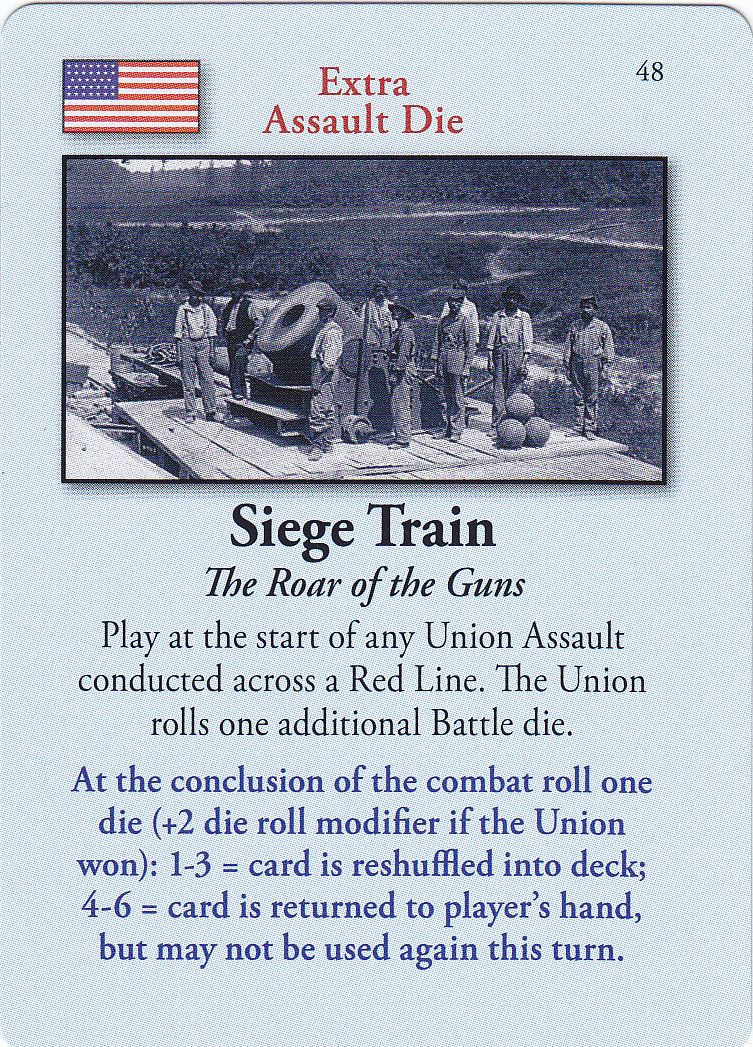
-the big guns of the Siege Train (USN Card 48),

-and, for the South:

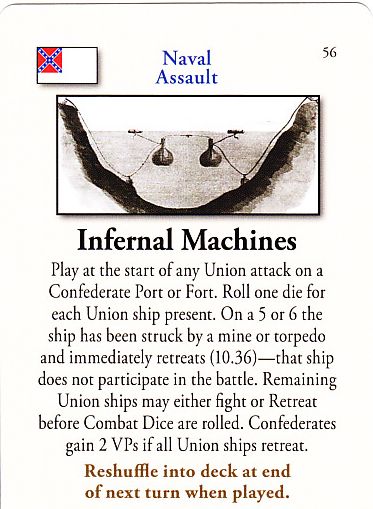
-the mines, torpedoes and other Infernal Machines (CSN Card 56),
-the general who tried to relieve the city, J.E. Johnston (CSN Card 91)
-the hidden batteries on the bluffs of Ring of Fire (CSN Card 101),


--and the only ship to see action on BOTH sides at Vicksburg:
--“Ellet’s Ram” USS Queen of the West (USN Card 38)– which was captured and put into service by the Confederacy as CSS Queen of the West


Friday, June 28, 2013

The Ships of Rebel Raiders   -  The Banshee

Rebel Raiders on the High Seas is a strategic game of the Civil War which focuses on the role of the navies on the rivers, along the coasts and on the oceans.  While most ships are represented by generic counters for Ironclads, Blockade Runners, Gunboats, Screw Sloops and, of course Raiders, there are cards and corresponding counters for many individual vessels.  This series presents those cards and offers a glimpse into the history of these storied ships.

The Blockade Runners – The Banshee


The Banshee (CSN Card 68) was one of the first ships built specifically to run the Union blockade.  She was also one of the first commercial vessels to build of steel.

 Under Joseph W. Steele the ship made eight successful runs, giving her owners their investment seven times over.  After a transatlantic maiden voyage in April 1863, most of her runs were from Bermuda or the Bahamas into Wilmington, where she was caught later that year on her ninth and final run by the USS Grand Gulf.  Taken to New York as a prize, she was purchased, armed and rechristened by the U.S. Navy as the gunboat USS Banshee, under which name she joined the blockade in Chesapeake Bay.


Saturday, June 22, 2013

Musing on Victory – and the “immersive experience” of playing Rebel Raiders or

“ I Think Mahan Himself Would Have Heartily Approved”

By Brandon Musler

On the Design:  a “CFG” (Card Flavored Game) vs a CDG (Card Driven Game)

Overall, I was amazed by how immersive an experience playing Rebel Raiders could be. Normally, I do not favor CDG  (Cared Driven Game) designs, and I really like this new thing called a CFG  (Card Flavored Game) because it had its priorities in order: play mechanics informed and spiced up by cards.  I also liked that there were endless decisions to make, and you could recover from mistakes.

 I thought the whole brown water navy aspect to things was brilliantly conceived and designed -- it fascinated me how the designer encapsulated the entire western theater by blending a point to point subsystem with a CDG dynamic.  He really, really distilled a crucial dynamic of the land campaigns in the ACW...in a game primarily focusing on the naval war.  I think Mahan himself would have heartily approved...but more importantly I feel I gained some crucial insights into a subject that I've never really been able to get my arms around before, despite reading Shelby Foote et al! And of course there was learning about the whole mercantile war via the raiders and runners.   

Union Play

First time players really ought to take the Union side because although the choices seem a bit overwhelming in the first half of the war, the enormous power of the Union industrial base makes it relatively easy to recover from a myriad of mistakes and power to victory in 1863 and 1864...or once Grant is on the board.  In other words, in the basic game we played (or without any of the many optional rules) it is a lot harder for the CSA player to keep morale up and get it right...

In the first year of the war when the Feds are down a die,  (and maybe the second when the odds are even,) it's probably a good idea to use Union attacks to take undefended port cities via amphibious assault. (The designer hinted at this repeatedly during our play, I believe, but I didn't hear it at the time.)  The risk is relatively low and late in the game it will leave the door open to pursue the maximum territory approach to victory.
 
Late in the game the designer reminded me that  the
Union need not take Richmond to win, provided it has 16 other cities (including Atlanta and the three on the Mississippi, which I did have).  At that point, however,  I had only half of turn 11 and turn 12 ahead of me, and would have had to shoot a 100% from the foul line (6 for 6, I think it was) so I chose the "On To Richmond!" path four years late...and then I got really, really lucky with Jackson getting killed etc...
 
 Final Thought:  Great Fun to Play


It was great fun to play, and refreshingly enlightening...pretty much everything I could expect out of historical board game. 

Monday, June 17, 2013

This day 150 years ago in Rebel Raiders’ History

-Dedicated to Civil War episodes, battles, people and ships that also appear in my game, GMT’s Rebel Raiders on the High Seas,  

June 17, 1863 - Maiden voyage – and death ride – of the mighty CSS Atlanta.

            Historical Event:  The ladies of Savannah sold their family silver and jewels to pay for the transformation of the blockade runner Fingal into the mighty ironclad CSS Atlanta, (see picture below, courtesy Navy Historical Society) and they stood waving on the shore as she came down the Savannah River on her way to break the Yankee blockade.  The ironclad ram, fitted with a torpedo spar and four big guns looked imposing – but her engines, sadly, were not up to the task of navigating Wassaw Sound.  As she struggled to free herself from a sandbar, the Union monitors USS Weehawken and Nahant pounced.  The former’s 11-inch Dahlgren’s pounded the helpless Rebel warship, whose crew, though brave, proved no match for the Yankee Guns.


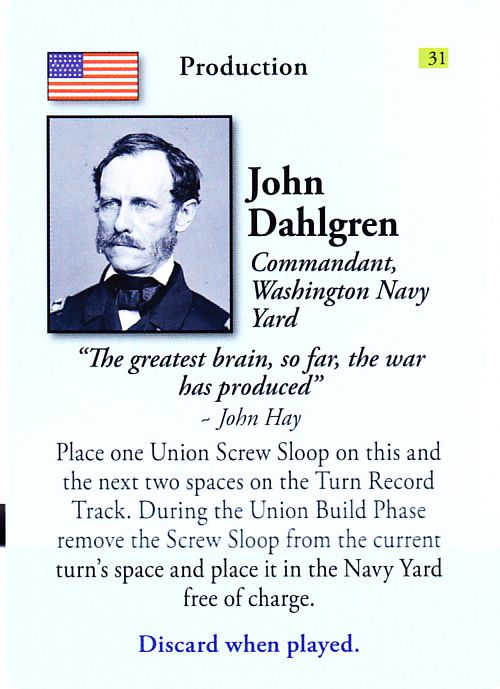
            Game Connection:  Confederate ironclads were notoriously underpowered, and that is reflected by USN Card 47 (Engine Breakdown).  Admiral Dahlgren, as commandant of the Navy Yard (which appears on the top right of center on the map) helped develop and produce powerful weapons which bore his name – as noted in USN Card 31 (John Dahlgren) and USN Card 3 (Yankee Guns).


Sunday, June 16, 2013

Rebel Raiders Replay  (Turn 10 –April 1864) -The Alabama and "Damn You, John Wayne"

Designer Mark McLaughlin as CSA; Naval Historian Brandon Musler as USA

When last we saw our valiant gamers at war, the North had swept the seas of Blockade Runners and had every Raider covered and surrounded.  Forts Jackson and St. Philip, the gateway to New Orleans, was burst open, but despite a massive force of Ironclads the Union could not blast away the Batteries at Memphis and assaults there and at Atlanta were both repulsed – narrowly, in ties, but repulsed still.

The South Holds and Now Alabama is in Play!

Although the old Blockade Runner fleet is no more, there are four new ones to try to bring home the desperately needed Cargo, along with five Raiders – four at sea and the Alabama ready to join them.

CSS Alabama is represented by a counter and a card (63).  Raiders get a plus 3 to the Speed Die Roll – making them hard enough to catch as it is – but Alabama gets one better!   There may be four Union Screw Sloops waiting off the Spanish port where Alabama has been readied for her maiden voyage, but Confederate confidence is high.

“Raphael Semmes is a Pirate We Say…”

Alabama was captained by the legendary Raphael Semmes, who had commanded the very first Raider (and only one to be armed in the South).  The Raider that begins the game in New Orleans at set up, is that vessel, the Sumter.   Unlike the real war, Sumter was caught on turn 1 (see turn one replay).  This time, however, Semmes has a better ship.

….unfortunately, Mark rolls a “1” when Alabama comes out to sea.  This is modified to a “5” – and while three of the four Union Screw Sloops roll less than that, one gets a “6” – and worse, it is no less a warship than USS Mississippi (Card 23), which, as the card correctly denotes, is the “Largest Ship in the U.S. Navy.”

Naval combat ensues.  Raiders get a single die, Screw Sloops two – although with Yankee Guns (Card 3) giving a re-roll of one die, this effectively gives the USS Mississippi a three-to-one dice advantage.  Worse, the most Alabama can score with her one shot is one hit – and Mississippi can ignore one hit in a battle.   Semmes’ only hope is that the Union ship misses and Alabama can then retreat and slip off into the night…

So how did the battle go?   Here is the song Brandon made up on the spot:
“Raphael Semmes is a pirate we say!
And we can prove it with his dead bo-day!”


More Bad News for the Confederate Navy

Their hearts broken by the demise of their hero and his fateful ship, the remaining four Raiders manage to scare up a mere two VP.  The four Blockade Runners fare worse: two get through with one VP each, and two others are captured.

Damn You, John Wayne.

In April 1863 Grant directed a Union colonel to take a brigade of cavalry behind Rebel lines to tear up railroads and burn supplies.  Grierson’s Raid was quite successful and one of the books written about it became the inspiration for the John Wayne 1959 movie, The Horse Soldiers.   Card 42 bears the same name.   Brandon plays it successfully at the start of the Confederate Turn 10 Build Phase, and as a result the South will build one fewer Battery this turn….

That single Battery goes – where else, but New Orleans.  Mark builds one Raider and buys a Counterattack, suspecting he will need it.


Thursday, June 13, 2013

 Rebel Raiders Replay  (Turn 8 –August 1863; Part II - The Union Turn)

Designer Mark McLaughlin as CSA; Naval Historian Brandon Musler as USA

When we left off, Mark was lamenting that Brandon was sinking Blockade Runners as fast as the South could build them, yet thanks to Cotton is King (Card 87) the remaining Blockade Runners managed to deliver a dozen victory points, to which the Raiders contributed another four.  Mark placed batteries in Chattanooga and Atlanta, expecting Brandon to build on his success at Nashville and strike at the heart of the Confederacy.

Grant Heads South(east)

Piqued that the South managed to get as much Cargo through as it did, Brandon sends his Gulf Squadron roaring into Galveston – wanting the Blockade Runner sitting there as much as he wants the city itself; he gets both and knocks the South down twice in Victory Points  (VPs) (from the victorious assault and the bonus die roll for taking the city).

That little bit of administrative tidying up done with, he plays All the World’s A Stage (Card 39) which allows him to draw two cards at random from the Rebel hand; one of which he must return but discard the other – in this case, the powerful Rebel Yell (Card 98) which would have given Mark three bonus cards.

Chattanooga beckons, and using the Siege Train (Card 48) to add a fourth die and Union tactics (giving up two of those dice to gain a plus 2 advantage to his highest die) Brandon  attacks!  What would have been a tie (and thus a Union repulse) is saved by Grant (Card 8) who by virtue of his re-roll snatches victory from the jaws of defeat – and the city falls.  Again, the South loses precious VPs both from the battle and from the loss of the city.  

The South takes some (very) small Southern Comfort as the Union fails the die roll that would have allowed Brandon to keep the Siege Train card, and back into the deck it goes.

 Hardly pausing to shrug off this minor disappointment, Brandon presses on to attack the undefended space at Kennesaw Mountain, which easily falls – and this costs the South a pair of VPs due to the difference in battle dice.  This space is important, as it is adjacent to Atlanta – the jewel and iron foundry of the South.  Its loss would be dearly felt by the Confederacy, for so many reasons.

Brandon places the two Ironclads he built last turn in the Union river ports, along with the free gunboat the North gets there each turn, and places the two Screw Sloops he also built last turn, along with a free gunboat, in the Navy Yards.  He buys TWO extra Attack Pawns – meaning he will be able to conduct FOUR Assaults next turn.


To be Continued….


Thursday, June 6, 2013

Rebel Raiders Replay  (Turn 6)
Designer Mark McLaughlin as CSA; Naval Historian Brandon Musler as USA


When we left off last time, the Union blockade had become so formidable that nearly half of the vessels trying to run it were caught - most with their cargo.  The net suitably tight, now the North is starting to send out packs of screw sloops to hunt down Raiders....

Four more Blockade Runners go down --- Brandon is capturing them faster than the South can build them.  Twelve victory points are acquired by the South this turn, bust mostly from Raiding, not Running.  Memphis is strengthened by the Gunboat the South built last turn (which was built in Vicksburg, as I failed to mention, as an Ironclad appeared in Memphis last turn and the South may only place one ship per port per Build Phase, other than through card play).

Beauregard (Card 88) again appears, with that blessed third battery, and Nashville and Memphis are now brought up to full strength with three batteries each, and another is placed in Richmond, just to safeguard the capital.   The South builds four Blockade Runners, one for each lost this turn, and builds a Gunboat in Memphis.

Brandon decides it is time to start chipping away at the Atlantic, and goes for an Amphibious Assault on Wilmington.  His fleet of four Gunboats and the Screw Sloop Brooklyn (Card 13) gets a surprise as the Ring of Fire (Card 101) adds a second battery to the defenses…although Mark rolls horribly (even with the bonuses from the card) and sinks only one Gunboat, Brandon backs off rather than take on two batteries with his under-gunned force.

Diplomatic Pressure  (Card 55) is applied through the card of the same name, which sends the Trent and Royal Navy (Cards 83 and 62) to the Discard Pile - this frees up the three screw sloops that were on the later card, giving the North yet more big warships to go a'Raider-hunting.

Brandon buys an extra Attack for next turn, as well as another Ironclad and some Gunboats.   Turn 7 apparently is going to be the start of the "big push," as it will be 1863 - which means the North increases its attack dice from two to three - giving it the edge on the South, which remains at two.  The Union is learning the art of war...and how to use its massive industrial base to powerful effect.

Images below:  The big map situation early in Turn 6, before the Union play...


...and some of the cards played on Turn 6....


Friday, May 31, 2013

Rebel Raiders Replay  (Turn 2)
Designer Mark McLaughlin as CSA; Naval Historian Brandon Musler as USA

When we last left our plucky warriors, the South had taken Louisville and strengthened Wilmington, and had a fleet of Blockade Runners ready to race in to deliver their cargo…

Turn 2- August 1861

Although one Blockade Runner is caught, the rest scurry through to unload 16 VPs of cargo – truly an auspicious beginning to the Southern “happy time.”  (If the South can’t make the VP in these early turns, they never will). Confederate Batteries are placed in New Berne and Key West, an aptly named “key” port as it allows Blockade Runners from all directions a refuge – and is a short hop for in-and-out runs to the many nearby foreign ports. Four Blockade Runners and a Raider are built.

The North decides that despite the poor odds the Union will try to take Louisville:  even with the South rolling three dice (two for being Southern, one for the battery) vs. his one die, the first attack is a close run thing, but the Union loses by 1 and gives the South a VP.  Second attack, however, is a rout:  a difference of 5 on the dice – and a corresponding gain of 5 VP for the South.

Brandon takes this as corroborative evidence of his being correct in the initial assumption that attacking this early was not a good idea.   He spreads out some gunboats, sliding down the coast to set up the inshore blockade, with Screw Sloops in the outer blockade.  A thin line, but a lengthening lasso nevertheless, as there is now only one port on the entire Atlantic coast that does not have at least one Yankee ship in its Blockade Station.. 

Brandon plays Card 31 – John Dahlgren for free Screw Sloops and Yankee Guns – and builds 2 Ironclads and a gunboat.


To be continued…..


Wednesday, May 29, 2013

This day 150 years ago in Rebel Raiders’ History

-Dedicated to Civil War episodes, battles, people and ships that also appear in my game, GMT’s Rebel Raiders on the High Seas.


Silly Ships of the Civil War: The “Double-Ender” Gunboat Design Pays Off

May 29, 1863

            Historical Event:  The “double-ender” gunboat USS Cimarron captured the Confederate blockade runner Evening Star as she tried to slip through the close-in blockade of Wassaw Sound, Georgia.   The “double-ender” sidewheel design incorporated a rudder at each end so the ship could go in either direction without having to turn around.  They were designed specifically for service in narrow inland waterways.
            The USS Cimarron was constructed in New Jersey and outfitted at the Philadelphia Navy Yard in 1862.  The 860-ton vessel could only make 10 knots, but carried a powerful arsenal of eight guns:  six 24-pound howitzers, one 9-inch smoothbore and one 100-pound rifle.  She participated in several engagements and caught three blockade runners during her service, the first of which was the ill-fated “Evening Star” she took as a prize on May 29, 1863.

            Game Connection:   The Confederate player relies on his Blockade Runners to bring in cargo that translates into badly-needed Victory Points.  These points are vital to Southern production, as they can be traded in for the additional ships, batteries, cards and counterattacks needed to match the growing industrial behemoth of the North.   Gunboats play a key role in making it more difficult for these ships to deliver the goods, as gunboats can stack up in the Blockade Stations, thus increasing the odds of intercepting the Rebel vessels as they try to enter and then leave Rebel ports.

USS Cimarron, courtesy U.S. Naval Historical Center.


Thursday, May 23, 2013

PBS Airing Rebel, About a Confederate Female Soldier Turned Spy -
-and there are spies for both sides in Rebel Raiders on the High Seas

One of the perks of being a journalist is previewing television shows for PBS, and today on Examiner.com I posted one for Rebel, which airs tomorrow (Friday, May 24) at 10 p.m. on most PBS stations.

Told through dramatic re-enactments Rebel is the true story of Loretta Velazquez, "an Hispanic woman in a white man's war" as she described herself in her memoir, A Woman in Battle, first published in 1876 (and still in print).    Donning her late husband's uniform she enlisted as a lieutenant in the 7th Louisiana and fought at both Bull Run and Shiloh.  She later became a spy for the Confederacy - and eventually may have been turned into a double-agent by the Union.

Two well-known female spies of the war appear on cards in Rebel Raiders:  actress Pauline Cushman (USN Card 39: "All the World's a Stage) and Rose O'Neal Greenhow (CSN Card 82: "A Rose by any other name...")

For more on Rebel, follow the link below to my article:  (the illustration below is of actress Romi Dias, who plays Loretta Velazquez in Rebel; photo courtesy of PBS Voces).

http://www.examiner.com/review/rebel-an-hispanic-woman-a-white-man-s-war-premieres-on-pbs


Monday, May 13, 2013


Boardgamegeek hails Rebel Raiders as: “A design that is well worth getting into”

“Rebel Raiders is a game I definitely enjoyed playing,” says noted Boardgamegeek reviewer Marco Arnaudo in a video tour of the game he posted on that site over the weekend.

“It is not complicated but it is complex, in the best sense of the word” says Arnaudo, explaining that by complex he means the “challenges and dilemmas that both sides have to face constantly.”

To watch the nearly 20 minute review, which includes examples of game play and strategy, go to:


Sunday, May 12, 2013

An Example of Battle:  Farragut takes on the Rebel Ram Manassas

Here is what a bad day for the Union looks like:  Farragut with only three ships has bulled his way into a port.  The Union uses its one screw sloop to protect one of his two gunboats (gunboats are easily sunk)...unfortunately, not only has the Union chosen to attack a very well defended target (this is about as strong as a defense can get) but the Confederate player has decided to really make the Union pay for it - playing both "Hulks, Rafts and Chains" which adds even more dice and having sent in the Manassas - a ram which he used to target a Union ironclad (not shown as the ram SANK the ironclad)....even with "Damn the Torpedoes..." the Union here is pretty much "damned" - and will retreat with his single surviving ship, the gunboat, thus at least saving Farragut himself....


Saturday, May 11, 2013


Rebel Raiders Rule Book Posted!

Want a closer look at how to play Rebel Raiders on the High Seas?  GMT has posted the rule book on its website for my game:

http://www.gmtgames.com/p-238-rebel-raiders-on-the-high-seas.aspx

You can browse the site and read strategy, historical and replay articles and other material, or you can go directly to the Final Rules link:  
http://www.gmtgames.com/rebelraiders/RebelRaiders-RULES-FINAL.pdf

Thursday, May 9, 2013

Our First Major Review - Boardgamegeek says Rebel Raiders is FUN!

Boardgamegeek gave Rebel Raiders a "thumbs up" and said many nice things about the game....notably that "it was fun"

Here are some excerpts:
-Fun (and no "rules issues we couldn't find an answer for")

Unlike most first-play wargames, when packing up the game we marveled over the fact that hadn't run into any rules issues which we couldn't find an answer for in the rulebook (sometimes it took a little digging, though!) before the end of play. That's a uncommon occurrence for any game, wargames especially.

... and a seldom-talked about aspect of wargames, it was fun. I found myself grinning as I caught up blockade runners in dragnets, groaned as raiders slipped through, and rubbed my hands together in Machiavellian glee at a particularly well timed Assault with several applicable card supplements. 


-"A solid, well-designed game with a high fun factor":


This is a pretty solid, well-designed game with a high fun factor and asymmetrical challenges for the Union and Confederate players. It's quick (plays in three hours), easy to play (once you get the rules down) and has a fair amount of colour (I wouldn't call it "chrome") in the rules and the play of cards. Both sides have difficult choices to make on how to pursue overall strategy as well as how to spend resources and cards on individual campaigns and battles.


So, should I buy it?

Short version: You're a naval warfare fan? Yes. American Civil War fan? Probably, unless you really don't like naval warfare or less "simulative" games. General wargamer - yes, if you're looking for a short, simple game that also explores a unusual and little-known side of the ACW. Caveat: it's "evocative", not "simulative".


A grateful thanks to Boardgamegeek from all of us on the Rebel Raiders team...

For the full review go to their website:  
http://boardgamegeek.com/thread/974540/first-impressions-after-truncated-introductory-gam