Showing posts with label Admiral David Glasgow Farragut. Show all posts

Monday, August 4, 2014

Farragut At Mobile Bay 150 Years Ago: "Damn The Torpedoes!" - Fact or Legend?

Farragut At Mobile Bay 150 Years Ago: "Damn The Torpedoes!"  - Fact or Legend?


The ironclad monitor leading one column into Mobile Bay hit an underwater mine, exploded, and sank in under a minute.  The "unsinkable" wooden man-o-war leading the other column reduced speed to avoid striking similar "infernal machines" -  all while gunners in Fort Morgan and two other harbor forts began ranging in on the remaining 13 Union warships.  His ships being pounded, and the mighty Confederate ironclad ram CSS Tennessee and her consorts steaming toward the fleet, Admiral David Glasgow Farragut ordered his captains to "Damn the Torpedoes" and go "Full speed ahead."

That, at least, is how the legend goes.

Or maybe that is not exactly what happened, says Civil War historian, Pulitzer Prize-winning author and professor emeritus at Princeton James McPherson.

As he noted in his latest book, War Upon the Waters, and reiterated in a talk at the New York Historical Society two years ago,  Farragut might - or might not have said exactly those words.. Even if he did, says McPherson, the "damn" part might very well have been an exclamation of surprise (or a curse).   

Other source report that Farragut remained extraordinarily cool, and that "Damn the Torpedoes" Full speed ahead" is an abbreviated version of a a much longer statement, a clear set of orders to the captain of the USS Hartford (Captain Percival Drayton) and the commander of the gunboat USS Metacomet, James Edward Jouet, which was lashed to the far side of the larger warship to give it some protection from the Rebel shore batteries.

"Damn the Torpedoes! Four bells, Captain Drayton! Go ahead. Jouett, full speed!"
Again, there are conflicting reports about whether the "go ahead" was part of the command to Drayton or to Jouett, although it seems more likely that command was meant for the later, as it directed him to separate from the protective shield of the USS Hartford, thus freeing him for action.

Then, again, as McPherson muses, it might all just be a combination of what officers and men present on the deck THOUGHT they heard - and with mines exploding, ships sinking, shells blasting overhead, engines churning and guns roaring on both sides, who can be certain what anybody said?

Whatever he really did say, or how he phrased it, Farragut did get his fleet moving from underneath the batteries and into the bay, where they could engage the Rebel flotilla and direct their broadsides at the Confederate ships and forts.   The attack started out looking bad for the Union, but by the end of the day, Farragut had won the U.S. Navy's greatest victory of the American Civil War.

Rebel Raiders on the High Seas allows players to recreate this epic fight at the strategic level, with ships and cards and counters for the forts, ironclads, warships, admirals and even the "torpedoes" that Farragut allegedly damned that day 150 years ago.


Tuesday, July 29, 2014

150 Years Ago: Two Weeks That Doomed the Confederacy


Late July – Early August 1864:  Atlanta, The Crater and Mobile Bay

Historical Event:   If July 1863 was the turning point that showed the South could not win the Civil War, late July-early August 1864 was the turning point that showed it was doomed.  Hood’s incredibly wasteful offensives around Atlanta, the carnage of the Crater at Petersburg – where Lee’s army was finally immobilized by chaining itself to Richmond- and, finally, Mobile Bay, where a triumphant Union Navy damned the torpedoes, stormed past massive forts, battled a monster ironclad and brought a great port city to its knees.

Game Connection:  Rebel Raiders on the High Seas focuses on the naval aspect of the Civil War, but also represents the land campaign, albeit in a more abstract way.  Thus the battles around Atlanta and the siege of Richmond can be fought with cards and dice, and Mobile Bay can be played out in the game – complete with a card with Admiral David Glasgow Farragut’s famous phrase (which according to historian James McPherson he may or may not have actually said) and cards and counters representing the great sailor, his rival, Confederate Admiral Franklin Buchanan, and some of their mighty ships (Farragut’s flagship, USS Hartford; Buchanan’s own ironclad ram, CSS Tennessee;  the giant “unsinkable” screw sloop USS Brooklyn,  and the armored gunboat CSS Gaines but to name a few).


Many stories of those ships, and of Farragut, Buchanan, their encounter at Mobile Bay have appeared before in this blog over the last year, and more will appear again – especially on the date of the 150th anniversary of their epic contest of August 5, 1864.


Sunday, June 8, 2014

Happy 201st Birthday, Adm. David Dixon Porter

Happy 201st Birthday, Adm. David Dixon Porter


Admiral David Dixon Porter would be 201 today.   The storied Union naval officer and Civil War hero is represented by both a counter and a card in my strategic naval game of the Civil War – Rebel Raiders on the High Seas. Judicious use of USN Card No. 2 “David Dixon Porter & His Little Mortar Boats” can greatly ease the Union Navy’s attacks into Confederate river and ocean ports.

Porter is USN Card No. 2 because he was the second officer to attain the rank of rear admiral in the Union Navy.  David Glasgow Farragut was the first – and hence he is on USN Card No. 1 (“Damn the Torpedoes…Full Speed Ahead”) – a little inside joke of mine.  Porter was also the adopted brother of Farragut, and their sibling rivalry was infamous.  Farragut also appears on USN Card 33 – “The Grand Fleet,” a card which allows the Union to stack 10 warships instead of the usual maximum of 6.  Porter, alas, being the junior of the two admirals/brothers, is limited to the lesser number.

Porter, however, made many contributions to the war effort and is also remembered by USN Card 25 – “The Black Terror.”  Although not listed on the card, it was his idea to build the phony ironclad that so frightened the Rebels on the river.

Porter and his mortar boats were vital to the Union victory at New Orleans (where he served under his elder brother), and to the first naval attack on Vicksburg (where he again served at his brother’s side).  Porter was promoted to a command of his own, leading the Western Gunboat Flotilla – renamed the Mississippi River Squadron – during the Vicksburg campaign.  He was named “acting” rear admiral in recognition of his role in its capture. 

The importance of Vicksburg is noted in Rebel Raiders, as it is one of the critical victory cities the Union needs to take to win the game.

Porter also took part in the abortive Red River Campaign (which is represented in the game by CSN Card 76 – “Red River Fiasco”).  It is a Rebel card because it was such an ill-conceived plan that no Union player in his right mind would willingly attempt it.

Porter redeemed himself by saving his fleet from disaster on the Red River (thanks to an Army engineer who built a damn to float his ironclads over the rapids to safety) and again by leading the naval forces that pounded and helped capture Fort Fisher in January 1865. 


After the war, Porter went on to become superintendent of the U.S. Naval Academy.   In 1866 Farragut became the nation’s first full admiral, and Porter became its first vice admiral – and when Farragut died, Porter was promoted, becoming the nation’s second full admiral.   He died in 1891 at the age of 77.


Friday, October 4, 2013

The Ships of Rebel Raiders – and their “Yankee Guns”


 Rebel Raiders on the High Seas is a strategic game of the Civil War which focuses on the role of the navies on the rivers, along the coasts and on the oceans.  Those ships carried a wide variety of weaponry, but among the most popular, at least on the Union side, were the storied Dahlgren smoothbores.  These mighty weapons which could hurl a 130-pound shot almost a mile were the mainstay of the fleet, and along with Parrot Rifles and other big cannons are represented in the game by the “Yankee Guns” of USN Card Number 3.


The inventor of the Dahlgren gun is also in the game: Captain (later Admiral) John Dahlgren,  (USN Card 31, which bears his name), as are many of the ships he armed and later commanded.  Dahlgren chaffed at the bit for years, being told he was too valuable in Washington and was a desk not blue water sailor – a jibe he proved wrong after taking over the South Atlantic Squadron from Samuel Francis DuPont (USN Card 54) off Charleston in 1863.   Although known as the “father of naval ordnance” he showed himself every bit the sea salt of his contemporaries, becoming one of the first five admirals of the U.S. Navy.  (David Glasgow Farragut – who appears on the “Damn The Torpedoes” card (USN Card 1) was the first, and DuPont, as well as David Dixon Porter – who appears on USN Card 2 were among the others in the first crop of those elevated to flag officer status).   Each of these admirals, by the way, owed their successes at least in part to Dahlgren the guns he invented, produced and saw installed on their ships.


Tuesday, September 3, 2013

A Rebel Raiders’ Happy (Almost) Birthday to the USNA - & Its Rebel Admiral


Sept 3, 1845 - Buchanan Takes command of the post at old Fort Severn, Annapolis


On this date in 1845 Franklin Buchanan – who later became the first admiral of the Confederate navy – took command of the post at old Fort Severn in Annapolis, with orders to prepare for the opening day of the United States Naval Academy.  That day came five weeks later on October 10, with “Old Buck” as its first superintendent.

Buchanan is represented three ways in Rebel Raiders on the High Seas; first, as a leader counter for the South, and then twice more in the cards – for the two ironclads he commanded during their historic encounters with the Union navy.


As James McPherson notes in his recent book, War Upon the Waters, Buchanan was a veteran of 45 years in the U.S. Navy. In addition to having been the first superintendent of Annapolis, he was also second in command of Commodore Matthew Perry’s expedition that “opened” Japan and was commandant of the Navy Yard in Washington when the Civil War began.   When mobs rioted in Baltimore, the native Marylander tendered his resignation from the service to Secretary of the Navy Gideon Welles.  Three days later, however, the hot-headed “Old Buck” realized as McPherson puts it that “he had acted rashly” and tried to withdraw the resignation.  Welles, however, explains McPherson “wanted no sunshine patriots in his navy.”  He refused Buchanan’s request, and told him rather “icily” as Mcpherson notes that “by direction of the President, your name has been stricken from the rolls of the Navy.”

Buchanan found a much warmer welcome when he went South – as did 258 other Southern-born naval officers.  In March of 1862 he personally took command of the CSS Virginia  (CSN Card 70 in Rebel Raiders) when it steamed out to attack Union warships in Hampton Roads.  During that action he became so incensed at Union snipers firing from the shore that he climbed OUT of the ironclad to fire a musket at the Yankees.  Wounded by the snipers, Buchanan had to turn over command of the ironclad – and thus missed out on the epic action the following day against the USS Monitor (USN Card 19).


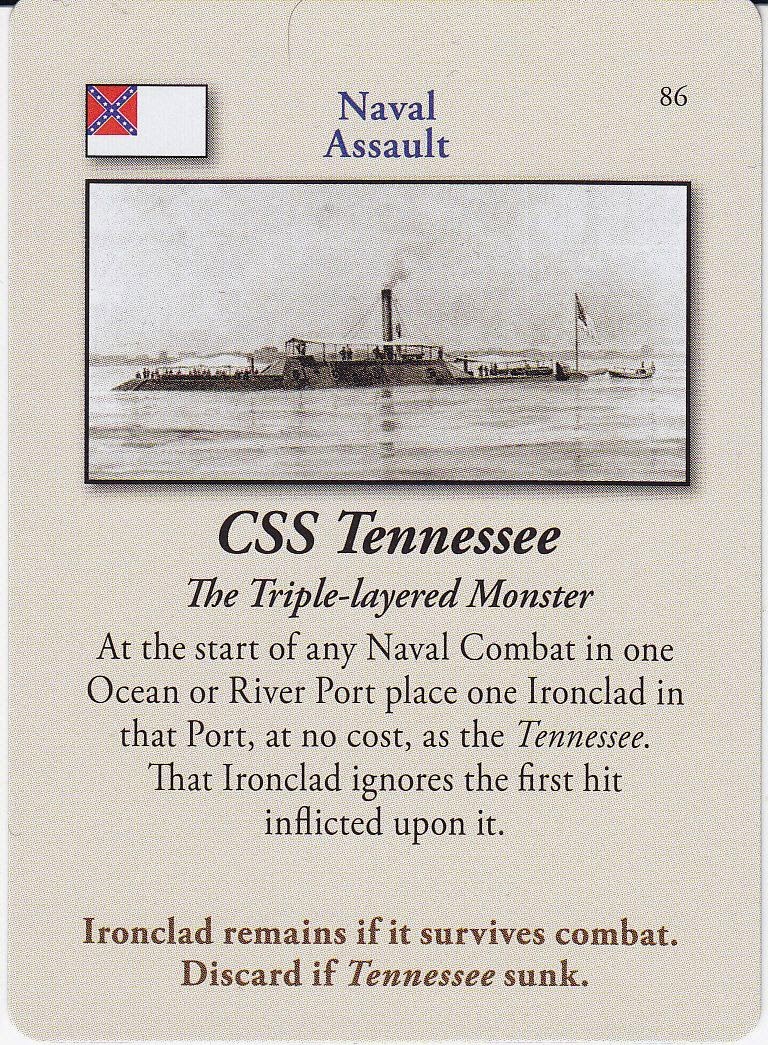
Buchanan was promoted to admiral – the first (and until almost the very end of the war, the only) admiral in the Confederate Navy.   He helped organize the fleet and defenses of Mobile, and when Admiral David Glasgow Farragut (who also appears in Rebel Raiders as a leader and on three cards – USN Cards 1, 33 and 37 – Damn the Torpedoes, the Grand Fleet and USS Hartford)  steamed into the Bay, it was “Old Buck” who went  out to meet him in the ironclad ram CSS Tennessee (CSN Card 86).


That confrontation is dramatized in the classic painting by William Heysham Overrend (see below).

“Old Buck” survived the war – and outlived Farragut, who passed away on August 14, 1870 – by nearly four years. 

Despite having “gone South,” Buchanan has not been forgotten by the Navy or the Academy: three U.S. Navy destroyers were named for him, as is the house that serves as the superintendent’s quarters at Annapolis.


Monday, August 19, 2013

How Patrick Kairns Won and Bob Kasabian ALMOST Won as the Union

Two Games, Two Condensed Replays of Rebel Raiders…and a compliment from Hong Kong.

“Rebel Raiders is a really great game” says Alfred Wong of Hong Kong.  “My friend and I enjoy every game we play.”

Bob Kasabian’s “Almost” Union Victory (“Both of us love this game”)
-This from Bob Kasbian:

Just finished our second game of Rebel Raiders. This time I had a much more coordinated Union strategy, and with the aid of the card that extends the game one turn, came within a whisker of winning. On the final turn, I took Atlanta and Richmond, despite there being three batteries in each, but Farragut, with an eight sloop Grand Fleet, could not defeat the Rebs in New Orleans. The CSA VP total was negative, but since I had only 12 CSA cities/ports, I needed all three of the above (already had Memphis and Vicksburg) to get the win. We used no optional rules. The one change in Union strategy I would make would be a wolfpack of Screw Sloops to hunt down Raiders. They roamed free much of the game, and earned lots of VPs. Both of us love this game.

Patrick Kairn’s “Emotional Rollercoaster” – or when the Union is down, the only way is back up…to victory

-This from Patrick Kairns in Montreal

An emotional roller-coaster
My nephew and I played Rebel Raiders last night for the first time face-to-face. We had played a couple of times using the Vassal module. We started with the 1862 scenario with no optional rules, although the play book advised using some optionals. We wanted to see how differently the 1862 scenario would play from the Basic Game (1861). Did we EVER find out!! I was the Union and he was the CSA.

The game was an amazing roller-coaster ride! All the way through 1862 and half way through 1863 the
Union could do NOTHING right and the CSA could do NOTHING wrong! My dice rolling was atrocious through that period or if I did get a good roll my nephew would get an exact same roll, therefore winning the assaults, speed rolls, etc. If I remember correctly I must have unsuccessfully assaulted New Orleans (the only city I needed to capture the Mississippi) about 5 times!! I had an amazingly difficult time (dice again) capturing coastal cities as well. So I turned my attention to destroying his Blockade Runners, and Raiders and was quite successful (at last). I had to. He topped-out many times at 50 VPs. He was on top of the world and I was about to burn the game...literally!

Then finally in mid-1863 the cards
AND dice finally turned. His inability to accumulate VPs by sea and my capturing of Atlanta started to bite into his VP total during the CSA supply phase (rolling two dice & subtracting that result from his VPs.) When I did capture New Orleans and he was to roll 3 negative dice in his supply phase, and I had him discard R.E. Lee from his hand hurting his chances of defending Richmond, he surrendered in April 1864. Now the roles reversed completely. I was elated and he was crushed.....emotionally.

The game play was very exciting, at times very frustrating, but immensely entertaining. As the
Union I learned to be patient, forget my bad dice rolling and concentrate on my plan, which was more or less trying to implement "The Anaconda Plan". To my relief it worked.

This was not a complete game, but very close to being one. As stated we played until April 1864 when we both agreed a Union victory was inevitable. I had whittled his VPs down to low 20's, and would have smashed through to
Richmond in the 3-4 turns we had remaining. I was building 2 extra Cannon Pawns/turn availing me of 4 assaults/turn plus his Supply rolls would have done the CSA in.

It was a tremendous game. An exciting time was had by all. If I may add a bit of advice, do not get too high or discouraged with your play. the tables can turn extremely quickly.

Have fun, and if you don't own Rebel Raiders on the High Seas, it is worth the price of admission and belongs in your game collection.

…and then he added:


Thanks to both you and Fred for creating such a great game!

Wednesday, August 14, 2013

A "Rebel Raiders" Homage Admiral David Glasgow “Damn the Torpedoes” Farragut!

A "Rebel Raiders" Homage to Admiral David Glasgow “Damn the Torpedoes” Farragut!


On this day in 1870 David Glasgow Farragut passed away.   The admiral appears in Rebel Raiders on the High Seas not only as a Leader counter but on TWO Union cards (USN Card 1 – “Damn the Torpedoes…Full Speed Ahead!” and USN Card 33 – The Grand Fleet).  The first card gives Union ships extra dice when firing on Rebel batteries – but only after they take a round of fire from the Confederates, thus mimicking the Navy tactic of directing fire at Rebel gun positions that have exposed themselves, and the second allows the Union to amass a larger stack of ships (10 vice the normal 6 allowed in the rules) when making an attack – which represents Farragut’s accumulation of a massive force to hit Mobile Bay.

Farragut was one of the first admirals in the U.S. Navy – attaining the rank of rear admiral as a reward for taking New Orleans in 1862.  Nine such rear admirals were authorized by act of Congress in 1862  (among these were Samuel Francis DuPont – USN Card 54,  John Dahlgren – USN Card 31, David Dixon Porter – USN Card 2 and Andrew Hull Foote, who appears as a Leader in the game).  Farragut later became the nation’s first vice admiral – promoted by Lincoln for his storming of Mobile Bay, and its first full admiral (four star rank), an honor he was given a year after the war in July 1866.


Farragut, though born in Tennessee and married to a Southern belle, stayed loyal to the Union – so much so that he told his wife that he was going North even if she and the family stayed South.  He and Confederate Admiral Franklin “Old Buck” Buchanan (a Confederate leader in the game) were among the senior officers in the Navy, and just as Buchanan felt Farragut had betrayed the South by coming North, so did Farragut believe “Buck” had betrayed his oath to the Union by going South.   The two men quite literally fought eye-to-eye at Mobile Bay,  Farragut supposedly uttering his famous “damn” not so much because of the torpedoes, but because from his perch on the rigging of the USS Hartford (USN Card 37) he could see Buchanan looking up at him from the pilot house of the ram CSS Tennessee (CSN Card 86), as depicted in the famous painting of that action by William Heysham Overrend (see below).