Showing posts with label Vicksburg. Show all posts

Sunday, June 8, 2014

Happy 201st Birthday, Adm. David Dixon Porter

Happy 201st Birthday, Adm. David Dixon Porter


Admiral David Dixon Porter would be 201 today.   The storied Union naval officer and Civil War hero is represented by both a counter and a card in my strategic naval game of the Civil War – Rebel Raiders on the High Seas. Judicious use of USN Card No. 2 “David Dixon Porter & His Little Mortar Boats” can greatly ease the Union Navy’s attacks into Confederate river and ocean ports.

Porter is USN Card No. 2 because he was the second officer to attain the rank of rear admiral in the Union Navy.  David Glasgow Farragut was the first – and hence he is on USN Card No. 1 (“Damn the Torpedoes…Full Speed Ahead”) – a little inside joke of mine.  Porter was also the adopted brother of Farragut, and their sibling rivalry was infamous.  Farragut also appears on USN Card 33 – “The Grand Fleet,” a card which allows the Union to stack 10 warships instead of the usual maximum of 6.  Porter, alas, being the junior of the two admirals/brothers, is limited to the lesser number.

Porter, however, made many contributions to the war effort and is also remembered by USN Card 25 – “The Black Terror.”  Although not listed on the card, it was his idea to build the phony ironclad that so frightened the Rebels on the river.

Porter and his mortar boats were vital to the Union victory at New Orleans (where he served under his elder brother), and to the first naval attack on Vicksburg (where he again served at his brother’s side).  Porter was promoted to a command of his own, leading the Western Gunboat Flotilla – renamed the Mississippi River Squadron – during the Vicksburg campaign.  He was named “acting” rear admiral in recognition of his role in its capture. 

The importance of Vicksburg is noted in Rebel Raiders, as it is one of the critical victory cities the Union needs to take to win the game.

Porter also took part in the abortive Red River Campaign (which is represented in the game by CSN Card 76 – “Red River Fiasco”).  It is a Rebel card because it was such an ill-conceived plan that no Union player in his right mind would willingly attempt it.

Porter redeemed himself by saving his fleet from disaster on the Red River (thanks to an Army engineer who built a damn to float his ironclads over the rapids to safety) and again by leading the naval forces that pounded and helped capture Fort Fisher in January 1865. 


After the war, Porter went on to become superintendent of the U.S. Naval Academy.   In 1866 Farragut became the nation’s first full admiral, and Porter became its first vice admiral – and when Farragut died, Porter was promoted, becoming the nation’s second full admiral.   He died in 1891 at the age of 77.


Wednesday, December 11, 2013

December 11, 1863 – “Pook’s Turtle” Saves the Day: USS Carondelet vs. Rebel Artillery

This day 150 years ago in Rebel Raiders’ History

-Dedicated to Civil War episodes, battles, people and ships that also appear in my game, GMT’s Rebel Raiders on the High Seas.

 Historical Event:  On December 11, 1863 the captain and crew of the river ironclad USS Carondelet  engaged  Confederate infantry and artillery and drove off the Rebel crews attempting to salvage guns from the wreck of another Federal ironclad, USS Indianola.  The USS Indianola had been run aground in February during a duel with a Rebel flotilla led by the CSS Queen of the West (a Union ship of the same name that had been captured and pressed into Confederate service).   This action was a routine part of USS Carondelet’s patrol duties along the Mississippi, Yazoo and Red Rivers.  

The USS Carondelet was one of seven City-Class vessels designed by Samuel Pook (hence the nickname for her and her sisters as Pook Turtles), and was built by James Buchanan Eads at his Carondelet Marine Way shipyard outside St. Louis.  The ship fought in the battles at Forts Henry and Donelson, Island Number 10, Memphis and Vicksburg, and participated in the ill-fated expedition up the Red River in early 1864.  Pook’s Turtle survived the war – as did the USS Indianola, which was finally in January of 1865 – thanks to having been rescued from the clutches of Rebel salvage crews by the USS Carondelet on December 11, 1863.


Game Connection:  Union ironclads play a vital role in Rebel Raiders on the High Seas, reducing Confederate batteries and battling Rebel ironclads and gunboats in ocean and river ports and forts – including those the Southern player is bound to place in the sites on the map where USS Carondelet fought.   The ironclad herself is represented in the game by a counter and a card (USN 15), as is her maker, James Buchanan Eads, whose card (USN Card 35 – Ead’s Ironclads) provides the Union with three ironclads over as many turns, free of charge, in Cairo or St. Louis.     (The Queen of West, mentioned above, is also represented in her Union colors in USN Card 38, and the Red River Fiasco in which USS Carondelet took part, as noted above, is induced by the play of a Confederate card, CSN Card 76).


Monday, August 12, 2013

“The Unsinkable” USS Brooklyn

The Ships of Rebel Raiders    - The Men o’War

Rebel Raiders on the High Seas is a strategic game of the Civil War which focuses on the role of the navies on the rivers, along the coasts and on the oceans.  While most ships are represented by generic counters for Ironclads, Blockade Runners, Gunboats, Screw Sloops and, of course Raiders, there are cards and corresponding counters for many individual vessels.  This series presents those cards and offers a glimpse into the history of these storied ships.


Part IV – The Union Screw Sloops: “The Unsinkable” USS Brooklyn


The sloop-of-war USS Brooklyn  (USN Card 13)  was practically a one-ship Navy; she did it all, and fought everywhere, in every kind of action.   She helped frustrate Confederate attempts to take Fort Pickens in Pensacola in 1861, then captured several blockade runners.  When Raphael Semmes made his initial foray out of New Orleans on the CSS Sumter (the Raider counter that begins the game there) she gave chase – but the elusive Semmes got away, as he always did.

USS Brooklyn caught several blockade runners in 1862, and battled her way up river past the guns of Forts Jackson and St. Philip to engage the Rebel Ironclad Ram CSS Manassas (CSN Card 71 in Rebel Raiders). The ironclad did ram her, but as the captain reported “did us little injury.”  (Only on the USS Brooklyn was a 24-foot long gash in the hull a “little injury.”)    Later in the summer of 1862 she went upriver to run the batteries at Vicksburg and drove the Rebel gunners away while troops landed at Donaldsonville, La.

USS Brooklyn was pulled out of the Mississippi to blockade Galveston, where she again was stymied by Semmes (who returned in the CSS Alabama (CSN Card 63) to trick, engage and sink the USS Brooklyn’s consort, the gunboat USS Hatteras (USN Card 16).   The mighty warship, however, got some measure of revenge by capturing a pair of blockade runners, including the Kate, skippered by the legendary and until then always lucky Thomas Lockwood – until then “the most successful of many Charlestonnians engaged in blockade running” (according to Robert N. Rosen, in his book, Confederate Charleston).  Kate was one of nine blockade runners captured (and one sunk) by the USS Brooklyn during the war.

Mobile Bay in August 1864, however, was where USS Brooklyn would be most sorely tested – as she led the second column into the Bay; when the ironclad USS Tecumseh immediately off her port bow hit a torpedo (i.e. mine) a sank in seconds, the captain stopped and began backing as the USS Brooklyn had also run into a net of mines.  The Rebel Ironclad Ram CSS Tennessee (CSN Card 86) tried to ram her, but she fended off the ram and added her guns to those of the other Union ships that forced the Rebel ship to strike.

Nearly 100 of those aboard USS Brooklyn were killed or wounded in the action, and 23 sailors and marines aboard were awarded the Medals of Honor.


After extensive repairs, USS Brooklyn was sent to aid in the attack on Fort Fisher.  After the war  she became the flagship of the South Atlantic Squadron and later that of the Asiatic Squadron.  For her final service, in 1889, she circumnavigated the globe – running Cape Horn – before returning home to New York to be decommissioned.


Monday, July 15, 2013

The Ships of Rebel Raiders - The Gunboats


Rebel Raiders on the High Seas is a strategic game of the Civil War which focuses on the role of the navies on the rivers, along the coasts and on the oceans.  While most ships are represented by generic counters for Ironclads, Blockade Runners, Gunboats, Screw Sloops and, of course Raiders, there are cards and corresponding counters for many individual vessels.  This series presents those cards and offers a glimpse into the history of these storied ships.

Part II – The Gunboats: The Mosquito Fleet- Montgomery at Memphis

“The Mosquito Fleet” (CSN Card 81) represents the rag-tag little squadrons the South cobbled together for the defense of Memphis and Mobile Bay.  Civilian vessels to which a gun or two and crew were hastily added, and to which bales of cotton, stacks of lumber or other makeshift defenses were added, these hopelessly outclassed and outgunned little ships and their brave crews performed far better than any could expect or demand. 

The two Confederate naval officers who led those forces --- Commander James Montgomery at Memphis and Admiral Franklin Buchanan at Mobile Bay – are both represented by stand-up Leader counters and Fleet Command Boxes on the lower left of the map.  (Players may take a stack of ships and place them in a Fleet Command Box and replace them on the map with the corresponding Leader – there are two such for the South, four for the North).

Montgomery had eight ships in his “Mosquito Fleet” at Memphis in June 1862.  Undergunned and underpowered, they were no match for Colonel Charles Ellet and his seven ships, which included five ironclads and two rams.   (Two of those ships, the  ironclad USS Carondelet – USN Card 15 – and the ram, USS Queen of the West – USN Card 38, are in the game).    Needless to say, Montgomery, though gallant, did not prevail.


Sunday, July 14, 2013

This day 150 years ago in Rebel Raiders’ History


-Dedicated to Civil War episodes, battles, people and ships that also appear in my game, GMT’s Rebel Raiders on the High Seas.  

July 13, 1863 merits a second entry (in addition to yesterday's post noting the start of the New York draft riots)...and ps: Happy Bastille Day!

July 13, 1863 – (Part II) – “Infernal Machines” Sink Union Ironclad

            Historical Event:    The ironclad USS Baron de Kalb was sunk this day 150 years ago by a Confederate “infernal machine” (a “torpedo” as they called it but what we today would dub a naval mine).   The ironclad was part of the Union force that captured Yazoo City  (on the river of the same name) during the mopping up operations that followed the surrender of Vicksburg and Port Hudson (see my blog entries for July 3 and July 8, respectively:    http://markgmclaughlin.blogspot.com/2013/07/this-day-150-years-ago-in-rebel-raiders.html   and http://markgmclaughlin.blogspot.com/2013/07/dedicated-to-civil-war-episodes-battles.html

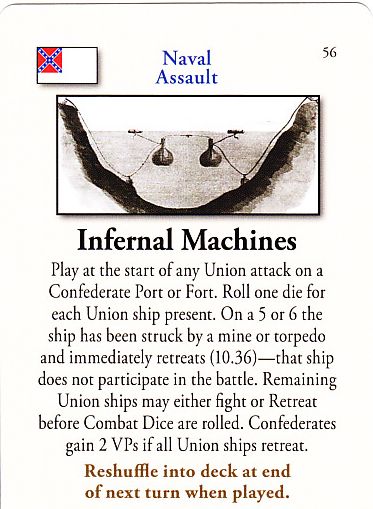
            Game Connection:    Ironclads are vital to the Confederacy to defend its ports and for the Union to battle through the batteries, sink Rebel ships and clear the way for the Army to land during an assault in Rebel Raiders on the High Seas.   Whether fighting into an ocean port or up or down the Mississippi or Yazoo, the Union player does have to take into account that the Rebel player can play many cards to impede his progress.  One of those is Infernal Machines (CSN Card 56). 


Friday, July 12, 2013

The Ships of Rebel Raiders - The Gunboats


Rebel Raiders on the High Seas is a strategic game of the Civil War which focuses on the role of the navies on the rivers, along the coasts and on the oceans.  While most ships are represented by generic counters for Ironclads, Blockade Runners, Gunboats, Screw Sloops and, of course Raiders, there are cards and corresponding counters for many individual vessels.  This series presents those cards and offers a glimpse into the history of these storied ships.

Part II – The Gunboats: USS/CSS Queen of the West - A Gunboat Under Two Flags

While many blockade runners were caught by the Union and turned into gunboats, the USS Queen of the West, is unique – this Union gunboat was captured by the South and turned against the Yankees on the Mississippi. 

Known as “Ellet’s Ram” this ship (represented in Rebel Raiders as (USN Card 38) was a side wheel steamer  built at Cincinnati before the war.  Colonel Charles Ellet, Jr, fitted her out as a ram and led her and other ships in the attack on Memphis in June 1862.  Ellet was mortally wounded but his ship fought on.  A month later, along with the ironclad USN Carondelet (USN Card 15) and the timber-clad gunboat USS Tyler (USN Card 18) she engaged the Rebel ironclad ram CSS Arkansas (see my posting of July 11).  The fight went badly for the Union, although the USS Queen of the West limped away and lived to fight another day.

Unfortunately, that other day was February 2, 1863.  The valiant ship rammed the Rebel armed steamer City of Vicksburg in a battle fought under the guns of the fortress for which that Confederate ship was named.   The USS Queen of the West took heavy damage and was set afire in at least two compartments.  She fought on, however, driving ashore two more Confederate gunboats – the steamers O.W. Baker Moro and Beruick Bay.  She then went up the Red River and on Valentine’s Day she captured yet another Rebel vessel – the steamer Era No.  Unfortunately as she reached Gordon’s Landing on the Black River she was ambushed by Confederate artillery – at which point she struck her colors.


The Confederacy wasted no time in raising its own flag over the vessel, but went against all naval custom and instead of renaming her ran her as CSS Queen of the West.  She fought well for the South, until she ran into a trio of Union warships on Atehafalaya River on April 14, 1863.  Battered and set afire, she drifted with the current until running aground and exploding.


Thursday, July 11, 2013

The Ships of Rebel Raiders - The Gunboats


Rebel Raiders on the High Seas is a strategic game of the Civil War which focuses on the role of the navies on the rivers, along the coasts and on the oceans.  While most ships are represented by generic counters for Ironclads, Blockade Runners, Gunboats, Screw Sloops and, of course Raiders, there are cards and corresponding counters for many individual vessels.  This series presents those cards and offers a glimpse into the history of these storied ships.

Part II – The Gunboats: USS Tyler


USS Tyler (USN Card 18).  A “timberclad” gunboat, the former river merchant ship from Cincinnati became one of the most famous ships in the Western Flotilla.  She participated in the bombardment of Forts Henry and Donelson, provided key gunfire support at Shiloh, fought at Island No. 10 and dueled with the ironclad CSS Arkansas.  USS Tyler survived that fight to take part in operations at Vicksburg and up the Yazoo and White Rivers into Arksansas.  Her last service was a mission of mercy, as she helped save the crew of the SS Sultana north of Memphis at the end of April 1865.


The Timberclad Takes on the Ironclad

In July 1862 the USS Tyler along with USS Queen of the West  and USS Carondelet (represented in Rebel Raiders by USN Card 38 and USN Card 15, respectively)  went hunting for the Confederate ironclad ram, CSS Arkansas.   Unfortunately, on July 15 they found her.  The USS Carondelet, being an ironclad, led the way – only to be disabled by the Confederate warship.  USS Queen of the West, a sidewheel gunboat also known as “Ellet’s Ram” was also knocked out of the action, leaving the timber-reinforced gunboat USS Tyler to duel with the iron monster all on her own.  The battle became a running fight down the Yazoo, as the USS Tyler sought and finally reached the protection of the Union fleet at the confluence of the Yazoo and Mississippi.  CSS Arkansas then broke off the action, and steamed on to Vicksburg, where she was welcomed with flags flying.


Wednesday, July 3, 2013

This Day 150 Years Ago in Rebel Raiders' History

This day 150 years ago in Rebel Raiders’ History –
Hours to Remember: 10:30 am, 1 pm, 3 pm….Vicksburg & Gettysburg

-Dedicated to Civil War episodes, battles, people, and ships that also appear in my game, GMT’s Rebel Raiders on the High Seas,  

July 3, 1863 -  For the South, The Saddest Day

            Historical Events:   

Vicksburg. At 10:30  in the morning, Confederate officers approached the Union lines at Vicksburg under a white flag.  They carried a request from General Pemberton for terms.   Although famed in newspapers as  U.S. “Unconditional Surrender” Grant,  after responding with that famous phrase the Union commander DID grant terms:  Pemberton’s men marched out but after giving their parole were left to go on their way rather than be interred as prisoners of war.    Grant was not necessarily being a gentleman – neither he nor Admiral Porter had any way to transport let alone care for nearly 30,000 Rebel soldiers.

Gettysburg.  At 1 in the afternoon the Army of Northern Virginia began the greatest cannonade yet heard in the Western Hemisphere.  For nearly two hours over 150 guns unleashed their fire upon the Union lines on and behind Cemetery Ridge.  As the barrage lifted, General George Pickett and 15,000 men from three divisions began that epic charge which Faulkner romanced so well in Intruder in the Dust:

 For every Southern boy fourteen years old, not once but whenever he wants it, there is the instant when it's still not yet two o'clock on that July afternoon in 1863, the brigades are in position behind the rail fence, the guns are laid and ready in the woods and the furled flags are already loosened to break out and Pickett with his long oiled ringlets and his hat in one hand probably and his sword in the other looking up the hill waiting for Longstreet to give the word and it's all in the balance, it hasn't happened yet, it hasn't even begun yet, it not only hasn't begun yet but there is still time for it not to begin against that position and those circumstances which made more men than Garnett and Kemper and Armistead and Wilcox  look grave yet it's going to begin, we all know that, we have come too far with too much at stake and that moment doesn't need even a fourteen-year-old boy to think This time. Maybe this time with all this much to lose and all this much to gain: Pennsylvania, Maryland, the world, the golden dome of Washington itself to crown with desperate and unbelievable victory the desperate gamble, the cast made two years ago; or to anyone who ever sailed a skiff under a quilt sail, the moment in 1492 when somebody thought This is it: the absolute edge of no return, to turn back now and make home or sail irrevocably on and either find land or plunge over the world's roaring rim.


            Game Connection:   While Gettysburg does not appear on the map for Rebel Raiders, the Confederate invasion of Maryland and Pennsylvania is represented by the Lee Moves North card (CSN Card 77).  Vicksburg is on the map, and as noted in the July 1 post on this blog, many of the ships and generals and weapons take took part in that epic siege are represented by cards.  The loss of Vicksburg costs the Confederacy dear in Rebel Raiders, especially if Memphis and New Orleans have also fallen, as that triggers major victory point losses for the South at that instant, and during the supply phase of each subsequent turn.


Monday, July 1, 2013

This day 150 Years Ago in Rebel Raiders's History

 This day 150 years ago in Rebel Raiders’ History
Gettysburg, Vicksburg and the Ships of Rebel Raiders.

 -Dedicated to Civil War episodes, battles, people and ships that also appear in my game, GMT’s Rebel Raiders on the High Seas,  Gettysburg, Vicksburg and the Ships of Rebel Raiders.

On this, the 150th anniversary of the First Day of Gettysburg, it is easy to forget that at Vicksburg an equally vicious and vital struggle was also reaching its climax.  

As a strategic naval game, Rebel Raiders on the High Seas focuses far more on the epic siege of the fortress on the Mississippi than on the titanic contest that was played out on the fields of Pennsylvania.   The later is represented by the Lee Moves North card (CSN Card 77), while many of the leaders and great ships who fought at Vicksburg are also represented, notably: 

 -David Dixon Porter & His Little Mortar Boats (USN Card 2),
 -Grant Takes Command (USN Card 8),
-the tinclad gunboat USS Black Hawk (USN Card 10), 
-the "Pook's Turtle" ironclad USS Carondelet (USN Card 15), 
-the timberclad gunboat USS Tyler (USN Card 18),
-the phony ironclad Black Terror (USN Card 25)
-the big guns of the Siege Train (USN Card 48),

-and, for the South:

-the mines, torpedoes and other Infernal Machines (CSN Card 56),
-the general who tried to relieve the city, J.E. Johnston (CSN Card 91)
-the hidden batteries on the bluffs of Ring of Fire (CSN Card 101),


--and the only ship to see action on BOTH sides at Vicksburg:
--“Ellet’s Ram” USS Queen of the West (USN Card 38)– which was captured and put into service by the Confederacy as CSS Queen of the West


Tuesday, June 18, 2013

Vive l'Empereur - and "Happy" Waterloo Day ...at 7 p.m. tonight the Old Guard goes up the hill....

Meanwhile...

Rebel Raiders Replay Turn 10 (Part 2) April 1864 - DuPont, Conqueror of the Mississippi

Designer Mark McLaughlin as CSA; Naval Historian Brandon Musler as USA

When we left off, the mighty CSS Alabama, upon whom the Confederacy (and Mark) had pinned their last hopes for doing ANYTHING at sea, was caught and sunk on her maiden voyage by the largest warship in the U.S. Navy - USS Mississippi.  Now it is the Union turn, and Brandon is turning his sights to another Mississippi - the river and the Rebel fortresses that dominate it at Memphis and Vicksburg...


It is 1864, and the Union has four dice now in combat.  Brandon knows the clock is ticking, and comes on strong.

He comes back at Memphis again but this time plays DuPont (Card 54) to gain a big advantage (Rebel Batteries only fire one, not two, dice in the first round of combat).  With 5 Ironclads and a Gunboat he faces a Rebel force of 2 Ironclads, 1 Gunboat and 3 Batteries.  Two Batteries are destroyed in the first round, along with an Ironclad and the Gunboat, at no loss to the North.  Mark retreats his remaining Ironclad, sending it down river to Vicksburg.   Brandon completes the destruction of the defenses of Memphis, which falls easily and at great cost in VP to the South.


The Union keeps going with its second Assault of the turn.  The Union has so many ships on the river it almost does not have space for them…so down to Vicksburg they come.   The single Rebel Ironclad that survived Memphis and the one Battery there are no match for five Yankee Ironclads – actually, six, as Brandon plays the Tyler (USN Card 18) turning his sixth ship, a Gunboat, into a virtual Ironclad for the brief battle.

Vicksburg falls.   The South is once again in the negatives in VP.

Unvexed to the Sea?

With Memphis and Vicksburg gone, the North needs only New Orleans to complete its conquest of the Mississippi.  Six Screw Sloops come up river from Forts Jackson and St. Philip.  One is lost to the Battery before the Union warships smother it in shot and shell.  Incredibly, however, despite the advantage in dice and Union Tactics – New Orleans holds!


Brandon then turns to hunting Raiders, fails to find any, and spends his builds to buy four Assaults and an Screw Sloops.  He draws four cards, as it is 1864 (the Union gets that fourth draw in 1863 turns).Two Ironclads and a free Gunboat are placed in the Navy Yards.

Tuesday, June 11, 2013

This day 150 years ago in Rebel Raiders’ History

-Dedicated to Civil War episodes, battles, people and ships that also appear in my game, GMT’s Rebel Raiders on the High Seas.

June 11, 1863  -  Grant Brings Up the Big Guns

            Historical Event:  As the siege of Vicksburg tightens, Grant brings up two monstrous 10-inch Columbiads and places them in firing positions a mere 100 yards from the Rebel front lines.  The huge guns begin pounding the city daily, forcing its civilian population to dig underground shelters.


            Game Connection:  Union Card 48 – Siege Train – gives the Union an additional die in assaults by land.  This bonus can be decisive, especially when faced with heavily defended cities such as Vicksburg, one of the keys to victory in the Civil War, just as it is in Rebel Raiders on the High Seas.


Sunday, May 26, 2013

This day 150 years ago in Rebel Raiders’ History

-Dedicated to Civil War episodes, battles, people and ships that also appear in my game, GMT’s Rebel Raiders on the High Seas,  

A Bad Day on the Mississippi....Union attacks repulsed; Ironclad USS Cincinnati sunk

May 27, 1863

            Historical Event:   Bad day on the Mississippi.   Bank’s ground assault on Port Hudson repulsed with heavy losses.  Porter’s fleet duels with Vicksburg batteries – USS Cincinnati sunk.
            May 27, 1863 was a bad day for the Union on the Mississippi River.  General Nathaniel Banks’s ill-conceived plan to rush the Rebel lines at Port Hudson resulted in the decimation of his army.  After losing nearly 1,850 dead and wounded, Banks called off the attack and resumed his siege.
            At Vicksburg, David Dixon Porter led a powerful force of ironclads to bombard Fort Hill, the city’s chief bastion on the water.  The at first inconclusive pounding turned to tragedy, as Rebel gunners sunk the USS Cincinnati  (pictured below, courtesy of  U.S. Naval Historical Center; the “action” shot is from the new stamp issued last week by the U.S. Postal Service).


            Game Connection:  Vicksburg is one of the key ports on the Mississippi the Union must take to win Rebel Raiders on the High Seas.  Due to the scale of the map Port Hudson itself is not shown, but is represented by the fort space at Baton Rouge, which incorporates both important locales between Vicksburg and New Orleans.
            Porter (USN Card No. 2) is represented as a leader and a card in the game, and counters represent his ironclads and other warships, as well as the Rebel ships and batteries, like that upon Fort Hill, with which they contended for mastery of the great river. 


Monday, May 20, 2013


This day 150 years ago in Rebel Raiders’ History

-Dedicated to Civil War episodes, battles, people and ships that also appear in my game, GMT’s Rebel Raiders on the High Seas,  

May 20, 1863

            Historical Event: Siege of Vicksburg.    
            After Pemberton’s retreat from Champion’s Hill (see the May 16 blog entry), Grant pressed forward, overrunning hasty Confederate works on the Big Black River on the 17th.  Federal engineers bridged the river and three Union corps crossed on the 18th.   Grant’s attempt to carry the fortified city of Vicksburg by coup de main on the 19th was a costly failure, resulting in nearly 1,000 casualties.  On May 20 the Union dug in, beginning the formal siege. 
            To complete the siege by water, Porter sent two ironclads (Choctaw and DeKalb) and four gunboats to attack the Rebel shipyard at Yazoo City.  The garrison set fire to the yards and to the three warships under construction rather than surrender them to the Union.

            Game Connection:
            Vicksburg is one of the three keys to the Mississippi, Federal control of which is one of the requirements for a Union victory.  Grant is in the game as a card (USN #8), and Porter appears both as a naval leader marker and as a card (USN#2).  Ironclads and gunboats are vital to both sides when battling for supremacy on the Mississippi.

Below is a photograph of USS Choctaw taken off Vicksburg in 1863 (Department of the Navy, Navy Historical Center)


Thursday, May 16, 2013


This day 150 years ago in Rebel Raiders’ History

-Dedicated to Civil War episodes, battles, people and ships that also appear in my game, GMT’s Rebel Raiders on the High Seas,  

May 16, 1863

            Historical Event:  Champion’s Hill.  Two Union corps under generals McPherson and McClernand repeatedly attack Confederate forces on Champion’s Hill.  Although the combat is indecisive, Confederate general Pemberton decides to retreat – but instead of marching to link up with J.E. Johnston as ordered, he decides to fall back upon Vicksburg.  It is a fatal decision, as not only with the South lose the city in two months, Pemberton’s 20,000-man army will fall with it.

            Game Connection:  Vicksburg is one of the three key cities, along with New Orleans and Memphis, which the Union needs to take to control the Mississippi.  Taking those cites not only costs the Confederate player much needed supplies (represented in victory points lost through die rolls each turn)  but is also one of the key conditions of victory for the Union.


Saturday, May 4, 2013


This day 150 years ago in Rebel Raiders’ History

-Dedicated to Civil War episodes, battles, people and ships that also appear in GMT’s Rebel Raiders on the High Seas, my next game.

May 4, 1863
            Historical Events:  While in the East Sedgwick struggled to hold the line to give the rest of the battered Army of the Potomac time to retreat after the debacle at Chancellorsville, in the West Grant was suffering a defeat of his own – although one far smaller in scope – along the Red River.  A Union flotilla went up the Red River to attack Fort De Russy and was repulsed with heavy damage to a number of its ships, notably the unfortunately named USS Albatross. (See the sketch below, made by a sailor at the time).

            Game Connection:  Although primarily a naval game, there is a great deal of land combat – attack and counter-attack—in Rebel Raiders.  Chancellorsville can be recreated through the play of the Confederate cards for Lee and Jackson (as noted in the May 2 blog entry).  Gunboats vs. Batteries is a key part of the river combat sequence in the game, as the Union needs to reduce those defenses in order to even the odds when attacking the cities and fort spaces those batteries protect.


Sunday, April 28, 2013

First Time Using the REAL Game...

Today I finally got to "play" Rebel Raiders on the REAL game (instead of my old hand-made playtest copy).

Actually, I did not "play" but taught the game.  My friend Bob, who had been a playtester but had not played for months, was the South, and Charlie, who had never played, was the North -- and I coached him just a little, but only on explaining what he could do, not what he should do.

 Bob as the South frustrated Charlie early on...by turn six he had not lost a single city or port...and had lost only Fredericksburg (which he took back) and had Louisville.  His blockade runners were steaming in and out of ports quite merrily and his raiders were having a romp on the seas.

Charlie got on a slow roll...he kept winning naval battles, sinking ships and blowing up batteries, but LOSING the final attack.  We counted: he made 12 amphibious attacks over the course of the game   and won ONE...Savannah was the ONLY port to fall!

But that was key...as from there he rolled through the South, where there were very few defensive batteries - as Bob concentrated on putting batteries in ports and on using his resources to build ironclads.

Charlie came out of Savannah and took Augusta, then into Atlanta and from there straight across to Vicksburg, then fought DOWN through Baton Rouge to New Orleans!

Jackson died defending Fredericksburg, and Grant took Richmond.

The final battle was a huge naval fight at Memphis (fourth such of the game).   Porter's mortar boats finally had an effect, knocking out a battery before the battle, and the duel of U.S. ironclad Carondelet vs rRebel ram Manassas was epic! Six rounds of combat during which four rebel and three union gunboats were sunk, along with one rebel ironclad forced to retreat due to a mechanical failure card and one Yankee ironclad sunk...then it was Carondelet and another ironclad alone vs Manassas and Charlie won.

That cleared the way for the attack by the army which took Memphis...and that was game (Atlanta,Richmond, the three Mississippi cities, negative rebel points makes for an automatic victory)...and it came on the last attack of the last turn of 1864.  (That is normally the last turn of the game, but Charlie played the card that gave him a chance for a 13th turn and he did win the election that would have given him one more turn)

Charlie sank 33 blockade runners through the course of the game -- there are 17 counters available, which means every blockade runner was basically sunk twice (the South still had four on the board)  and he sank four raiders (but Alabama, ironclad raider Stonewall and two others were still at sea)

It was a great game, both had a lot of fun and both want to play again! (Hopefully next time I will get to play!)