Showing posts with label Carondelet. Show all posts

Friday, July 26, 2013

The Ships of Rebel Raiders - The Ironclads

Rebel Raiders on the High Seas is a strategic game of the Civil War which focuses on the role of the navies on the rivers, along the coasts and on the oceans.  While most ships are represented by generic counters for Ironclads, Blockade Runners, Gunboats, Screw Sloops and, of course Raiders, there are cards and corresponding counters for many individual vessels.  This series presents those cards and offers a glimpse into the history of these storied ships.

Part IV– The Union Ironclads : USS Carondelet  “Pook’s Turtle” vs. Hood
  
USS Carondelet (USN Card 15) was a City-Class ironclad built in the Missouri city for which it was named.  One of the shallow-draft “Pook’s Turtles” designed by Samuel Pook, she was commissioned at Cairo in January 1862 and was one of the first and most powerful ships in the Western Gunboat Flotilla of Flag Officer Andrew Foote (who is one of the Union leaders in Rebel Raiders).

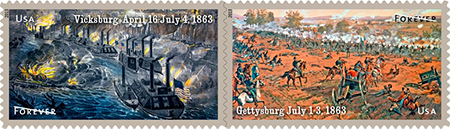
The ironclad fought at Forts Henry and Donelson , Island No. 10, and Memphis, and was badly damaged in a close action duel with the Confederate ironclad CSS Arkansas on the Yazoo River.  She was repaired in time to run the guns at Vicksburg in April 1863 (see U.S. Postage stamp shown below), and was also part of the Red River Fiasco (represented in the game by CSN Card 76).


USS Carondelet survived that disaster, and went back up the Cumberland in December 1864 to duel with Rebel artillery during the Nashville campaign – and later pouring heavy fire into the flank of John Bell Hood’s army when General Thomas counterattacked.  (Hood and his last, desperate effort to turn the tide are represented by CSN Card 89, which bear’s the luckless general’s name).


Monday, July 15, 2013

The Ships of Rebel Raiders - The Gunboats


Rebel Raiders on the High Seas is a strategic game of the Civil War which focuses on the role of the navies on the rivers, along the coasts and on the oceans.  While most ships are represented by generic counters for Ironclads, Blockade Runners, Gunboats, Screw Sloops and, of course Raiders, there are cards and corresponding counters for many individual vessels.  This series presents those cards and offers a glimpse into the history of these storied ships.

Part II – The Gunboats: The Mosquito Fleet- Montgomery at Memphis

“The Mosquito Fleet” (CSN Card 81) represents the rag-tag little squadrons the South cobbled together for the defense of Memphis and Mobile Bay.  Civilian vessels to which a gun or two and crew were hastily added, and to which bales of cotton, stacks of lumber or other makeshift defenses were added, these hopelessly outclassed and outgunned little ships and their brave crews performed far better than any could expect or demand. 

The two Confederate naval officers who led those forces --- Commander James Montgomery at Memphis and Admiral Franklin Buchanan at Mobile Bay – are both represented by stand-up Leader counters and Fleet Command Boxes on the lower left of the map.  (Players may take a stack of ships and place them in a Fleet Command Box and replace them on the map with the corresponding Leader – there are two such for the South, four for the North).

Montgomery had eight ships in his “Mosquito Fleet” at Memphis in June 1862.  Undergunned and underpowered, they were no match for Colonel Charles Ellet and his seven ships, which included five ironclads and two rams.   (Two of those ships, the  ironclad USS Carondelet – USN Card 15 – and the ram, USS Queen of the West – USN Card 38, are in the game).    Needless to say, Montgomery, though gallant, did not prevail.


Friday, June 7, 2013

Rebel Raiders Replay  (Turn 7)

Designer Mark McLaughlin as CSA; Naval Historian Brandon Musler as USA

When we left off, the South was suffering from an increasingly effective Union blockade, and girding itself for the terrible swift sword the North is preparing to wield at the dawn of the new and fateful year - 1863


Turn 7 – April 1863   “The Yankees Are Coming!”  - The First Battle of Nashville

The Confederate submarine David  (Card 65) tried to open a path on one Blockade Station, but failed. Three more Blockade Runners are caught.  The Raiding fleet, now being hunted and shadowed, manage to snag only 3 VP – and what Blockade Runners made it home brought in a mere 2 VP.     The South is now done to single digit VPs, which means no more heady bonus buys of batteries and ironclads!

Fortunately, the Tredegar Iron Works (Card 95) is once again drawn after having been reshuffled into the deck, and that again means a third battery – so Norfolk, Wilmington and Mobile get strengthened, and 4 Blockade Runners and a Raider are built.

“The Yankees Are Coming! The Yankees Are Coming!”

With the number of dice thrown in land combat now finally to the Union’s advantage (it increases in 1863 and again in 1864) and his wall of ships on blockade firmly in place, Brandon begins the great push – and last turn he paid build points to allow him to make a third attack.   The first target is Nashville:

Battle of Nashville – Ironclads vs. Batteries; Five Card Stud or "You Shall Not Pass!"

Brandon now has FOUR Ironclads on the river, and with a pair of gunboats they sail into Nashville – which has three batteries.

Proclaiming loudly "You shall not pass!" Mark empties half of his hand to defend the city – playing Infernal Machines (56), The Mosquito Fleet (81) (which adds a Gunboat on a die roll) and the Hulks, Rafts and Chains  (110) Cards.  Brandon makes one of his Ironclads The Carondelet (Card 15) and plays Queen of the West (38) to turn a gunboat into a ram.   This makes FIVE cards being played out of the 12 held by the two players.

 The Infernal Machines force one Ironclad and one Gunboat to retreat.  The Queen of the West misses ramming the Rebel Gunboat.   In the exchange of fire the Union loses an Ironclad and a Gunboat, the South loses its sole Gunboat and one of the three batteries.

Brandon decides that his two surviving Ironclads are not enough to take on the remaining two batteries --- as the Union would have but one die each vs. two die per Battery.  He retreats, but only so he can unleash a second, fresh force…as we will see next time in Turn 7 (Part II) – The Second Battle of Nashville.
  

To be continued…


Tuesday, April 30, 2013


This day 150 years ago in Rebel Raiders’ History

-Dedicated to Civil War episodes, battles, people and ships that also appear in GMT’s Rebel Raiders on the High Seas, my next game.

April 30, 1863
            Historical Events:  The Camerone, Stoneman’s Raid and Porter at Grand Gulf.

            Game Connections:  Three big events for one day.

  While the epic last stand of the Foreign Legion at The Camerone is beyond the scope of Rebel Raiders, the French intervention in Mexico is not – as Card 61 Maximillian  (see below), which gives the South a free blockade runner and a bonus to its Supply roll each turn it is in effect attests.

Stoneman’s Raid in which 10,000 Yankee cavalrymen were sent by “Fighting Joe” Hooker to disrupt Lee’s supply lines in Virginia, should have been a huge success, considering how well Colonel Grierson did with a single brigade in Mississippi (see Card 42 The Horse Soldiers – and the blog posts from April 18 and 19 commemorating it – and the John Ford-John Wayne movie based upon that ride).  It was not, however, in part because half the Union cavalry lolled about Rapidan Station celebrating a minor victory and Stoneman, who suffered from piles (perhaps the worst affliction of all for a horseman), failed to push the other half to action.

On the Mississippi, on April 29 Acting Rear Admiral  David Dixon Porter silenced the lower batteries around Grand Gulf in a five-and-a-half hour slugfest, then sent the Lafayette and Carondelet (which appears in the game as Card 15 ) back in an action that continued on into the morning hours of the 30th to pound the upper batteries.  This opened the river to Grant’s transports.


Sunday, April 28, 2013

First Time Using the REAL Game...

Today I finally got to "play" Rebel Raiders on the REAL game (instead of my old hand-made playtest copy).

Actually, I did not "play" but taught the game.  My friend Bob, who had been a playtester but had not played for months, was the South, and Charlie, who had never played, was the North -- and I coached him just a little, but only on explaining what he could do, not what he should do.

 Bob as the South frustrated Charlie early on...by turn six he had not lost a single city or port...and had lost only Fredericksburg (which he took back) and had Louisville.  His blockade runners were steaming in and out of ports quite merrily and his raiders were having a romp on the seas.

Charlie got on a slow roll...he kept winning naval battles, sinking ships and blowing up batteries, but LOSING the final attack.  We counted: he made 12 amphibious attacks over the course of the game   and won ONE...Savannah was the ONLY port to fall!

But that was key...as from there he rolled through the South, where there were very few defensive batteries - as Bob concentrated on putting batteries in ports and on using his resources to build ironclads.

Charlie came out of Savannah and took Augusta, then into Atlanta and from there straight across to Vicksburg, then fought DOWN through Baton Rouge to New Orleans!

Jackson died defending Fredericksburg, and Grant took Richmond.

The final battle was a huge naval fight at Memphis (fourth such of the game).   Porter's mortar boats finally had an effect, knocking out a battery before the battle, and the duel of U.S. ironclad Carondelet vs rRebel ram Manassas was epic! Six rounds of combat during which four rebel and three union gunboats were sunk, along with one rebel ironclad forced to retreat due to a mechanical failure card and one Yankee ironclad sunk...then it was Carondelet and another ironclad alone vs Manassas and Charlie won.

That cleared the way for the attack by the army which took Memphis...and that was game (Atlanta,Richmond, the three Mississippi cities, negative rebel points makes for an automatic victory)...and it came on the last attack of the last turn of 1864.  (That is normally the last turn of the game, but Charlie played the card that gave him a chance for a 13th turn and he did win the election that would have given him one more turn)

Charlie sank 33 blockade runners through the course of the game -- there are 17 counters available, which means every blockade runner was basically sunk twice (the South still had four on the board)  and he sank four raiders (but Alabama, ironclad raider Stonewall and two others were still at sea)

It was a great game, both had a lot of fun and both want to play again! (Hopefully next time I will get to play!)