Showing posts with label war games. Show all posts

Wednesday, October 9, 2013

A Rebel Raiders’ Happy Birthday to the USNA - & Its Rebel Admiral

  
On this date in 1845 Franklin Buchanan – who later became the first admiral of the Confederate navy – opened the doors of the United States Naval Academy at Annapolis.    “Old Buck” was the academy’s first superintendent, and many of the midshipmen who studied while he was at the helm of the academy would see him again through the smoke of battle during the Civil War.

 Buchanan did not stay long at Annapolis, as the old salt longed to go sea – which he did as second in command of Commodore Matthew Perry’s expedition that “opened” Japan. At the start of the Civil War he was commandant of the Navy Yard in Washington, but resigned his commission and went South after the Baltimore riots in 1861.  (Although when his native Maryland failed to secede, he tried to get his federal commission back, but Secretary of the Navy Gideon Welles would have none of that and sent him packing, with a curse).

Buchanan’s reputation and service, however, propelled him up the ranks of a grateful Confederacy, which named him its first admiral.  “Old Buck” was a fighting admiral, a combat sailor in the finest tradition of the USNA, personally taking charge of the South’s first ironclad, the CSS Virginia at Hampton Roads in 1862 and later the CSS Tennessee in the fateful battle at Mobile Bay in 1964.
 .

Buchanan is represented three ways in Rebel Raiders on the High Seas; first, as a leader counter for the South, and then twice more in the cards – for the two ironclads he commanded during their historic encounters with the Union navy.  Those ships are represented by CSN Cards 70 and 86.  Despite having “gone South,” Buchanan has not been forgotten by the Navy or the Academy: three U.S. Navy destroyers were named for him, as is the house that serves as the superintendent’s quarters at Annapolis.


Thursday, August 1, 2013

The Ships of Rebel Raiders - The Ironclads

Part IV– The Union Ironclads :   USS Passaic – The Giant Monitor

First in a class that would bear her name, USS Passaic (USN Card 28) was one of the few Navy ships – and perhaps the only ironclad – which President Abraham Lincoln himself visited.  A week later she and the USS Monitor (USN Card 19) were caught in a storm off Cape Hatteras.  She survived only by bailing, pumping and throwing overboard all of her shot;  USS Monitor was less fortunate, foundering and going to her grave beneath the stormy waves.

With her mighty guns (an 11-inch and a 15-inch Dahlgren) the USS Passaic was a powerful addition to Samuel Francis DuPont’s (USN Card 54) South Atlantic Blockading Squadron of Charleston.  In addition to capturing a blockade runner, the outgoing cotton-laden Glide,  (a rarity for the lumber ironclads) she took part in DuPont’s abortive April 1863 assault on Charleston Harbor.  After repairs she rejoined the squadron and was chosen by its new commander, John Dahlgren (USN Card 31) as his flagship.  He directed the attack on Fort Moultrie from her pilot house.  When her sister ship USS Lehigh (USN Card 22) was driven aground (see my blog post from yesterday) the USS Passaic offered covering fire and help pull her to safety.


Wednesday, July 31, 2013

The Ships of Rebel Raiders - The Ironclads

Rebel Raiders on the High Seas is a strategic game of the Civil War which focuses on the role of the navies on the rivers, along the coasts and on the oceans.  While most ships are represented by generic counters for Ironclads, Blockade Runners, Gunboats, Screw Sloops and, of course Raiders, there are cards and corresponding counters for many individual vessels.  This series presents those cards and offers a glimpse into the history of these storied ships.
  
Part IV– The Union Ironclads :   USS Lehigh- The Medal of Honor Ironclad

No ship in U.S. Naval history has had more crew members receive the Medal of Honor for a single action than the ironclad monitor USS Lehigh.  Among the five was one with a name he had – and did – live up to:  Seaman Horatio Nelson Young.

When John Dahlgren (USN Card 31) took over command of the Union the fleet opposite Charleston from Samuel Francis DuPont (USN Card 54) in the summer of 1863, he brought with him an exceptionally powerful new ironclad monitor: the USS Lehigh (USN Card 22).  Mounting a 15-inch Dahlgren smoothbore and an 8-inch (or 150-pound) Parrott Rifle inside a turret protected with 11 inches of armor, USS Lehigh was one of the lead ships in Dahlgren’s repeated attempts to knock out Fort Sumter and Fort Moultrie, two of the most important of the man guardians of Charleston Harbor.  

The ironclad engaged with Sumter many times between September 1 and late November, including engaging in an almost daily duel over a three week period.  On November 16 the ship was so badly pounded that she was driven aground – and it was for freeing her while under deadly fire that Seaman Young and four other crewman were honored with the nation’s highest decoration.

(See the photo below, courtesy of the Naval Historical Society, which shows the numerous dents on her turret from that fight).

Sent back to Port Royal for repairs, the Medal of Honor ship returned to duty off Charleston in January, where she continued to pound away at Rebel batteries and forts until the city succumbed to Sherman’s advancing armies.


Wednesday, July 24, 2013

What Gamers Are Saying about Rebel Raiders:


“Fun and pretty darn grounded historically;”  “what an ingenious game!” 

“Simple to play, very good for solitaire…thanks for taking the risk and breaking new ground.”

 Gamers continue to say good things about Rebel Raiders on the High Seas.  Here are just a few comments we have received this week:

Panzer Digest magazine: “Fun and pretty darn grounded historically;” 

-“Katie and I welcome Mark McLaughlin – designer of that truly awesome game at GMT: Rebel Raiders.  It’s both fun and pretty darn grounded historically considering the scale – and keeping it playable!”


Michael Syrett  (from Scotland):   “Simple to play, very good for solitaire…thanks for taking the risk and breaking new ground.”
  
“As a veteran board gamer and purchaser of GMT products (I have 30 of your games), I’d like to congratulate Mark McLaughlin and Fred Schachter on their excellent new offering Rebel Raiders on the High Seas.  The naval war between the States has been the one aspect of ACW gaming that has been sadly neglected.  This game, along with Iron & Oak, more than fills the gap.  It is simple to play, very good for solitaire – yet covers most of the key events.  It is right up there among my top five favourite games.  Many thanks for taking the risk and breaking new ground.”
  
Paul Pressler (on Consimworld):  “what an ingenious game!”  “We have had a really great time!”

 My brother and I just finished playing four straight games of Rebel Raiders starting in 1861 each time.  We have had a really great time!  What an ingenious game! It’s easy to play but really brings out a flavor for the war and covers aspects of the war never covered by other games on the war.  Covering the Blockade Running, Confederate Raiders aspects of the war lets the war be seen in its full international scope, which helps one to fully understand the conflict.  Good job on that!  The assortment of Confederate and Union cards was well thought out and guaranteed that each game was different from the other.”

Monday, July 15, 2013

The Ships of Rebel Raiders - The Gunboats


Rebel Raiders on the High Seas is a strategic game of the Civil War which focuses on the role of the navies on the rivers, along the coasts and on the oceans.  While most ships are represented by generic counters for Ironclads, Blockade Runners, Gunboats, Screw Sloops and, of course Raiders, there are cards and corresponding counters for many individual vessels.  This series presents those cards and offers a glimpse into the history of these storied ships.

Part II – The Gunboats: The Mosquito Fleet- Montgomery at Memphis

“The Mosquito Fleet” (CSN Card 81) represents the rag-tag little squadrons the South cobbled together for the defense of Memphis and Mobile Bay.  Civilian vessels to which a gun or two and crew were hastily added, and to which bales of cotton, stacks of lumber or other makeshift defenses were added, these hopelessly outclassed and outgunned little ships and their brave crews performed far better than any could expect or demand. 

The two Confederate naval officers who led those forces --- Commander James Montgomery at Memphis and Admiral Franklin Buchanan at Mobile Bay – are both represented by stand-up Leader counters and Fleet Command Boxes on the lower left of the map.  (Players may take a stack of ships and place them in a Fleet Command Box and replace them on the map with the corresponding Leader – there are two such for the South, four for the North).

Montgomery had eight ships in his “Mosquito Fleet” at Memphis in June 1862.  Undergunned and underpowered, they were no match for Colonel Charles Ellet and his seven ships, which included five ironclads and two rams.   (Two of those ships, the  ironclad USS Carondelet – USN Card 15 – and the ram, USS Queen of the West – USN Card 38, are in the game).    Needless to say, Montgomery, though gallant, did not prevail.


Friday, July 12, 2013

The Ships of Rebel Raiders - The Gunboats


Rebel Raiders on the High Seas is a strategic game of the Civil War which focuses on the role of the navies on the rivers, along the coasts and on the oceans.  While most ships are represented by generic counters for Ironclads, Blockade Runners, Gunboats, Screw Sloops and, of course Raiders, there are cards and corresponding counters for many individual vessels.  This series presents those cards and offers a glimpse into the history of these storied ships.

Part II – The Gunboats: USS/CSS Queen of the West - A Gunboat Under Two Flags

While many blockade runners were caught by the Union and turned into gunboats, the USS Queen of the West, is unique – this Union gunboat was captured by the South and turned against the Yankees on the Mississippi. 

Known as “Ellet’s Ram” this ship (represented in Rebel Raiders as (USN Card 38) was a side wheel steamer  built at Cincinnati before the war.  Colonel Charles Ellet, Jr, fitted her out as a ram and led her and other ships in the attack on Memphis in June 1862.  Ellet was mortally wounded but his ship fought on.  A month later, along with the ironclad USN Carondelet (USN Card 15) and the timber-clad gunboat USS Tyler (USN Card 18) she engaged the Rebel ironclad ram CSS Arkansas (see my posting of July 11).  The fight went badly for the Union, although the USS Queen of the West limped away and lived to fight another day.

Unfortunately, that other day was February 2, 1863.  The valiant ship rammed the Rebel armed steamer City of Vicksburg in a battle fought under the guns of the fortress for which that Confederate ship was named.   The USS Queen of the West took heavy damage and was set afire in at least two compartments.  She fought on, however, driving ashore two more Confederate gunboats – the steamers O.W. Baker Moro and Beruick Bay.  She then went up the Red River and on Valentine’s Day she captured yet another Rebel vessel – the steamer Era No.  Unfortunately as she reached Gordon’s Landing on the Black River she was ambushed by Confederate artillery – at which point she struck her colors.


The Confederacy wasted no time in raising its own flag over the vessel, but went against all naval custom and instead of renaming her ran her as CSS Queen of the West.  She fought well for the South, until she ran into a trio of Union warships on Atehafalaya River on April 14, 1863.  Battered and set afire, she drifted with the current until running aground and exploding.


Tuesday, July 9, 2013

The Ships of Rebel Raiders - The Gunboats


Rebel Raiders on the High Seas is a strategic game of the Civil War which focuses on the role of the navies on the rivers, along the coasts and on the oceans.  While most ships are represented by generic counters for Ironclads, Blockade Runners, Gunboats, Screw Sloops and, of course Raiders, there are cards and corresponding counters for many individual vessels.  This series presents those cards and offers a glimpse into the history of these storied ships.

Part II – The Gunboats: USS Hatteras, The gunboat that took on the CSS Alabama


USS Hatteras (USN Card 16) was a civilian steamer outfitted as a gunboat and sent to blockade Key West and later Galveston.  There she was surprised and sunk by Raphael Semmes and his storied raider, CSS Alabama (CSN Card 63).    Prior to that fatal engagement, however, USS Hatteras captured seven blockade runners (hence her speed advantage as noted on the card).

USS Hatteras died well that day in January 1863.  She was chasing down a vessel that had identified itself as HBMS Petrel – but when Commander Blake brought his ship in close, Semmes showed his true colors and declared by signal “We are the CSS Alabama.”  The duel was fought at under 200 yards, with the USS Hatteras at first giving as good as she got with her 32-pounders…but after being holed and set afire, the Union warship was forced to strike.

Battle on the board: USS Hatteras vs CSS Alabama combat in Rebel Raiders

USS Hatteras is a Gunboat.  In a battle in Rebel Raiders she fires one die.  As her target is a Raider, she needs a 5 or 6 to hit and sink CSS Alabama.   (Her card does not give her any advantage in combat, only in searching for Raiders and Blockade Runners.)

CSS Alabama is a Raider.  In a battle a Raider also fires a single die – but her chances to hit and sink a gunboat are slightly better – a 4,5 or 6.   CSS Alabama, however, being a singularly epic man of war (her commander, Raphael Semmes, bridled at being labeled a “pirate” and sought out the USS Hatteras in part to prove that he was not afraid to take on an armed opponent) adds a plus to her die in combat (as per the bonuses listed on (CSN Card 63) - so, CSS Alabama thus rolls one dice, and with that bonus now needing a 3, 4, 5 or 6 ;  which apparently in the real war she rolled, and down went the USS Hatteras, which rolled her single die – but missed.


Thursday, July 4, 2013

The Ships of Rebel Raiders - The Douglas


Rebel Raiders on the High Seas is a strategic game of the Civil War which focuses on the role of the navies on the rivers, along the coasts and on the oceans.  While most ships are represented by generic counters for Ironclads, Blockade Runners, Gunboats, Screw Sloops and, of course Raiders, there are cards and corresponding counters for many individual vessels.  This series presents those cards and offers a glimpse into the history of these storied ships.

The Blockade Runners – The  Douglas


  The Douglas (CSN Card 84)  was a little steamer that ran in and out of the Isle of Man before being purchased by Confederate agents for use as a blockade runner.  After making her first crossing to Charleston in January 1863 she was renamed The Margaret & Jessie.  The little 726-ton iron side-wheel steamer made five more runs in and out of that port and three in and out of Wilmington.  On her fourth attempt to run into the North Carolina den, however, she was caught by an armed transport of the U.S. Army – The Fulton, and a navy warship, USS Nansemond.   The Douglas/Margaret & Jessie was taken into service as USS Gettysburg, and later took part in the assault on the Wilmington forts.   She ended her career as a U.S. Navy survey vessel and was sold off in Italy in 1879.


Wednesday, June 26, 2013

The Ships of Rebel Raiders   -  The Don

Rebel Raiders on the High Seas is a strategic game of the Civil War which focuses on the role of the navies on the rivers, along the coasts and on the oceans.  While most ships are represented by generic counters for Ironclads, Blockade Runners, Gunboats, Screw Sloops and, of course Raiders, there are cards and corresponding counters for many individual vessels.  This series presents those cards and offers a glimpse into the history of these storied ships.

The Blockade Runners -  The Don

With few arsenals or factories of its own, the Confederacy relied upon European manufacturers for much of its war material as well as other vital supplies.  As European vessels would not cross the Union naval blockade to deliver those goods into Southern ports, the South relied upon a fleet of swift merchantmen to “run” the blockade.  

The Don (CSN Card 66) was a particularly fast twin-screw, two-stacker Blockade Runner.   Capable of 14 knots and drawing only six feet, The Don was hard to run down and could slip into coastal inlets to hide.  The vessel cost $115,000 to build, but made back that and more for her owners, who included the State of North Carolina and Francis Muir of Pudding Lane in London and on her first trip from England via Nassau in 1863.  Her 32-year-old captain, Fred Cory, made a second similarly successful voyage, but on his third trip his ship was caught off Beauport, on March 4, 1864, by the wooden screw gunboat USS Pequot.


On that final voyage the ship was packed not with weapons and munitions, but with uniforms, blankets and shoes, a cargo valued at over $200,000 – or twice what it cost to build The Don.


Monday, June 24, 2013

Rebel Raiders Rocks –
What Gamers Are Saying About Rebel Raiders on the High Seas – June 24, 2013

Good reports, congratulations and recommendations continue to flow in for Rebel Raiders on the High Seas;  here are some of the latest:

Rebel Raiders Rocks!
“Kudos Fred and Mark on this gem. Really captures the feel of the naval war, with lots of flavor and definitely a player’s game.”
-Darin Leviloff, Foster City CA (and designer of Soviet Dawn, Israeli Independence and Ottoman Sunset)

That Game Really Rocks!
“Charles and I just played about 2/3 of a game of Rebel Raiders (it’s set up on my table until we can finish it). That game really rocks! I’ll write more later, I just wanted to let you know I really enjoy it....I really enjoyed the game, can't wait to finish it. 
Chris Buhl, Pittsfield, MA


A Very Entertaining Game..Oodles of choices to make...
“A very entertaining game.  Oodles of choices to make and opportunities for variation.  I’ve started a second.”
-John Bolash, Consimworld


A Nail Biter Down to the Wire and We Had a Great Time With It
“Got to play our first full game of RR last Wednesday and had a great time with it.”
“A nail biter down to the wire and we had a great time with it.”
-Chuck Parrot, Winnabow, NC


This is a Game I Would Recommend to Anyone
“This is a game I would recommend to anyone. It is fairly simple to learn and understand, but it does not suffer from insufficient strategy and AP. You are constantly second guessing yourself and wondering what you could have done differently with each play.  Really well done game and one I think will hit the table a few more times.”
- Erich Vereen, Leland NC


And Cheers for the AAR too….


….and on the just-completed After Action Report of the game between the designer and naval historian Brandon Musler:

-“I must say this was one of the most exciting AARs I’ve ever read. It reinforces my desire to play RR to death.”
-Pat Kairns, Montreal, Canada

-“I think it says a lot (in a good way) that the designer wants to play his game after all the toil to produce it. I hear sometimes/often that is not the case”

-Steve Duke, Georgetown, Texas

Saturday, June 22, 2013

Musing on Victory – and the “immersive experience” of playing Rebel Raiders or

“ I Think Mahan Himself Would Have Heartily Approved”

By Brandon Musler

On the Design:  a “CFG” (Card Flavored Game) vs a CDG (Card Driven Game)

Overall, I was amazed by how immersive an experience playing Rebel Raiders could be. Normally, I do not favor CDG  (Cared Driven Game) designs, and I really like this new thing called a CFG  (Card Flavored Game) because it had its priorities in order: play mechanics informed and spiced up by cards.  I also liked that there were endless decisions to make, and you could recover from mistakes.

 I thought the whole brown water navy aspect to things was brilliantly conceived and designed -- it fascinated me how the designer encapsulated the entire western theater by blending a point to point subsystem with a CDG dynamic.  He really, really distilled a crucial dynamic of the land campaigns in the ACW...in a game primarily focusing on the naval war.  I think Mahan himself would have heartily approved...but more importantly I feel I gained some crucial insights into a subject that I've never really been able to get my arms around before, despite reading Shelby Foote et al! And of course there was learning about the whole mercantile war via the raiders and runners.   

Union Play

First time players really ought to take the Union side because although the choices seem a bit overwhelming in the first half of the war, the enormous power of the Union industrial base makes it relatively easy to recover from a myriad of mistakes and power to victory in 1863 and 1864...or once Grant is on the board.  In other words, in the basic game we played (or without any of the many optional rules) it is a lot harder for the CSA player to keep morale up and get it right...

In the first year of the war when the Feds are down a die,  (and maybe the second when the odds are even,) it's probably a good idea to use Union attacks to take undefended port cities via amphibious assault. (The designer hinted at this repeatedly during our play, I believe, but I didn't hear it at the time.)  The risk is relatively low and late in the game it will leave the door open to pursue the maximum territory approach to victory.
 
Late in the game the designer reminded me that  the
Union need not take Richmond to win, provided it has 16 other cities (including Atlanta and the three on the Mississippi, which I did have).  At that point, however,  I had only half of turn 11 and turn 12 ahead of me, and would have had to shoot a 100% from the foul line (6 for 6, I think it was) so I chose the "On To Richmond!" path four years late...and then I got really, really lucky with Jackson getting killed etc...
 
 Final Thought:  Great Fun to Play


It was great fun to play, and refreshingly enlightening...pretty much everything I could expect out of historical board game. 

Friday, June 21, 2013

Rebel Raiders Replay  (Turn 12 –December 1864)

Designer Mark McLaughlin as CSA; Naval Historian Brandon Musler as USA

When we left off, the South was burning.  Two Rebel attempts to retake Vicksburg failed. New Bern, Atlanta, Montgomery  and New Orleans fell to the Union, completing the Northern conquest of "The Father of Waters." It is, hopefully, the final turn, and if the South, in the negative victory point range, can manage to hold on to Richmond it can still squeeze out a win.

The Albemarle Sallies Forth!

Just to show the South can still fight at sea, Mark plays the CSS Albemarle (Card 75).  The only Southern Ironclad that can go beyond Blockade Stations and into Coastal Waters, it stands a chance of breaking a hole in the Blockade.  Brandon tries to stop her coming out of Charleston with Engine Breakdown (Card 47) but the plucky iron devil keeps coming, sinks the Union Gunboat on the Blockade Station and engages the single Screw Sloop offshore – which sinks her.   Perhaps Albemarle, too, was built by Acme – Charleston Branch.  (That same Sloop catches the Blockade Runner that was trying to get into Charleston).


Once More On To Vicksburg…

The Rebel Counterattack is launched once again at Vicksburg.  Should this counter-attack fail, Baton Rouge, Corinth and Meridan will “wither on the vine” as they have no cities to supply them…and with them will go the Ironclad CSS Virginia, which retreated from New Orleans to Baton Rouge.

Third time, it seems, IS a charm – and the South regains Vicksburg!  Virginia promptly works up steam and goes in to help defend the regained city – which in the Build Phase gets the one Battery the South can still build (losing Atlanta reduces Battery builds from two to one; loss of Richmond would cost the other).

The South is still in negative VPs  but is not dead yet.

One More Push

The North is in a pickle.  It has two ways to win:

-1.  Take 16 of the 20 Rebel cities, which MUST include all three key Mississippi cities (Vicksburg, Memphis, New Orleans), PLUS EITHER Richmond OR Atlanta, and have the South at negative VP.  OR

-2. Take the three key Mississippi cities (Vicksburg, Memphis, New Orleans), PLUS Richmond AND Atlanta – and if the South is at negative VP at that moment the game ends immediately.

Ten cities are in Yankee control, so to get the first it would need Six Assaults – Brandon shows that he has the Sea to Shining Sea (Card 24) that would give him two assaults in ADDITION to the Four he bought – however, the two extras are only good for attacking Ocean Ports in bonus Amphibious Attacks.     It is a great card, but he would need to win ALL SIX battles (one of them Vicksburg) to meet the first victory condition.

Brandon does not bother; he announces he will go for Vicksburg and Richmond – although getting there means he has to take a space adjacent to the Southern Capital.  That means he must win THREE out of FOUR Combats.    Fortunately, however, Brandon has Loose the Fateful Lightning (Card 34), which gives him a FIFTH Assault where he needs it.


Five Battles  - and Bobby Lee

With his powerful Ironclad fleet on the river, Vicksburg, even with Virginia and a Battery, is no match.  It falls in one Assault.

Brandon takes his second attack on Fredericksburg – and runs into BOTH  Bobby Lee (Card 60) and Stonewall Jackson (Card 104).  The dice and re-rolls are too much for the North, and Brandon is repulsed….unfortunately for the South, however, Jackson is killed!


Assault number three is Fredericksburg again – this time, the Union takes it.

Assault number four is Richmond – and Lee holds!

The Union, however, has that fifth and final assault left thanks to Loose the Fateful Lightning….  the Union dice total is higher by ONE than the South…Can Lee pull off one last miracle re-roll to change the outcome.

Sadly, for the South, the answer is no….

On the very last die roll of the very last turn, the South Falls – victory to Brandon and the Union, which holds 12 cities – including the five all-important ones of New Orleans, Vicksburg, Memphis, Atlanta and, finally, Richmond.

 ....The Union is restored....


Thursday, June 13, 2013

 Rebel Raiders Replay  (Turn 8 –August 1863; Part II - The Union Turn)

Designer Mark McLaughlin as CSA; Naval Historian Brandon Musler as USA

When we left off, Mark was lamenting that Brandon was sinking Blockade Runners as fast as the South could build them, yet thanks to Cotton is King (Card 87) the remaining Blockade Runners managed to deliver a dozen victory points, to which the Raiders contributed another four.  Mark placed batteries in Chattanooga and Atlanta, expecting Brandon to build on his success at Nashville and strike at the heart of the Confederacy.

Grant Heads South(east)

Piqued that the South managed to get as much Cargo through as it did, Brandon sends his Gulf Squadron roaring into Galveston – wanting the Blockade Runner sitting there as much as he wants the city itself; he gets both and knocks the South down twice in Victory Points  (VPs) (from the victorious assault and the bonus die roll for taking the city).

That little bit of administrative tidying up done with, he plays All the World’s A Stage (Card 39) which allows him to draw two cards at random from the Rebel hand; one of which he must return but discard the other – in this case, the powerful Rebel Yell (Card 98) which would have given Mark three bonus cards.

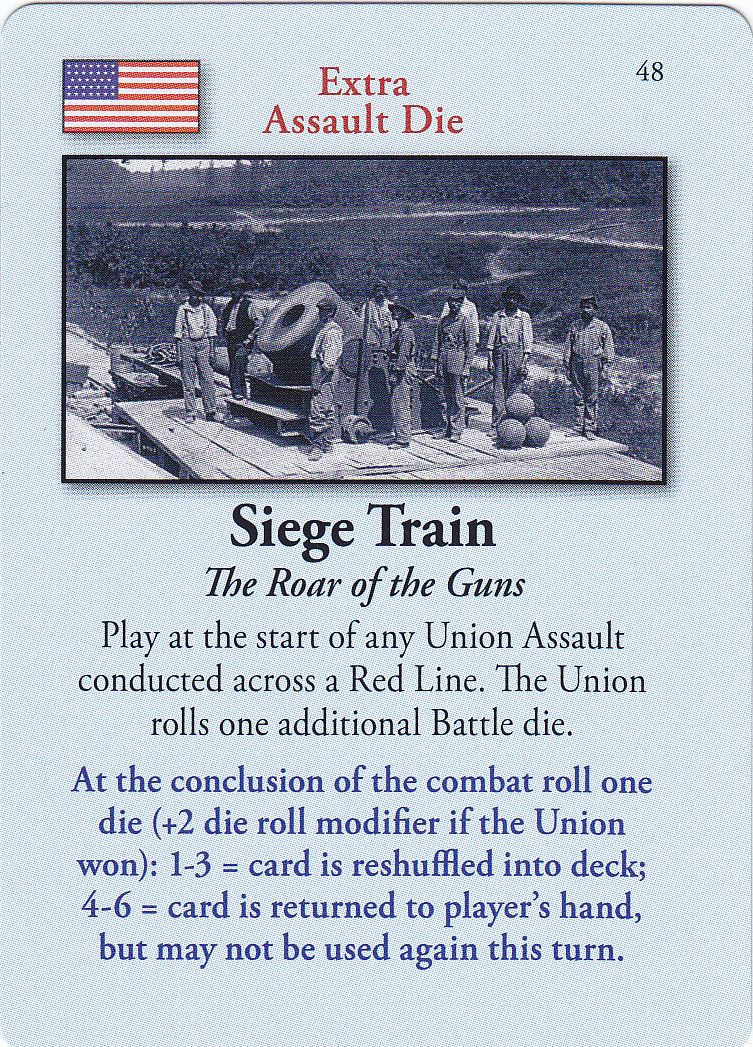
Chattanooga beckons, and using the Siege Train (Card 48) to add a fourth die and Union tactics (giving up two of those dice to gain a plus 2 advantage to his highest die) Brandon  attacks!  What would have been a tie (and thus a Union repulse) is saved by Grant (Card 8) who by virtue of his re-roll snatches victory from the jaws of defeat – and the city falls.  Again, the South loses precious VPs both from the battle and from the loss of the city.  

The South takes some (very) small Southern Comfort as the Union fails the die roll that would have allowed Brandon to keep the Siege Train card, and back into the deck it goes.

 Hardly pausing to shrug off this minor disappointment, Brandon presses on to attack the undefended space at Kennesaw Mountain, which easily falls – and this costs the South a pair of VPs due to the difference in battle dice.  This space is important, as it is adjacent to Atlanta – the jewel and iron foundry of the South.  Its loss would be dearly felt by the Confederacy, for so many reasons.

Brandon places the two Ironclads he built last turn in the Union river ports, along with the free gunboat the North gets there each turn, and places the two Screw Sloops he also built last turn, along with a free gunboat, in the Navy Yards.  He buys TWO extra Attack Pawns – meaning he will be able to conduct FOUR Assaults next turn.


To be Continued….


Tuesday, June 11, 2013

This day 150 years ago in Rebel Raiders’ History

-Dedicated to Civil War episodes, battles, people and ships that also appear in my game, GMT’s Rebel Raiders on the High Seas.

June 11, 1863  -  Grant Brings Up the Big Guns

            Historical Event:  As the siege of Vicksburg tightens, Grant brings up two monstrous 10-inch Columbiads and places them in firing positions a mere 100 yards from the Rebel front lines.  The huge guns begin pounding the city daily, forcing its civilian population to dig underground shelters.


            Game Connection:  Union Card 48 – Siege Train – gives the Union an additional die in assaults by land.  This bonus can be decisive, especially when faced with heavily defended cities such as Vicksburg, one of the keys to victory in the Civil War, just as it is in Rebel Raiders on the High Seas.


Wednesday, June 5, 2013

Boardgamegeek Praises, Recommends Rebel Raiders in After Action Report

In an after action report posted on June 3, on Boardgamegeek,  J.R. Tracy calls Rebel Raiders on the High Seas:  "a surprisingly light and breezy (in a good way) treatment of a sprawling topic. The vast scope of the naval war was captured in a way that still left room for a little tactical nuance in terms of deployment and combat resolution. The cards add a lot of flavor...."

To read the after action report (which begins with a brief AAR of a short Advanced Squad Leader game) go to:

http://www.boardgamegeek.com/blogpost/20077/aar-3-june-2013-advanced-squad-leader-rebel-raid


More Praise for Rebel Raiders:

"A very entertaining game," says John Bolash in a posting last week on ConSimWorld.  "Oodles of choices to make and opportunities for variation."

...and this from Steve Duke, commenting on the postings on my blog of the  Replay of the game between Naval Historian Brandon Musler and myself (which will resume tomorrow with Turn 6)....

"I think it says a lot (in a good way) that the designer wants to play his game after all the toil to produce it. I hear sometimes/often that is not the case."

Tuesday, June 4, 2013

Rebel Raiders Replay  (Turn  5)
Designer Mark McLaughlin as CSA; Naval Historian Brandon Musler as USA

When we left off last time, the Union had gained its first big victories, taking the port of St. Augustine and the fort space at Island No. 10…

Turn 5 – August 1862…Blockade Runner Captains Rethinking Career Choices…

Six Blockade Runners are caught in the Union net! Four of them loaded!  The Francis Bonneau card   comes out again, giving the South a much needed free Blockade Runner.  Even with Bonneau, only 8 VP of cargo make it through.  A desperate attempt to clear out the Blockade Station at Norfolk in a one-on-one gunboat sortie fails, and the Blockade Runner in the port has to take its chances getting out – and is promptly intercepted by the Union.

At least now the growing fleet of Raiders is taking a toll – sweeping up 10 VP for the South. 

Batteries are placed in Memphis and Nashville in response to the Union push down the River to Island No. 10.   The new Ironclad appears in Memphis, along with a Gunboat.  Three Blockade Runners and a Raider are built, and 20 VP is spent to place a Battery in Savannah. 

The Rebel spy A Rose by Any Other Name (Card 82) allows Mark a sneak peak at two cards from the Union hand, and Mark chooses to discard the Engine Breakdown  (Card 47) which can immobilize Rebel Ironclads, as this could seriously hamper his defense of Memphis, which now has two Ironclads and two Gunboats with its Batteries.  

...Be Vewy, Vewy Quiet, Wewe Hunting Webel Waiders...eh eh eh eh eh

The Union, its blockade now solid on the Atlantic Coast and with gunboats filtering around into the Gulf ports as well, decides it has such as surfeit of Screw Sloops that it can afford to go hunting Raiders.    Brandon has been sending out single sloops to search for and sit beside Raiders (this later tactic means the South can not just sit in one spot and raid-raid-raid, as it would be subject to increasingly better searches, but must move and thus give up at least one of those raid attempts).   Now he is send out stacks to hunt them…no luck at first, but the “happy time” for Raiders is drawing to its end.

Rather than take on the massive force at Memphis, Brandon sends his river fleet to Henry & Donelson, where he destroys the battery but TWICE fails the attack rolls, leaving it in Rebel hands.  (See Illustration Below).

 Brandon builds two more Ironclads, a Gunboat and two Screw Sloops.


To be continued…..


Saturday, June 1, 2013

Rebel Raiders Replay  (Turn 3)
Designer Mark McLaughlin as CSA; Naval Historian Brandon Musler as USA

When we last left our intrepid gamers, the Union had been rebuffed twice at Louisville, and the Confederacy was enjoying the first “happy time” running the blockade…


Turn 3 – December 1861

The “happy time” is no more.  The Thin Blue Line rounds up THREE Blockade Runners in the Caribbean (one fewer than the South built last turn), and all of those were stacked with cargo, so it is a double loss!  The remainder manage to unload a mere 7 VP – most of which is eaten up by the attrition roll in the Supply Phase – and the two Raiders contribute nothing, finding no targets to sink or ransom.

 (NB: The South wants VP to build extra ships and defenses, buy extra cards and counterattacks – but also needs VP to keep getting three cards a turn).

Fortunately the Tredegar Iron Works  (Card 95) gives the South an extra battery, one of which goes to setting down an Ironclad.  (The others are placed in Savannah and, as seems fitting, Richmond, where those Iron Works were situated).    The South also builds a Raider and 3 Blockade Runners (to replace the 3 it lost), and spends 20 VP to build an Ironclad.

Brandon, despite not liking the odds, decides to go for Louisville again.  The South wins but Brandon plays “Lack of Brains” (Card 7) forcing a re-roll.  This turns the battle around and the Union takes Louisville!

Heady with victory, Brandon decides to rush for Nashville, which has no Battery, so it is two Rebel to one Yankee die.  The Union rolls a “1” and the South a “6”, which instead of a loss of merely 5 VP is doubled to 10 by play of Card 102 - Matthew Brady. To add insult to injury, this card also requires the Union to discard a card at random from its hand as further penance for its battlefield loss.   

At the start of the Union Build Phase the Confederacy plays Corruption (Card 58) – increasing the cost to build Union ships this turn and forcing the discard of Yankee Guns (Card 3) – which gives the Union Screw Sloops and Ironclads some re-rolls.


The North builds 3 Screw Sloops….which cost 2 each not just 1 due to Corruption.


Thursday, May 30, 2013

Rebel Raiders Replay
Designer Mark McLaughlin as CSA; Naval Historian Brandon Musler as USA

My old friend Brandon knows more about naval warfare and naval games than just about anybody I know, and as he had invited me to NYC where lives to hear a lecture at the Soldiers and Sailors Club that night, we decided to make a full day of it by gaming Rebel Raiders.  Although the Playbook offers many optional rules for advanced and enhanced play that “spice up the game considerably with added variability,” as Brandon put it, we decided to stick with just the basic game as this is where all new gamers should start.

 Turn 1 – April 1861

As the Confederates I open with Card 96 – “The Most Daring Blockade Runner” Francis Nathaniel Bonneau.  This gives me a free Blockade Runner in Havana, loaded with a 2 VP cargo and immune to interception this turn.  I also play Card 94 -  To the Dark Shores, putting bonus VP cargo on three foreign ports ..AND then I also play Card 83 - Trent Affair – a prerequisite for play of cards that can be quite detrimental to the Union (Royal Navy and Maximillian) should I draw them.

Playing my entire starting hand at once is lot a shot across the bow to Brandon, letting him know this game is not going to start slow.

My first move is to take the Raider that begins in New Orleans (historically Raphael Semmes and his CSS Sumter) out into the Gulf – and she is immediately caught and sank!  (A bad opening omen for the South). I send out my six Blockade Runners to load cargo, and hover offshore in international waters rather than use up all of their movement points just to leave them vulnerable to Union searches in the Blockade Stations or Coastal Areas.   Bonneau, of course, does come home to deliver his cargo.

The Confederacy places batteries at Louisville (taking Kentucky) and Wilmington, to guard a Blockade Runner I built there.  Two other Blockade Runners are built in other fortified Atlantic ports, and another Blockade Runner and a Raider are built in Europe..

The Union moves to reinforce the blockade but eschews land combat, preferring not to risk losing VPs in attacks where the Union rolls only 1 die and the South 2 – and where the South wins ties.   As Brandon put it:  “I’m a numbers kind of guy, and the odds aren’t even 50-50.”

He plays Card 30 - Gustavus Fox to get some free gunboats for this and subsequent turns.


To be continued…..


Wednesday, May 29, 2013

This day 150 years ago in Rebel Raiders’ History

-Dedicated to Civil War episodes, battles, people and ships that also appear in my game, GMT’s Rebel Raiders on the High Seas.


Silly Ships of the Civil War: The “Double-Ender” Gunboat Design Pays Off

May 29, 1863

            Historical Event:  The “double-ender” gunboat USS Cimarron captured the Confederate blockade runner Evening Star as she tried to slip through the close-in blockade of Wassaw Sound, Georgia.   The “double-ender” sidewheel design incorporated a rudder at each end so the ship could go in either direction without having to turn around.  They were designed specifically for service in narrow inland waterways.
            The USS Cimarron was constructed in New Jersey and outfitted at the Philadelphia Navy Yard in 1862.  The 860-ton vessel could only make 10 knots, but carried a powerful arsenal of eight guns:  six 24-pound howitzers, one 9-inch smoothbore and one 100-pound rifle.  She participated in several engagements and caught three blockade runners during her service, the first of which was the ill-fated “Evening Star” she took as a prize on May 29, 1863.

            Game Connection:   The Confederate player relies on his Blockade Runners to bring in cargo that translates into badly-needed Victory Points.  These points are vital to Southern production, as they can be traded in for the additional ships, batteries, cards and counterattacks needed to match the growing industrial behemoth of the North.   Gunboats play a key role in making it more difficult for these ships to deliver the goods, as gunboats can stack up in the Blockade Stations, thus increasing the odds of intercepting the Rebel vessels as they try to enter and then leave Rebel ports.

USS Cimarron, courtesy U.S. Naval Historical Center.


Tuesday, May 28, 2013

 "Inside the Box" of Rebel Raiders by The Gaming Gang - and some "Wow" Praise

Jeff McAleer of The Gaming Gang has an 11-minute "inside the box" preview of Rebel Raiders.  His preview is very upbeat, and he says especially nice things about the Playbook  - "I love the GMT Playbook!" says Jeff, because it includes "historical info,"  "how to play the game," and "rules for advanced play."   All of that, says Jeff, "really helps turn a light bulb on in my head."

http://thegaminggang.com/2013/05/tgg-inside-the-box-rebel-raiders-on-the-high-seas-from-gmt-games-video/


Two AARs of the game were posted on Consimworld this weekend.

"We'll definitely play again"

Allen Hill in his report called it "A fun game, not least for providing detail to the naval campaign while abstracting the land struggle.  The Union player has to be prepared to watch blockade runners and raiders roll successfully time after time, with nothing to do for it, but then the tide turns as the Union economy and land forces grow in strength and effectiveness. We'll definitely play again!"

"All I can say was....WOW!"...."What a great strategic game!"

Pat Kairns wrote in his comments: "It's rare that a game 'grabs me' as quickly as RR."...and "This IMHO is a MUST play game!"  "What a great strategic game" and "had a blast!"