Showing posts with label Confederate. Show all posts

Tuesday, August 13, 2013

“American Civil War games are very popular in Japan”

Rebel Raiders – In Japanese?

“American Civil War games are very popular in Japan” 

My old friend, the renowned artist Rodger MacGowan made that comment when he sent me the photos (see below) of the Japanese language edition of Rebel Raiders on the High Seas.

“Based on my contacts in Japan and the photos I have seen on the web from Japan,” Rodger told me, “the American Civil War is a very popular subject among wargamers in Japan today.”

Rodger should know, he has been doing covers of my games for 30 years – including all of my Civil War titles, from the early 1980s Army of the Potomac, Army of the Tennessee pairing that combined make Mr. Lincoln’s War right up to, of course, Rebel Raiders on the High Seas.


Look for more Rebel Raiders images on his website, and for major coverage of Rebel Raiders in an upcoming issuing of his C3i magazine.


Wednesday, August 7, 2013

Kentucky in the Civil War: Speed Bump or Trap Play?

Rebel Raiders Strategy Question #1:

Kentucky in the Civil War:  Speed Bump or Trap Play?

At the WBC (World Boardgaming Championships) convention in Lancaster last week, I got into an interesting discussion about the role of Kentucky, most notably Louisville, in Rebel Raiders on the High Seas (as well as in other Civil War games and in history).   It began with this comment from my friend Evan:


“Why would any Rebel player in their right mind NOT invade Kentucky on turn one?”

In Rebel Raiders as in many Civil War games the South goes first.  That means it can get into Kentucky and take Louisville before the North, presenting the Union with a fait d’accompli.   In Rebel Raiders the South takes it by simply placing in Louisville one of the two batteries they can build in a turn.  The South then rolls two dice, and loses the difference in Victory Points.

Evan put forth the notion that this is a no-brainer move.  It is an “in-your-face” challenge to the Union to take this initially neutral city, and it blocks the Ohio – which means any Union warships built in Cincinnati cannot join the Union fleet on the Mississippi unless and until Louisville is taken.  In addition, he pointed out, it protects Nashville.

“What Rebel player in his right mind doesn’t take Louisville on turn one?” He reiterated.  I answered: “me.”

While Evan is not WRONG, I see Louisville not as a speed bump but as a trap play. 

First, the Union never has to take Louisville back from the South – not to win, not even to attack Nashville – which can be assaulted by hitting Forts Henry and Donelson out of Cairo.  So that means the battery may never fire a shot, and that he Victory Points lost will never be recovered.

Second, if the South does not take Louisville, the North might just be tempted to grab it – and that uses up one of their attacks (although in 1861 their attack odds are poor, they can still get lucky in a fight in an undefended port or fort space).  It also means the North has to roll two dice, and give the South the difference in the roll as Victory Points.  The maximum difference is only FIVE – but that is enough to build a Blockade Runner or Gunboat for the South.  It is as much as five Blockade Runners can bring home in a turn from going to any ports other than the two big European ones.

Third, the battery that is used to take Louisville for the South is better used anywhere else:  at Nashville or Forts Henry and Donelson, for example, or at Island No. 10 or Memphis – and that is just in that same theater of operations.  In addition, compensating for the Victory Points expended to take Louisville, as noted above, means extra work for the Blockade Runners – or, if the difference between the dice is the full Five, it means it cost the South a ship it could have built – either a gunboat for defense or a Runner to make points.

The Yankee Case: Louisville is an easy victory and a jumping off point.

There are, of course, those who see Louisville in a different light.  A Union Louisville does open up Cincinnati as an extra shipyard to build up the Mississippi Squadron more quickly.  It does threaten Nashville from the land side – which means the South has to worry about Tennessee being invaded from another direction, and if Nashville falls the North can immediately strike either Memphis or Chattanooga before the South can react (assuming the North took Nashville on its first attack of the two it gets each turn, or that the Union purchased or has cards that give it additional attacks).

Bottom Line:  Both Sides are Right

As in many games (and many wars) both sides make a good argument for why Louisville is or is not important.  Next time you play Rebel Raiders, which way will you jump?

(Photo below shows a Union Louisville - top center, yellow square with round blue marker with white star - and a Union controlled Island No. 10, with a fleet at Cairo.)


Tuesday, August 6, 2013

The Ships of Rebel Raiders - The Ironclads

 Rebel Raiders on the High Seas is a strategic game of the Civil War which focuses on the role of the navies on the rivers, along the coasts and on the oceans.  While most ships are represented by generic counters for Ironclads, Blockade Runners, Gunboats, Screw Sloops and, of course Raiders, there are cards and corresponding counters for many individual vessels.  This series presents those cards and offers a glimpse into the history of these storied ships.

Part IV– The Union Ironclads :   Black Terror – The $8.63 Ironclad

The art of military deception was alive and well in the American Civil War, and there is perhaps no greater example of this, at least on the naval side, than the story of the Black Terror (as represented by USN Card 25).  A “mock” ironclad, it was built in 12 hours for a cost of $8.63 and sent downriver with the current in February 1863.  Its mission was to scare the Confederates into abandoning construction on a real warship  (the USS Indianola, which they had captured and were repairing for use on the Mississippi).

It worked.  The Confederates, fearful that this menacing warship belching smoke from two stacks and with a dozen guns poking out from all sides would recapture the USS Indianola, set their prize on fire and blew her sky-high  (see illustration below).  The flotilla of Rebel rams scurried away rather than face this “Black Terror” – a mountain of a ship that was painted all black, with smoke billowing from tar pots and wooden “Quaker” guns and which bore in bold letters on her (phony) paddle-wheel housing the warning “Deluded People Cave In.”

As the Rebels fled, the dummy ironclad drifted on for two miles until running aground on a sandbar – at which point she was “captured” by Rebel Partisan Rangers.


 While the Union press of course had a field day with this story, the Confederate newspapers took it quite well.  As The Richmond Examiner put it, may as well “laugh and hold your sides lest you die of a surfeit of derision.”


Thursday, August 1, 2013

The Ships of Rebel Raiders - The Ironclads

Part IV– The Union Ironclads :   USS Passaic – The Giant Monitor

First in a class that would bear her name, USS Passaic (USN Card 28) was one of the few Navy ships – and perhaps the only ironclad – which President Abraham Lincoln himself visited.  A week later she and the USS Monitor (USN Card 19) were caught in a storm off Cape Hatteras.  She survived only by bailing, pumping and throwing overboard all of her shot;  USS Monitor was less fortunate, foundering and going to her grave beneath the stormy waves.

With her mighty guns (an 11-inch and a 15-inch Dahlgren) the USS Passaic was a powerful addition to Samuel Francis DuPont’s (USN Card 54) South Atlantic Blockading Squadron of Charleston.  In addition to capturing a blockade runner, the outgoing cotton-laden Glide,  (a rarity for the lumber ironclads) she took part in DuPont’s abortive April 1863 assault on Charleston Harbor.  After repairs she rejoined the squadron and was chosen by its new commander, John Dahlgren (USN Card 31) as his flagship.  He directed the attack on Fort Moultrie from her pilot house.  When her sister ship USS Lehigh (USN Card 22) was driven aground (see my blog post from yesterday) the USS Passaic offered covering fire and help pull her to safety.


Friday, July 26, 2013

The Ships of Rebel Raiders - The Ironclads

Rebel Raiders on the High Seas is a strategic game of the Civil War which focuses on the role of the navies on the rivers, along the coasts and on the oceans.  While most ships are represented by generic counters for Ironclads, Blockade Runners, Gunboats, Screw Sloops and, of course Raiders, there are cards and corresponding counters for many individual vessels.  This series presents those cards and offers a glimpse into the history of these storied ships.

Part IV– The Union Ironclads : USS Carondelet  “Pook’s Turtle” vs. Hood
  
USS Carondelet (USN Card 15) was a City-Class ironclad built in the Missouri city for which it was named.  One of the shallow-draft “Pook’s Turtles” designed by Samuel Pook, she was commissioned at Cairo in January 1862 and was one of the first and most powerful ships in the Western Gunboat Flotilla of Flag Officer Andrew Foote (who is one of the Union leaders in Rebel Raiders).

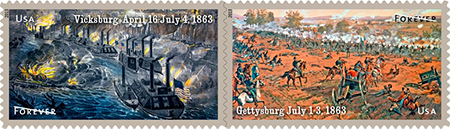
The ironclad fought at Forts Henry and Donelson , Island No. 10, and Memphis, and was badly damaged in a close action duel with the Confederate ironclad CSS Arkansas on the Yazoo River.  She was repaired in time to run the guns at Vicksburg in April 1863 (see U.S. Postage stamp shown below), and was also part of the Red River Fiasco (represented in the game by CSN Card 76).


USS Carondelet survived that disaster, and went back up the Cumberland in December 1864 to duel with Rebel artillery during the Nashville campaign – and later pouring heavy fire into the flank of John Bell Hood’s army when General Thomas counterattacked.  (Hood and his last, desperate effort to turn the tide are represented by CSN Card 89, which bear’s the luckless general’s name).


Wednesday, July 24, 2013

What Gamers Are Saying about Rebel Raiders:


“Fun and pretty darn grounded historically;”  “what an ingenious game!” 

“Simple to play, very good for solitaire…thanks for taking the risk and breaking new ground.”

 Gamers continue to say good things about Rebel Raiders on the High Seas.  Here are just a few comments we have received this week:

Panzer Digest magazine: “Fun and pretty darn grounded historically;” 

-“Katie and I welcome Mark McLaughlin – designer of that truly awesome game at GMT: Rebel Raiders.  It’s both fun and pretty darn grounded historically considering the scale – and keeping it playable!”


Michael Syrett  (from Scotland):   “Simple to play, very good for solitaire…thanks for taking the risk and breaking new ground.”
  
“As a veteran board gamer and purchaser of GMT products (I have 30 of your games), I’d like to congratulate Mark McLaughlin and Fred Schachter on their excellent new offering Rebel Raiders on the High Seas.  The naval war between the States has been the one aspect of ACW gaming that has been sadly neglected.  This game, along with Iron & Oak, more than fills the gap.  It is simple to play, very good for solitaire – yet covers most of the key events.  It is right up there among my top five favourite games.  Many thanks for taking the risk and breaking new ground.”
  
Paul Pressler (on Consimworld):  “what an ingenious game!”  “We have had a really great time!”

 My brother and I just finished playing four straight games of Rebel Raiders starting in 1861 each time.  We have had a really great time!  What an ingenious game! It’s easy to play but really brings out a flavor for the war and covers aspects of the war never covered by other games on the war.  Covering the Blockade Running, Confederate Raiders aspects of the war lets the war be seen in its full international scope, which helps one to fully understand the conflict.  Good job on that!  The assortment of Confederate and Union cards was well thought out and guaranteed that each game was different from the other.”

Saturday, July 20, 2013

The Ships of Rebel Raiders - The Ironclads

Rebel Raiders on the High Seas is a strategic game of the Civil War which focuses on the role of the navies on the rivers, along the coasts and on the oceans.  While most ships are represented by generic counters for Ironclads, Blockade Runners, Gunboats, Screw Sloops and, of course Raiders, there are cards and corresponding counters for many individual vessels.  This series presents those cards and offers a glimpse into the history of these storied ships.

Part III – The  Rebel Ironclads: CSS Virginia

…and why the iconic duel with the USS Monitor was such a “dud”


“The CSS Virginia was not the first ironclad warship in history, nor in the Civil War, nor even in the Confederacy,” notes historian James McPherson in his new book War Upon the Waters, but she is the most famous.  CSS Virginia, which is represented in Rebel Raiders by its own counter and card (CSN Card 70) is best known for being the Confederate side in the first duel of ironclad warships (her opponent being the USS Monitor – also represented in Rebel Raiders by a counter and card (USN Card 19).

Built up from the captured bones of the USS Merrimack in Norfolk, the CSS Virginia mounted six 9-inch Dahlgren smoothbores (three per side) and four Brooke rifles (a pair of 7-inchers forward, a pair of 6.4-inchers aft).  The iron casemate, which was rolled out in a single piece at Tredegar Iron Works (represented in Rebel Raiders by the production rules and CSN Card 95) was bolted onto the hull and then pierced to allow the placement of the guns. She also mounted a seven-foot iron ram (which nearly proved her undoing when it got stuck into the USS Cumberland whom she rammed in the Battle of Hampton Roads in March 1862).

“A novelty in naval construction,” as Confederate Secretary of the Navy Stephen R. Mallory called her (Mallory is also in Rebel Raiders as CSN Card 78) she took on the Union blockading fleet in Hampton Roads, sinking the USS Cumberland, compelling the USS Congress to strike her colors and forcing the USS Minnesota to run aground.  It was upon returning the next day to finish off the last of those when she met the USS Monitor

Unfortunately (or, rather, fortunately for the crews) neither ship was at her best in that fight.  The Union shells were charged with only 15 pounds of powder out of fear they would blow up in the guns (later tests showed they could handle three times that amount) and the Confederates brought only explosive shell, not solid shot or iron bolts, as they expected to face only wooden warships.  As a result although they battered away at each other, scoring hit after hit, neither could inflict any serious damage on the other.

Although technically a draw, CSS Virginia did retire to port – never to fight again.  She was burned by the Rebels to prevent her capture by Union forces advancing on Norfolk.


Friday, July 19, 2013

The Ships of Rebel Raiders - The Gunboats

Rebel Raiders on the High Seas is a strategic game of the Civil War which focuses on the role of the navies on the rivers, along the coasts and on the oceans.  While most ships are represented by generic counters for Ironclads, Blockade Runners, Gunboats, Screw Sloops and, of course Raiders, there are cards and corresponding counters for many individual vessels.  This series presents those cards and offers a glimpse into the history of these storied ships.

Part II – The Gunboats:  A Victory for The Mosquito Fleet Rams

Not all of the Confederacy’s gunboats were more boat than gun, to paraphrase one of their commanders.  The Rebel River Defense Fleet under Captain James Montgomery (who appears in Rebel Raiders as one of the two Confederate naval leaders counters) had one very good day – that day was May 10, 1862, in what became known as “The Battle of Plum Point Bend.”

In preparation for the attack on Fort Pillow, the Union ironclad USS Cincinnati was escorting a mortar boat (of the type portrayed in Rebel Raiders by USN Card 2 – David Dixon Porter & His Little Mortar Boats) when they were suddenly surprised by all eight ships of  Montgomery’s flotilla.  Three rams steamed quickly to hit the USS Cincinnati in succession (CSS General Price, CSS General Bragg and CSS General Sumter).

 The Union ironclad USS Mound City tried to come to the aid of the sinking USS Cincinnati, but was in turn set upon by another ram,  CSS General Van Dorn, which despite being pounded by “broadside after broadside” from the Union warship, as an officer aboard recalled, the Rebel ram came on, struck and “tore away nearly half of our forecastle (and) opened an awful hole in our bows.” To save the ship and crew, the captain of the USS Mound City ran her aground on a sandbar.

 Montgomery, promoted to flag officer for his victory, upon his return to Memphis boasted that after Plum Point Bend the Union fleet would “never penetrate farther down the Mississippi.”

He was wrong.  The Union raised the USS Cincinnati and repaired both her and USS Mound City, brought in their own rams  (as depicted by USN Card 38 – USS Queen of the West or Ellet’s Ram) and drove down the river to take on Montgomery and his Mosquito Fleet (CSN Card 81) in full view of the citizens of Memphis.  Montgomery went out to meet them, bravely announcing as he left the dock that “you may see Lincoln’s gunboats sent to the bottom by the fleet which you have built and manned.”

That was June 6, less than a month after his victory at Plum Point Bend.  Within minutes of the engagement three of his eight ships were sunk; the other five, with Montgomery aboard, fled downriver, the Yankees in hot pursuit.  During the 10-mile running fight four of the Rebel ships were sunk; only the CSS General Van Dorn got away.


Thursday, July 18, 2013

The Ships of Rebel Raiders - The Gunboats

Rebel Raiders on the High Seas is a strategic game of the Civil War which focuses on the role of the navies on the rivers, along the coasts and on the oceans.  While most ships are represented by generic counters for Ironclads, Blockade Runners, Gunboats, Screw Sloops and, of course Raiders, there are cards and corresponding counters for many individual vessels.  This series presents those cards and offers a glimpse into the history of these storied ships.

Part II – The Gunboats: The Mosquito Fleet Rams at New Orleans

“The Mosquito Fleet” (CSN Card 81) represents the rag-tag little squadrons the South hastily cobbled together to defend their ports from the Union Navy.  One such force supported the ironclad CSS Manassas in the battle at Forts Jackson and St. Philip below New Orleans in late April 1862.

While the CSS Manassas is represented in the game (as CSN Card 71), the vessels that accompanied her are represented by the generic Gunboat counters, one or two of which may be added to a Confederate defense by play of The Mosquito Fleet (CSN Card 81).   General Mansfield Lowell had purchased and armed 14 civilian craft for his flotilla in the late winter of 1862 – but was ordered to send more than half of them upriver to Memphis to join Commander Montgomery’s river defense force (see my posting for July 15: http://markgmclaughlin.blogspot.com/2013/07/the-ships-of-rebel-raiders-gunboats_15.html)

When David G. Farragut and his massive Union fleet made their move on the forts below his city, Lowell had only six of his armed riverboats left, a force that even the Confederate secretary of war lamented was “a peculiar one.”  (Lowell himself admitted that his group had “little or no discipline” and was “too much ‘steamboat’ and too little of the man-of-war’ to be very effective.”  Still, when Farragut’s gunboats and screw sloops broke through the barrier of Hulks, Rafts and Chains (as represented in Rebel Raiders by CSN Card 110) Lowell and his makeshift flotilla were there to meet him.

While the turtle-shaped ironclad CSS Manassas   was the spearpoint of Lowell’s counterattack against the screw sloops (notably the massive USS Mississippi – represented in the game by USN Card 23), his gunboats closed with their Union counterparts.  The J.C. Breckinridge and Governor Moore worked together to each ram and sink the USS Varuna, then headed for the USS Cayuga – but were driven off by the fire of another Union gunboat, USS Oneida.  (USS Cayuga broke through the line of Rebel ships, surprised five companies of militia in their camp, who after taking a few rounds from the gunboat became the first Confederate regiment to surrender to a Union gunboat).


Lowell fought on, sending fireships down the river, but after the USS Mississippi’s guns pummeled and set afire the CSS Manassas, the fight was over.  Farragut  (USN Card 1) in the USS Hartford (USN Card 37), along with the USS Brooklyn (USN Card 13) and the rest of the fleet steamed forward, the forts already partially silenced by David Dixon Porter and his Little Mortar Boats (USN Card 2).   From there, it was on to New Orleans for the Union fleet.   As for Lowell, all but one ship in his Mosquito Fleet was lost.


Monday, July 15, 2013

The Ships of Rebel Raiders - The Gunboats


Rebel Raiders on the High Seas is a strategic game of the Civil War which focuses on the role of the navies on the rivers, along the coasts and on the oceans.  While most ships are represented by generic counters for Ironclads, Blockade Runners, Gunboats, Screw Sloops and, of course Raiders, there are cards and corresponding counters for many individual vessels.  This series presents those cards and offers a glimpse into the history of these storied ships.

Part II – The Gunboats: The Mosquito Fleet- Montgomery at Memphis

“The Mosquito Fleet” (CSN Card 81) represents the rag-tag little squadrons the South cobbled together for the defense of Memphis and Mobile Bay.  Civilian vessels to which a gun or two and crew were hastily added, and to which bales of cotton, stacks of lumber or other makeshift defenses were added, these hopelessly outclassed and outgunned little ships and their brave crews performed far better than any could expect or demand. 

The two Confederate naval officers who led those forces --- Commander James Montgomery at Memphis and Admiral Franklin Buchanan at Mobile Bay – are both represented by stand-up Leader counters and Fleet Command Boxes on the lower left of the map.  (Players may take a stack of ships and place them in a Fleet Command Box and replace them on the map with the corresponding Leader – there are two such for the South, four for the North).

Montgomery had eight ships in his “Mosquito Fleet” at Memphis in June 1862.  Undergunned and underpowered, they were no match for Colonel Charles Ellet and his seven ships, which included five ironclads and two rams.   (Two of those ships, the  ironclad USS CarondeletUSN Card 15 – and the ram, USS Queen of the WestUSN Card 38, are in the game).    Needless to say, Montgomery, though gallant, did not prevail.


Sunday, July 14, 2013

This day 150 years ago in Rebel Raiders’ History


-Dedicated to Civil War episodes, battles, people and ships that also appear in my game, GMT’s Rebel Raiders on the High Seas.  

July 13, 1863 merits a second entry (in addition to yesterday's post noting the start of the New York draft riots)...and ps: Happy Bastille Day!

July 13, 1863 – (Part II) – “Infernal Machines” Sink Union Ironclad

            Historical Event:    The ironclad USS Baron de Kalb was sunk this day 150 years ago by a Confederate “infernal machine” (a “torpedo” as they called it but what we today would dub a naval mine).   The ironclad was part of the Union force that captured Yazoo City  (on the river of the same name) during the mopping up operations that followed the surrender of Vicksburg and Port Hudson (see my blog entries for July 3 and July 8, respectively:    http://markgmclaughlin.blogspot.com/2013/07/this-day-150-years-ago-in-rebel-raiders.html   and http://markgmclaughlin.blogspot.com/2013/07/dedicated-to-civil-war-episodes-battles.html

            Game Connection:    Ironclads are vital to the Confederacy to defend its ports and for the Union to battle through the batteries, sink Rebel ships and clear the way for the Army to land during an assault in Rebel Raiders on the High Seas.   Whether fighting into an ocean port or up or down the Mississippi or Yazoo, the Union player does have to take into account that the Rebel player can play many cards to impede his progress.  One of those is Infernal Machines (CSN Card 56). 


Saturday, July 13, 2013

This day 150 years ago in Rebel Raiders’ History


-Dedicated to Civil War episodes, battles, people and ships that also appear in my game, GMT’s Rebel Raiders on the High Seas,  

July 13, 1863New York City Burns – the Draft Riots

            Historical Event:   On July 13, 1863 names were pulled from a drum in New York City to fill a draft for the Union Army.  As the rich could buy their way out of service and freed Blacks were excluded from conscription, poor whites – most of them Irish immigrants – felt the draft unfair.  What began as a protest against the draft turned into a riot, and one further fueled by racial tensions as more than a dozen Blacks were lynched and the Colored Orphans’ Asylum set ablaze.  Troops, including several New York regiments that had fought at Gettysburg only 10 days before, were called home to restore order, which they did by July 16, but only after more than 100 people had died and 20 times that many or more had been injured.

            Game Connection:   “Northern Draft Riots” is one of the “Pro-Confederacy Optional Rules” available in the Playbook for Rebel Raiders on the High Seas.  The likelihood of the riots occurring is directly related to how well (or, more accurately, how poorly) the North is doing in the war.  Should they occur, that turn the Union may not purchase additional assaults or buy extra cards, due to the disruption and distraction of riots in New York (along with growing anti-war sentiment in other Northern cities).

Note the drawing below that was originally featured in The Illustrated London News in July 1863:


            For more on the Riots, see my article on examiner.com:    http://www.examiner.com/article/150-years-ago-this-weekend-new-york-burned


Friday, July 12, 2013

The Ships of Rebel Raiders - The Gunboats


Rebel Raiders on the High Seas is a strategic game of the Civil War which focuses on the role of the navies on the rivers, along the coasts and on the oceans.  While most ships are represented by generic counters for Ironclads, Blockade Runners, Gunboats, Screw Sloops and, of course Raiders, there are cards and corresponding counters for many individual vessels.  This series presents those cards and offers a glimpse into the history of these storied ships.

Part II – The Gunboats: USS/CSS Queen of the West - A Gunboat Under Two Flags

While many blockade runners were caught by the Union and turned into gunboats, the USS Queen of the West, is unique – this Union gunboat was captured by the South and turned against the Yankees on the Mississippi

Known as “Ellet’s Ram” this ship (represented in Rebel Raiders as (USN Card 38) was a side wheel steamer  built at Cincinnati before the war.  Colonel Charles Ellet, Jr, fitted her out as a ram and led her and other ships in the attack on Memphis in June 1862.  Ellet was mortally wounded but his ship fought on.  A month later, along with the ironclad USN Carondelet (USN Card 15) and the timber-clad gunboat USS Tyler (USN Card 18) she engaged the Rebel ironclad ram CSS Arkansas (see my posting of July 11).  The fight went badly for the Union, although the USS Queen of the West limped away and lived to fight another day.

Unfortunately, that other day was February 2, 1863.  The valiant ship rammed the Rebel armed steamer City of Vicksburg in a battle fought under the guns of the fortress for which that Confederate ship was named.   The USS Queen of the West took heavy damage and was set afire in at least two compartments.  She fought on, however, driving ashore two more Confederate gunboats – the steamers O.W. Baker Moro and Beruick Bay.  She then went up the Red River and on Valentine’s Day she captured yet another Rebel vessel – the steamer Era No.  Unfortunately as she reached Gordon’s Landing on the Black River she was ambushed by Confederate artillery – at which point she struck her colors.


The Confederacy wasted no time in raising its own flag over the vessel, but went against all naval custom and instead of renaming her ran her as CSS Queen of the West.  She fought well for the South, until she ran into a trio of Union warships on Atehafalaya River on April 14, 1863.  Battered and set afire, she drifted with the current until running aground and exploding.


Thursday, July 11, 2013

The Ships of Rebel Raiders - The Gunboats


Rebel Raiders on the High Seas is a strategic game of the Civil War which focuses on the role of the navies on the rivers, along the coasts and on the oceans.  While most ships are represented by generic counters for Ironclads, Blockade Runners, Gunboats, Screw Sloops and, of course Raiders, there are cards and corresponding counters for many individual vessels.  This series presents those cards and offers a glimpse into the history of these storied ships.

Part II – The Gunboats: USS Tyler


USS Tyler (USN Card 18).  A “timberclad” gunboat, the former river merchant ship from Cincinnati became one of the most famous ships in the Western Flotilla.  She participated in the bombardment of Forts Henry and Donelson, provided key gunfire support at Shiloh, fought at Island No. 10 and dueled with the ironclad CSS ArkansasUSS Tyler survived that fight to take part in operations at Vicksburg and up the Yazoo and White Rivers into Arksansas.  Her last service was a mission of mercy, as she helped save the crew of the SS Sultana north of Memphis at the end of April 1865.


The Timberclad Takes on the Ironclad

In July 1862 the USS Tyler along with USS Queen of the West  and USS Carondelet (represented in Rebel Raiders by USN Card 38 and USN Card 15, respectively)  went hunting for the Confederate ironclad ram, CSS Arkansas.   Unfortunately, on July 15 they found her.  The USS Carondelet, being an ironclad, led the way – only to be disabled by the Confederate warship.  USS Queen of the West, a sidewheel gunboat also known as “Ellet’s Ram” was also knocked out of the action, leaving the timber-reinforced gunboat USS Tyler to duel with the iron monster all on her own.  The battle became a running fight down the Yazoo, as the USS Tyler sought and finally reached the protection of the Union fleet at the confluence of the Yazoo and MississippiCSS Arkansas then broke off the action, and steamed on to Vicksburg, where she was welcomed with flags flying.


Saturday, July 6, 2013

The Ships of Rebel Raiders - The Gunboats


Rebel Raiders on the High Seas is a strategic game of the Civil War which focuses on the role of the navies on the rivers, along the coasts and on the oceans.  While most ships are represented by generic counters for Ironclads, Blockade Runners, Gunboats, Screw Sloops and, of course Raiders, there are cards and corresponding counters for many individual vessels.  This series presents those cards and offers a glimpse into the history of these storied ships.

Part II – The Gunboats: USS Osceola

The USS Osceola  (USN Card 9).  Built in Boston as a “fighting tow,” she took part in operations on the James River and against Fort Fisher in 1864.  Capable of speeds of up to 15 knots, the heavily armed (nine guns) warship also helped clear a minefield and supported the landing of Union troops at Bermuda Hundred.


As part of the North Atlantic Squadron the ship was also part of the inshore blockade, and had many an encounter with enemy vessels, one such instant Commander Clitz, then officer commanding, describes in a report he send to Admiral David Dixon Porter on November 1, 1864.

“I have to inform you that yesterday at 11 o’clock a.m., when in latitude 33 55’ N., longitude 75 45’ W.,  discovered black smoke bearing N.W., distant about 15 miles.  Gave chase immediately and continued to do so until about 8:45 p.m. The chase was a side wheel steamer, painted white, with two masts and two smokestacks.  She was either a blockade runner or a privateer, I think the later, as her decks were crowded with men.   When first discovered she was steering towards Wilmington (N.C.) but we pressed her so hard she was compelled to change her course to every point of the compass.  At sunset we were about 4 miles from said steamer, opened fire with the forward 100-pounder Parrot rifle, firing five shots; finding that they fell short, discontinued the firing, but continued to follow until the time above mentioned, when we lost her in a fog bank.
            “We kept up a uniform speed of 13 ½ knots during the entire chase.

            “I think that I can safely say but for the darkness and fog it would have been our good fortune to have captured her.”


Friday, June 21, 2013

Rebel Raiders Replay  (Turn 12 –December 1864)

Designer Mark McLaughlin as CSA; Naval Historian Brandon Musler as USA

When we left off, the South was burning.  Two Rebel attempts to retake Vicksburg failed. New Bern, Atlanta, Montgomery  and New Orleans fell to the Union, completing the Northern conquest of "The Father of Waters." It is, hopefully, the final turn, and if the South, in the negative victory point range, can manage to hold on to Richmond it can still squeeze out a win.

The Albemarle Sallies Forth!

Just to show the South can still fight at sea, Mark plays the CSS Albemarle (Card 75).  The only Southern Ironclad that can go beyond Blockade Stations and into Coastal Waters, it stands a chance of breaking a hole in the Blockade.  Brandon tries to stop her coming out of Charleston with Engine Breakdown (Card 47) but the plucky iron devil keeps coming, sinks the Union Gunboat on the Blockade Station and engages the single Screw Sloop offshore – which sinks her.   Perhaps Albemarle, too, was built by Acme – Charleston Branch.  (That same Sloop catches the Blockade Runner that was trying to get into Charleston).


Once More On To Vicksburg

The Rebel Counterattack is launched once again at Vicksburg.  Should this counter-attack fail, Baton Rouge, Corinth and Meridan will “wither on the vine” as they have no cities to supply them…and with them will go the Ironclad CSS Virginia, which retreated from New Orleans to Baton Rouge.

Third time, it seems, IS a charm – and the South regains Vicksburg!  Virginia promptly works up steam and goes in to help defend the regained city – which in the Build Phase gets the one Battery the South can still build (losing Atlanta reduces Battery builds from two to one; loss of Richmond would cost the other).

The South is still in negative VPs  but is not dead yet.

One More Push

The North is in a pickle.  It has two ways to win:

-1.  Take 16 of the 20 Rebel cities, which MUST include all three key Mississippi cities (Vicksburg, Memphis, New Orleans), PLUS EITHER Richmond OR Atlanta, and have the South at negative VP.  OR

-2. Take the three key Mississippi cities (Vicksburg, Memphis, New Orleans), PLUS Richmond AND Atlanta – and if the South is at negative VP at that moment the game ends immediately.

Ten cities are in Yankee control, so to get the first it would need Six Assaults – Brandon shows that he has the Sea to Shining Sea (Card 24) that would give him two assaults in ADDITION to the Four he bought – however, the two extras are only good for attacking Ocean Ports in bonus Amphibious Attacks.     It is a great card, but he would need to win ALL SIX battles (one of them Vicksburg) to meet the first victory condition.

Brandon does not bother; he announces he will go for Vicksburg and Richmond – although getting there means he has to take a space adjacent to the Southern Capital.  That means he must win THREE out of FOUR Combats.    Fortunately, however, Brandon has Loose the Fateful Lightning (Card 34), which gives him a FIFTH Assault where he needs it.


Five Battles  - and Bobby Lee

With his powerful Ironclad fleet on the river, Vicksburg, even with Virginia and a Battery, is no match.  It falls in one Assault.

Brandon takes his second attack on Fredericksburg – and runs into BOTH  Bobby Lee (Card 60) and Stonewall Jackson (Card 104).  The dice and re-rolls are too much for the North, and Brandon is repulsed….unfortunately for the South, however, Jackson is killed!


Assault number three is Fredericksburg again – this time, the Union takes it.

Assault number four is Richmond – and Lee holds!

The Union, however, has that fifth and final assault left thanks to Loose the Fateful Lightning….  the Union dice total is higher by ONE than the South…Can Lee pull off one last miracle re-roll to change the outcome.

Sadly, for the South, the answer is no….

On the very last die roll of the very last turn, the South Falls – victory to Brandon and the Union, which holds 12 cities – including the five all-important ones of New Orleans, Vicksburg, Memphis, Atlanta and, finally, Richmond.

 ....The Union is restored....


Thursday, June 20, 2013

Rebel Raiders Replay  (Turn 11 –August 1864, Part II)

Designer Mark McLaughlin as CSA; Naval Historian Brandon Musler as USA

The South is being rendered to shreds by the North.  With their stunning and hard-fought naval victory at New Orleans, the Union has complete control of the Mississippi.  Atlanta is next....but first, one more strike at the Coast, as Brandon continues his efforts to sweep the seas of Rebel Raiders and Blockade Runners...

New Bern – and Coeur de Lion

Using the Coeur de Lion (Card 44) to tow a bunch of Ironclads, Brandon hits New Bern on the Atlantic Coast.  The “blizzard of fire” as one bystander watching over Brandon’s shoulder remarks, sweeps the city clean of all traces of the Secession.

For good measure, Brandon hunts down Raiders, sinking one in the chilly waters of the North Atlantic.

The Burning of Atlanta

The Navy done, now it is time for the Army.  Grant takes Atlanta with ease.  The Union plays War is Cruelty (Card 6) to attack out of Atlanta into Montgomery; even with having one fewer die (as the card notes), the city is an easy capture, as there is no Battery and the South has no card to help. The special VP penalty Atlanta's loss entails does not faze the staggering Confederacy from a Victory Points' perspective - as they can not be driven down below negative 5 VP.   

Brandon bought four Assaults and used three (War is Cruelty gave a bonus breakthrough attack).  Seeing Mark’s Counterattack sitting there on the turn record, Brandon takes that fourth and final Assault into Augusta.   This is not a city but a fort space, but by taking it (and Montgomery) he has built a cordon around Atlanta – Mark will not be able to Counterattack that jewel of the South, with its now permanently razed arsenal, as he will have no place from which to launch his assault.

Brandon plays Gideon Welles (Card 29) to draw the top three cards from his deck; he keeps one, discards two, reshuffles and then draws four cards (it is 1864). He buys two more Assaults, and yet another card to build his hand to its maximum size of six (Cards may be purchased at a cost of 2 builds per).
  
To be Continued….