Showing posts with label blockade runnders. Show all posts

Monday, August 26, 2013

USS Housatonic: First Warship to be Sunk by a Submarine

The Ships of Rebel Raiders    - The Men o’ War

Rebel Raiders on the High Seas is a strategic game of the Civil War which focuses on the role of the navies on the rivers, along the coasts and on the oceans.  While most ships are represented by generic counters for Ironclads, Blockade Runners, Gunboats, Screw Sloops and, of course Raiders, there are cards and corresponding counters for many individual vessels.  This series presents those cards and offers a glimpse into the history of these storied ships. 

USS Housatonic:  First Warship to be Sunk by a Submarine

 The mighty USS Housatonic (USN Card 27)  was the first warship to be sunk by a submarine  (falling victim to the  CSS Hunley – CSN Card 73 in Rebel Raiders).  Before that fateful encounter that night in February 1864, however, the USS Housatonic earned other honors, most of them while blockading the very harbor, Charleston, in which she would be sunk.

Launched at the Boston Navy Yard in November 1861, USS Housatonic was one in a class of four powerful screw sloops, each capable of moving under sail or steam, and each carrying 11 guns – including a 100-pounder Parrot rifle, three 30-pouner Parrot rifles, and an 11-inch Dahlgren along with a mix of other rifles, guns and howitzers. 

Assigned to the South Atlantic Blockading Squadron off Charleston, her first capture came in January 1863 when, working with the gunboat USS Unadilla (USN Card 17) she cornered and then sent boarding parties to seize the Princess Royal.  The blockade runner was carrying engines, armor and ordnance meant to equip a pair of rebel ironclads.  At the time USS Housatonic was hailed for having been responsible for capturing “the war’s most important single cargo of contraband.”

The South knew this as well, and sent two ironclad rams out of Charleston to try to recover the Princess Royal, which USS Housatonic was attempting to refloat after having driven her aground.  Initially successful in driving back Union gunboats, the two ironclads could not contend with the massive broadsides of the mighty screw sloop – and soon retired under the protection of Charleston’s guns, leaving USS Housatonic with her prize.  

USS Housatonic took many other prizes off Charleston, bombarded her forts and frequently sent landing parties ashore to harry the Rebels, seize prisoners and conduct raids. 

No wonder  that  when the Confederates launched their first submarine, USS Housatonic was chosen as the target for the CSS Hunley.


Friday, August 23, 2013

USS New Ironsides: U.S. Navy’s First Armored Steam Frigate

The Ships of Rebel Raiders    - The Men o’ War

Rebel Raiders on the High Seas is a strategic game of the Civil War which focuses on the role of the navies on the rivers, along the coasts and on the oceans.  While most ships are represented by generic counters for Ironclads, Blockade Runners, Gunboats, Screw Sloops and, of course Raiders, there are cards and corresponding counters for many individual vessels.  This series presents those cards and offers a glimpse into the history of these storied ships.


USS New Ironsides:  U.S. Navy’s First Armored Steam Frigate


The first of a new breed of modern warships, the USS New Ironsides (USN Card 26) was an ocean-going, wooden-hulled, armored man-o-war; a true battleship, with plenty of big guns, powerful steam engines – and even a ram, just in case.

Protected by 4.5 inches of belt armor, the USS New Ironsides would be hit many, many times by the Confederate guns she dueled with at Charleston and Fort Fisher – but like her namesake, the original “Old Ironsides” (USS Constitution) most shots seemed to bounce off; she was never seriously damaged by enemy fire.  USS New Ironsides, however, did have the dubious distinction of being the first victim of a submarine (technically a “semi-submersible torpedo boat”)– when the CSS David (CSN Card 65) set off a spar torpedo on October 5, 1863.  Damage, however, was minor – USS New Ironsides remained on station.

 (In Rebel Raiders, if the Confederate player declared an attack with the CSS David card on a Union warship, say the USS New Ironsides, each side would roll one die, with the Confederate player adding one to his die if his target is the only warship in the port or blockade space.  If the Confederate die roll is higher, the Union ship is sunk.)

USS New Ironsides was the flagship for Rear Admiral Samuel Francis DuPont (USN Card 54) during the April 1863 naval attack on Fort Sumter and the other defenses of Charleston harbor, and went back into the harbor for the second attack on Charleston.  She also supported the abortive assault by the gallant 54th Massachusetts (as depicted in the movie, Glory) on Fort Wagner, and took part in the two bombardments of Fort Fisher, the second of which resulted in a Union victory in January 1865.  


Decommissioned and laid up in Philadelphia after the war, she was the victim of an accidental fire, allegedly caused by a watchman’s unattended stove, and burned and sank in December 1866.


Wednesday, August 21, 2013

USS Mississippi (USN Card 23) “Largest Ship in the U.S. Navy”- Perry’s Flagship

The Ships of Rebel Raiders    - The Men o’War

Rebel Raiders on the High Seas is a strategic game of the Civil War which focuses on the role of the navies on the rivers, along the coasts and on the oceans.  While most ships are represented by generic counters for Ironclads, Blockade Runners, Gunboats, Screw Sloops and, of course Raiders, there are cards and corresponding counters for many individual vessels.  This series presents those cards and offers a glimpse into the history of these storied ships.


USS Mississippi (USN Card 23) “Largest Ship in the U.S. Navy”- Perry’s Flagship

......and the bane of Confederate Coffee Drinkers!


When Commodore Matthew Perry went to Japan he wanted to make a big impression – and so he chose the biggest vessel he could find for his flagship.  At over 3,300 long tons, in 1861 the USS Mississippi (USN Card 23) was easily the largest ship in the fleet.  Having served in the Mexican War, she was also already a veteran combatant. 

As the Civil War broke out, USS Mississippi was sent to blockade Key West, and within less than a week on station, captured an inbound blockade runner packed with Brazilian coffee (a highly-prized commodity the South would do without for four years). The massive warship was then sent to the mouth of the river whose name she bore -  and while on blockade duty captured another coffee ship, thus depriving the Confederacy of much-needed caffeine.

When David Glasgow Farragut took on Forts Jackson and St. Phillip in April 1862, USS Mississippi was with him – and it was two massive broadsides from her huge Paixhans Guns that wrecked the Confederate ironclad ram, CSS Manassas. (CSN Card 71).  (Farragut is a leader counter in the game and appears on three cards – giving strategic and tactical advantages on USN Cards 33 and 1, respectively, and with his presence on the map allowing play of the card marking his flagship, USS Hartford – USN Card 37).


Despite protestations by Captain Melancton Smith that her displacement and length made her unsuited for operations upriver, in March 1863 Farragut sent her to support the attack on Port Hudson. As Smith feared, she grounded while under enemy fire.  Smith and his exec, George Dewey (of Manila Bay fame over 40 years later), struggled mightily to refloat her – but Confederate gunners could not miss this huge, immobilized target.  Smith finally gave the order to scuttle her – and when the fires he set reached her magazine, the largest ship in the U.S. Navy became a part of the river with which she shared her name.


Tuesday, August 20, 2013

USS Powhattan: From Porter to Dahlgren, From First Shots to Last

The Ships of Rebel Raiders    - The Men o’War

Rebel Raiders on the High Seas is a strategic game of the Civil War which focuses on the role of the navies on the rivers, along the coasts and on the oceans.  While most ships are represented by generic counters for Ironclads, Blockade Runners, Gunboats, Screw Sloops and, of course Raiders, there are cards and corresponding counters for many individual vessels.  This series presents those cards and offers a glimpse into the history of these storied ships.

USS Powhattan: From Porter to Dahlgren, From First Shots to Last


When Fort Pickens in Florida was threatened by Secessionists in early April, it was the powerful USS Powhattan (USN Card 21)  which was dispatched to ward them off.  President Lincoln tried to recall her from that mission and send her instead to show the flag at Fort Sumter, but Lt. David Dixon Porter set sail before the change in orders could reach him.   That was probably fortunate for him and his ship,  for although this modern sidewheel steam frigate 16 guns – including ten 9-inch and one 11-inch Dahlgren smoothbores, and five 12-pounders – it would have been no match for the massed batteries in Charleston Harbor – guns which would pulverize Sumter that month and ward off fleets of ironclads over the next four years.

Porter (USN Card 2) went on to other fronts (notably commanding the mortar boats at New Orleans, as depicted on his card for Rebel Raiders),  while USS Powhattan went on without him to Charleston, where she chased down blockade runners (catching several prizes) and battered the defenses of Fort Fisher over Christmas, 1864.  Her guns later supported the landing and assault which led to Fisher’s capture three weeks later.

After the war, USS Powhattan took on another Dahlgren – Rear Admiral John Dahlgren, the designer of the guns she carried.  He chose her as his flagship for the South Pacific Squadron, and sailed aboard her to Valparaiso to guard American shipping and interests during the Chincha Islands War.  Dahlgren appears in Rebel Raiders twice – once on a card with his name (USN 31) and as the inspiration for USN Card 3 “Yankee Guns.”


Saturday, August 17, 2013

August 17, 1863 – “Swamp Angel” In Place To Shell Charleston

This day 150 years ago in Rebel Raiders’ History

-Dedicated to Civil War episodes, battles, people and ships that also appear in my game, GMT’s Rebel Raiders on the High Seas,  

August 17, 1863 – “Swamp Angel” In Place To Shell Charleston


            Historical Event:   On this day in 1863 Union forces completed one of the most amazing engineering feats of the war.  They unveiled a massive siege gun, which would earn the nickname “Swamp Angel,” as they readied a new bombardment of Charleston and its defenses.  The huge 8-inch 200-pounder Parrot Rifle was installed in secret by soldiers who worked nights in 30-man teams to create a road and gun platform in a swamp by vertically driving huge logs 20 feet through the soft mud into the sandy substratum below, then adding a layer of pine logs, earth and sand bags on top.  It took 450 men to drag the 12-ton gun into position (which they did in two parts, the heavier carriage first, then the barrel) – and then to ferry powder and shot and shell – including incendiary rounds filled with a combustible fluid of gun-designer William Parrot’s own invention -  “Solidified Greek Fire.”    Firing would commence on August 21, with devastating and demoralizing if not decisive effect - and would conclude two days later when a the breech exploded, dismounting the gun.  That final shot, however, the 36th launched by the mighty weapon, hit its target.  The "Swamp Angel" never fired again - her position being taken over by a pair of giant siege mortars.

            Game Connection:    Attacking Confederate ports is a tough job for the Union, especially if they are as heavily fortified as was Charleston.  Massive mortars and huge guns like the “Swamp Angel” were often used to aid the Army and the Navy in its attacks, and are represented by USN Card 48 – Siege Train.  As the card (see below) notes, when used successfully, it is returned to the player's hand for use on another turn.


Tuesday, August 6, 2013

The Ships of Rebel Raiders - The Ironclads

 Rebel Raiders on the High Seas is a strategic game of the Civil War which focuses on the role of the navies on the rivers, along the coasts and on the oceans.  While most ships are represented by generic counters for Ironclads, Blockade Runners, Gunboats, Screw Sloops and, of course Raiders, there are cards and corresponding counters for many individual vessels.  This series presents those cards and offers a glimpse into the history of these storied ships.

Part IV– The Union Ironclads :   Black Terror – The $8.63 Ironclad

The art of military deception was alive and well in the American Civil War, and there is perhaps no greater example of this, at least on the naval side, than the story of the Black Terror (as represented by USN Card 25).  A “mock” ironclad, it was built in 12 hours for a cost of $8.63 and sent downriver with the current in February 1863.  Its mission was to scare the Confederates into abandoning construction on a real warship  (the USS Indianola, which they had captured and were repairing for use on the Mississippi).

It worked.  The Confederates, fearful that this menacing warship belching smoke from two stacks and with a dozen guns poking out from all sides would recapture the USS Indianola, set their prize on fire and blew her sky-high  (see illustration below).  The flotilla of Rebel rams scurried away rather than face this “Black Terror” – a mountain of a ship that was painted all black, with smoke billowing from tar pots and wooden “Quaker” guns and which bore in bold letters on her (phony) paddle-wheel housing the warning “Deluded People Cave In.”

As the Rebels fled, the dummy ironclad drifted on for two miles until running aground on a sandbar – at which point she was “captured” by Rebel Partisan Rangers.


 While the Union press of course had a field day with this story, the Confederate newspapers took it quite well.  As The Richmond Examiner put it, may as well “laugh and hold your sides lest you die of a surfeit of derision.”


Monday, August 5, 2013

The Healing and Teaching Power of Board Games

My "Napoleonic Wars" Cited as Useful in "Dealing With Stress" and for "Leadership Lessons"

Award-winning fellow wargamer  and noted business consultant Scott Pfeiffer featured my Napoleonic Wars boardgame in an article on his company's blog.  Entitled "Dealing With Stress: Lessons from a Boardgame,"  Scott not only said many complimentary things about it ("Trust me, this is a great game,") but also demonstrated how games, and my game in particular, can help teach people and the companies they run or work for some good lessons in how to deal with stress, especially in hard times.

For the full article, please go to http://marshallfredrickco.com/On_Business/stress-boardgame/

On a related note, consultant Richard Bliss mentioned my Napoleonic Wars in his piece in Forbes entitled "Juicy Leadership Lessons...From Boardgames?"

http://www.forbes.com/sites/netapp/2013/07/31/leadership-lessons-boardgames/

....

Thursday, August 1, 2013

The Ships of Rebel Raiders - The Ironclads

Part IV– The Union Ironclads :   USS Passaic – The Giant Monitor

First in a class that would bear her name, USS Passaic (USN Card 28) was one of the few Navy ships – and perhaps the only ironclad – which President Abraham Lincoln himself visited.  A week later she and the USS Monitor (USN Card 19) were caught in a storm off Cape Hatteras.  She survived only by bailing, pumping and throwing overboard all of her shot;  USS Monitor was less fortunate, foundering and going to her grave beneath the stormy waves.

With her mighty guns (an 11-inch and a 15-inch Dahlgren) the USS Passaic was a powerful addition to Samuel Francis DuPont’s (USN Card 54) South Atlantic Blockading Squadron of Charleston.  In addition to capturing a blockade runner, the outgoing cotton-laden Glide,  (a rarity for the lumber ironclads) she took part in DuPont’s abortive April 1863 assault on Charleston Harbor.  After repairs she rejoined the squadron and was chosen by its new commander, John Dahlgren (USN Card 31) as his flagship.  He directed the attack on Fort Moultrie from her pilot house.  When her sister ship USS Lehigh (USN Card 22) was driven aground (see my blog post from yesterday) the USS Passaic offered covering fire and help pull her to safety.


Wednesday, July 31, 2013

The Ships of Rebel Raiders - The Ironclads

Rebel Raiders on the High Seas is a strategic game of the Civil War which focuses on the role of the navies on the rivers, along the coasts and on the oceans.  While most ships are represented by generic counters for Ironclads, Blockade Runners, Gunboats, Screw Sloops and, of course Raiders, there are cards and corresponding counters for many individual vessels.  This series presents those cards and offers a glimpse into the history of these storied ships.
  
Part IV– The Union Ironclads :   USS Lehigh- The Medal of Honor Ironclad

No ship in U.S. Naval history has had more crew members receive the Medal of Honor for a single action than the ironclad monitor USS Lehigh.  Among the five was one with a name he had – and did – live up to:  Seaman Horatio Nelson Young.

When John Dahlgren (USN Card 31) took over command of the Union the fleet opposite Charleston from Samuel Francis DuPont (USN Card 54) in the summer of 1863, he brought with him an exceptionally powerful new ironclad monitor: the USS Lehigh (USN Card 22).  Mounting a 15-inch Dahlgren smoothbore and an 8-inch (or 150-pound) Parrott Rifle inside a turret protected with 11 inches of armor, USS Lehigh was one of the lead ships in Dahlgren’s repeated attempts to knock out Fort Sumter and Fort Moultrie, two of the most important of the man guardians of Charleston Harbor.  

The ironclad engaged with Sumter many times between September 1 and late November, including engaging in an almost daily duel over a three week period.  On November 16 the ship was so badly pounded that she was driven aground – and it was for freeing her while under deadly fire that Seaman Young and four other crewman were honored with the nation’s highest decoration.

(See the photo below, courtesy of the Naval Historical Society, which shows the numerous dents on her turret from that fight).

Sent back to Port Royal for repairs, the Medal of Honor ship returned to duty off Charleston in January, where she continued to pound away at Rebel batteries and forts until the city succumbed to Sherman’s advancing armies.


Friday, July 26, 2013

The Ships of Rebel Raiders - The Ironclads

Rebel Raiders on the High Seas is a strategic game of the Civil War which focuses on the role of the navies on the rivers, along the coasts and on the oceans.  While most ships are represented by generic counters for Ironclads, Blockade Runners, Gunboats, Screw Sloops and, of course Raiders, there are cards and corresponding counters for many individual vessels.  This series presents those cards and offers a glimpse into the history of these storied ships.

Part IV– The Union Ironclads : USS Carondelet  “Pook’s Turtle” vs. Hood
  
USS Carondelet (USN Card 15) was a City-Class ironclad built in the Missouri city for which it was named.  One of the shallow-draft “Pook’s Turtles” designed by Samuel Pook, she was commissioned at Cairo in January 1862 and was one of the first and most powerful ships in the Western Gunboat Flotilla of Flag Officer Andrew Foote (who is one of the Union leaders in Rebel Raiders).

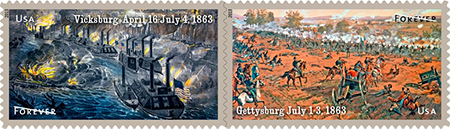
The ironclad fought at Forts Henry and Donelson , Island No. 10, and Memphis, and was badly damaged in a close action duel with the Confederate ironclad CSS Arkansas on the Yazoo River.  She was repaired in time to run the guns at Vicksburg in April 1863 (see U.S. Postage stamp shown below), and was also part of the Red River Fiasco (represented in the game by CSN Card 76).


USS Carondelet survived that disaster, and went back up the Cumberland in December 1864 to duel with Rebel artillery during the Nashville campaign – and later pouring heavy fire into the flank of John Bell Hood’s army when General Thomas counterattacked.  (Hood and his last, desperate effort to turn the tide are represented by CSN Card 89, which bear’s the luckless general’s name).


Wednesday, July 24, 2013

What Gamers Are Saying about Rebel Raiders:


“Fun and pretty darn grounded historically;”  “what an ingenious game!” 

“Simple to play, very good for solitaire…thanks for taking the risk and breaking new ground.”

 Gamers continue to say good things about Rebel Raiders on the High Seas.  Here are just a few comments we have received this week:

Panzer Digest magazine: “Fun and pretty darn grounded historically;” 

-“Katie and I welcome Mark McLaughlin – designer of that truly awesome game at GMT: Rebel Raiders.  It’s both fun and pretty darn grounded historically considering the scale – and keeping it playable!”


Michael Syrett  (from Scotland):   “Simple to play, very good for solitaire…thanks for taking the risk and breaking new ground.”
  
“As a veteran board gamer and purchaser of GMT products (I have 30 of your games), I’d like to congratulate Mark McLaughlin and Fred Schachter on their excellent new offering Rebel Raiders on the High Seas.  The naval war between the States has been the one aspect of ACW gaming that has been sadly neglected.  This game, along with Iron & Oak, more than fills the gap.  It is simple to play, very good for solitaire – yet covers most of the key events.  It is right up there among my top five favourite games.  Many thanks for taking the risk and breaking new ground.”
  
Paul Pressler (on Consimworld):  “what an ingenious game!”  “We have had a really great time!”

 My brother and I just finished playing four straight games of Rebel Raiders starting in 1861 each time.  We have had a really great time!  What an ingenious game! It’s easy to play but really brings out a flavor for the war and covers aspects of the war never covered by other games on the war.  Covering the Blockade Running, Confederate Raiders aspects of the war lets the war be seen in its full international scope, which helps one to fully understand the conflict.  Good job on that!  The assortment of Confederate and Union cards was well thought out and guaranteed that each game was different from the other.”

Thursday, July 18, 2013

The Ships of Rebel Raiders - The Gunboats

Rebel Raiders on the High Seas is a strategic game of the Civil War which focuses on the role of the navies on the rivers, along the coasts and on the oceans.  While most ships are represented by generic counters for Ironclads, Blockade Runners, Gunboats, Screw Sloops and, of course Raiders, there are cards and corresponding counters for many individual vessels.  This series presents those cards and offers a glimpse into the history of these storied ships.

Part II – The Gunboats: The Mosquito Fleet Rams at New Orleans

“The Mosquito Fleet” (CSN Card 81) represents the rag-tag little squadrons the South hastily cobbled together to defend their ports from the Union Navy.  One such force supported the ironclad CSS Manassas in the battle at Forts Jackson and St. Philip below New Orleans in late April 1862.

While the CSS Manassas is represented in the game (as CSN Card 71), the vessels that accompanied her are represented by the generic Gunboat counters, one or two of which may be added to a Confederate defense by play of The Mosquito Fleet (CSN Card 81).   General Mansfield Lowell had purchased and armed 14 civilian craft for his flotilla in the late winter of 1862 – but was ordered to send more than half of them upriver to Memphis to join Commander Montgomery’s river defense force (see my posting for July 15: http://markgmclaughlin.blogspot.com/2013/07/the-ships-of-rebel-raiders-gunboats_15.html)

When David G. Farragut and his massive Union fleet made their move on the forts below his city, Lowell had only six of his armed riverboats left, a force that even the Confederate secretary of war lamented was “a peculiar one.”  (Lowell himself admitted that his group had “little or no discipline” and was “too much ‘steamboat’ and too little of the man-of-war’ to be very effective.”  Still, when Farragut’s gunboats and screw sloops broke through the barrier of Hulks, Rafts and Chains (as represented in Rebel Raiders by CSN Card 110) Lowell and his makeshift flotilla were there to meet him.

While the turtle-shaped ironclad CSS Manassas   was the spearpoint of Lowell’s counterattack against the screw sloops (notably the massive USS Mississippi – represented in the game by USN Card 23), his gunboats closed with their Union counterparts.  The J.C. Breckinridge and Governor Moore worked together to each ram and sink the USS Varuna, then headed for the USS Cayuga – but were driven off by the fire of another Union gunboat, USS Oneida.  (USS Cayuga broke through the line of Rebel ships, surprised five companies of militia in their camp, who after taking a few rounds from the gunboat became the first Confederate regiment to surrender to a Union gunboat).


Lowell fought on, sending fireships down the river, but after the USS Mississippi’s guns pummeled and set afire the CSS Manassas, the fight was over.  Farragut  (USN Card 1) in the USS Hartford (USN Card 37), along with the USS Brooklyn (USN Card 13) and the rest of the fleet steamed forward, the forts already partially silenced by David Dixon Porter and his Little Mortar Boats (USN Card 2).   From there, it was on to New Orleans for the Union fleet.   As for Lowell, all but one ship in his Mosquito Fleet was lost.


Tuesday, July 16, 2013

The Ships of Rebel Raiders - The Gunboats

 Rebel Raiders on the High Seas is a strategic game of the Civil War which focuses on the role of the navies on the rivers, along the coasts and on the oceans.  While most ships are represented by generic counters for Ironclads, Blockade Runners, Gunboats, Screw Sloops and, of course Raiders, there are cards and corresponding counters for many individual vessels.  This series presents those cards and offers a glimpse into the history of these storied ships.

Part II – The Gunboats: The Mosquito Fleets Swatted:  Du Pont, Port Royal & Roanoke Island

“The Mosquito Fleet” (CSN Card 81) represents the rag-tag little squadrons the South hastily cobbled together to defend their ports from the Union Navy. While Montgomery at Memphis and “Old Buck” at Mobile put up grand if doomed fights (see my blog postings for July 15 and 16, respectively), the Mosquito Fleets at Port Royal and Roanoke Island never even had a chance.

The term “Mosquito Fleet” dates from the Mexican War, when the U.S. Navy formed a “Mosquito Division” of steam gunboats for coastal patrols and close in operations around Vera Cruz.   Its first known application in the Civil War came when a Union naval officer spied Commander Josiah Tatnall’s Rebel Squadron during the attack by the Navy in Port Royal Sound on November 7, 1861.  Tatnall, ironically, had commanded one of the ships of the “Mosquito Division” off Vera Cruz (USS Spitfire).

For the operation against Port Royal Captain Samuel Francis Du Pont  (represented in Rebel Raiders by USN Card 54) had amassed what historian James McPherson in his new book War Upon the Waters describes as “the largest fleet in American history to that time: seventeen warships with 157 guns, twenty-five colliers and supply ships, and thirty-three troop transports carrying 12,000 soldiers and 600 marines.”

(In order to place Du Pont on at least equal footing with the major general commanding the Army units, President Lincoln authorized his promotion to the rank of “Flag Officer,”  thus making Du Pont, the senior captain in the Navy, America’s first de facto admiral - he would eventually be promoted to rear admiral in July 1862.

Commander Josiah Tatnall had far, far less to defend Port Royal.  His small flotilla of six ships, most converted tugs, mounted less than a dozen guns among them – and weak guns at that.   Du Pont pealed off five of his gunboats to drive them back up the Beaufort River while his main battle fleet pounded Forts Walker and Beauregard into submission.

Three months later, another Mosquito Fleet tried to oppose the Union landings at Roanoke Island.  Captain William F. Lynch led eight small gunboats against Commander Stephen Rowan’s 13 much larger Union gunboats.  (These were part of Commander Louis M. Goldsborough’s flotilla that was supporting the landing by General Ambrose Burnside on the island).


Lynch sought to slow the Yankees with sunken hulks (similar to the Hulks, Rafts and Chains of CSN Card 110).  He fought valiantly, but briefly, and after one of his ships was sunk Lynch began to retire from the unequal contest.  Rowan, however, was not about to let him retreat.  He signaled his ships to “Dash at the enemy” and “dash” the Yankee gunboats did, chasing the Rebels up to Elizabeth City and the Dismal Swamp Canal, sinking six of the seven retreating Rebels in the process – thus in effecting “swatting” the mosquitoes by the very swamp from which they had spawned.


Wednesday, July 10, 2013

The Ships of Rebel Raiders - The Gunboats

  
Rebel Raiders on the High Seas is a strategic game of the Civil War which focuses on the role of the navies on the rivers, along the coasts and on the oceans.  While most ships are represented by generic counters for Ironclads, Blockade Runners, Gunboats, Screw Sloops and, of course Raiders, there are cards and corresponding counters for many individual vessels.  This series presents those cards and offers a glimpse into the history of these storied ships.

Part II – The Gunboats: USS Unadilla : From Charleston Runners to Chinese Pirates

USS Unadilla (USN Card 17) was one of the first of nearly two-dozen of the “90-day gunboats” churned out by Union naval yards during the first months of  the war.  Built and launched in New York, the nearly 700-ton warship could move under steam or sail (as her sail plan was that of a two-masted schooner)  and could make 10 knots.  She carried five guns, including an 11-inch Dahlgren.  In January of 1862 she and USS Pembina fought a naval battle against five armed gunboats, three of which were damaged before the Rebels withdrew.


In addition to fighting other warships, bombarding forts and floating batteries and other combats, USS Unadilla captured many a blockade runner off Charleston, the Mary Teresa being her first catch in May 1862. (Hence her plus 2 advantage on the “Speed” die – which is rolled to intercept blockade runners.) Among her many prizes was the Princess Royal, which was carrying English-built steam engines for Confederate ironclads.   After the war the USS Unadilla was sent to the Far East to fight Chinese pirates.  Her last voyage was to Siam in 1868 – where after seven years in service the “90 day gunboat” was condemned as being too unseaworthy to risk a return voyage.