Showing posts with label ironclads. Show all posts

Sunday, May 4, 2014

Ironclad CSS Albemarle: One Ship vs. a Union Blockading Squadron


This day 150 years ago in Rebel Raiders’ History

-Dedicated to Civil War episodes, battles, people and ships that also appear in my game, GMT’s Rebel Raiders on the High Seas.

May 5, 1864 –  Ironclad CSS Albemarle:  One Ship vs. a Union Blockading Squadron


Historical Event:   The Battle of Albemarle Sound was a rare event in the Civil War, as it was one of the few times a Rebel fleet initiated combat, let alone sortied to break the Union blockade in an amphibious operation, no less.  On May 5, 1864, however,  the Confederate Navy did just that, sending its newest and most feared ironclad ram, CSS Albemarle, into the body of water for which it was named.

 The Albemarle came down the Roanoke River with the gunboat CSS Bombshell and the troopship CSS Cotton Planter.  The goal of the operation was to recapture the key port of New Bern and thus break the Union blockade on North Carolina.  As Commander J.W. Cooke brought the ironclad out into the Sound, he found Captain Melancton Smith and his fleet of eight Union warships waiting for him.   Although heavily outnumbered as well as out-gunned, Cooke plowed ahead, confidant that Union shells would bounce off the thickly-armored, sloping casemate of the CSS Albemarle

Cooke’s faith in his warship was well placed, for the Yankee guns (even those firing 100-pound shot ) did little harm.  CSS Albemarle carried only two guns, 6.4-inch Brooke Rifles, but Cooke used them to good effect, gingerly moving them on their pivots to fire out of the six gun-port positions.  The captain of the USS Sassacus, frustrated and declaring that he might as well have been “firing blanks,” poured on the coal, built up to a speed of nearly a dozen knots and rammed the Confederate ram, knocking her so hard as she nearly foundered.  Cooke, however, righted his ship and poured fire at point-blank range into the Union vessel, causing many casualties and inflicting heavy damage.

Three other Union double-ender side-wheel gunboats circled about, adding their fire but each taking more damage than they gave.  USS Wyalusing and USS Mattabesett gave covering fire as USS Miami, armed with a spar torpedo, moved in for the attack, but Cooke evaded successfully.  Unfortunately, his consort, CSS Bombshell, being a mere gunboat, was so badly pounded that she was forced to strike her colors.  At that the troopship turned about and Cooke retired, his reason for fighting the Union fleet now moot.  


 Game ConnectionCSS Albemarle is one of the many named ships in Rebel Raiders on the High Seas.  Represented by a counter and card (CSN Card 75) she is one of the most powerful warships in the small but plucky Confederate Navy.  While the gunboat that accompanied her and the types of Union warships they fought on May 5, 1864 are represented by generic counters of their type, many another individual Yankee man-o-war is present with its own card and counter, as are the big Dahlgrens and other “Yankee Guns” they carried (USN Card 3).  New Bern is a key port in the game, as it was in the war, and holding on to or recapturing it is of great importance in Rebel Raiders on the High Seas.


Wednesday, April 30, 2014

April 30, 1864 – Union Fleet Escapes Red River Trap via “Bailey’s Dam”

This day 150 years ago in Rebel Raiders’ History

-Dedicated to Civil War episodes, battles, people and ships that also appear in my game, GMT’s Rebel Raiders on the High Seas.

April 30, 1864 – Union Fleet Escapes Red River Trap via “Bailey’s Dam”


Historical Event:   As if the Union campaign up the Red River had not been enough of a failure, falling waters trapped the fleet above the rapids at Alexandria.  Faced with the ignominious choice of either surrendering or scuttling the ships, Rear Admiral David Dixon Porter eagerly agreed to a scheme by a lieutenant colonel from the 4th Wisconsin, Joseph Bailey, to build a dam to raise the river.  Construction began on April 30. While Bailey built his dam and its attendant structures, Porter’s sailors lightened their vessels by unshipping many of their heavy guns and even removing some of the armor from the ironclads.  Two weeks later, with Confederate troops fast approaching, most of the fleet managed to ride the rapids to safety before the dam collapsed.   Porter, saying he was done with rivers, sought and took command of the North Atlantic Blockading Squadron.


Game Connection:  The Red River campaign is represented by a space on the map and a card played by the Confederates (CSN Card 76 – Red River Fiasco).  This is a design choice because few Union players would otherwise voluntarily commit such large forces, including their precious ironclads, to the complicated and highly problematic scheme concocted by Union General Henry Halleck.  Admiral Porter is also represented in the game, both as a stand-up leader and as a card (USN Card 2 – David Dixon Porter & His Little Mortar Boats).


Wednesday, March 12, 2014

March 12, 1864 – Red River Campaign: Disaster in the Making

This day 150 years ago in Rebel Raiders’ History

-Dedicated to Civil War episodes, battles, people and ships that also appear in my game, GMT’s Rebel Raiders on the High Seas.

March 12, 1864Red River Campaign: Disaster in the Making


Historical Event:  On March 12, 1864 a score of Union ironclads and gunboats began what would become an ill-fated campaign on Louisiana’s Red River.  Sailing in support of the invading army of General Nathaniel Banks, the fleet would eventually become trapped as water levels fell and Confederate resistance under Kirby Smith rose.  Only by dint of an engineering miracle that included the building of a dam would the fleet be saved.

Additional Event:  On this date in 1864 two blockade runners lowered their colors.   The sloop Persis surrendered to USS Massachusetts in Wassaw Sound, Georgia and the schooner Marion was captured by USS Arostook near Velasco, Texas.

Game Connection:  In Rebel Raiders on the High Seas, Blockade Runners like the Persis and Marion play a vital role in bringing in cargo to keep the South in the war.  To stop them the Union player deploys screw sloops, like the USS Massachusetts and gunboats, like the USS Arostook.  The sloops tend to stay offshore in the outer ring, while the gunboats patrol the blockade stations directly opposite the key Confederate ports.    While the above-named ships themselves are represented by generic ship counters of their type, many of their sister ships appear as named counters and on corresponding cards in Rebel Raiders on the High Seas.

The Red River campaign is represented by a space on the map and a card played by the Confederates (CSN Card 76 – Red River Fiasco).  This is a design choice because few Union players would otherwise voluntarily commit such large forces, including their precious ironclads, to the complicated and highly problematic scheme concocted by Union General Henry Halleck.


Wednesday, September 11, 2013

Rebel Raiders Replay: 1862 Jump Start Part II: 1863 The Nightmare Year


The Developer & A Naval Historian Team Up Against the Designer in the 1862 Scenario

As noted in Part I, the South built up a strong crust defense and repulsed almost all of the Union’s attacks in 1862, yet despite an initial “happy time” was all but swept from the seas.  On to 1863:  The Nightmare Year

1863 was a nightmare for the South on land.  The Union broke through the crust defense, playing Three Cigars (USN Card 45) which stopped Stonewall Jackson and any Confederate cards from being played and enabled the Northern capture of Richmond. On the following turn the Union cracked the line at Chattanooga – despite a stout defense of three Batteries and J.E. Johnston – and used Grant and Sherman  (USN Cards 8 and 50) and other cards to dash down to Atlanta.  Suddenly there were no arsenals to build Batteries and very few Blockade Runners to bring in cargo. There were also fewer Raiders to destroy Union commerce for Victory Points – and even if more had survived, each turn’s Supply Roll penalties for losing Atlanta and Richmond, as well as the regular one die roll (three dice in all each turn!) would have rendered their point contributions moot.

Thus, the rest of 1863 and into 1864 were very difficult for the Confederacy but Mark did not despair; he mounted inspired counterattacks to keep the South viable. The Union had built a cordon around Richmond by seizing Fredericksburg, Norfolk and Goldsboro but Lee and Jackson nonetheless staged a whirlwind campaign, first recapturing Goldsboro with a regular counter-attack and then Richmond itself with The South Shall Rise (CSN Card 107) to regain the capital of the Confederacy. After Island No. 10’s capture, successive waves of Yankee Ironclads and gunboats conquered Memphis, which the South successfully retook with a Counterattack.


The Union responded to this last Rebel Western Theatre offensive success by marching west out of Union-held Atlanta to seize Montgomery and Vicksburg via its land approach and then on to capture the Fort of Baton Rouge.   This was complemented, after several failures, by Farragut at long last capturing the fort guarding New Orleans from the Gulf. As the nightmare of 1863 came to an end, the South pinned its hopes on a pair of Virginia gentlemen hunkering down in a smoldering Richmond, and on New Orleans, which with its defense of three Batteries, a Gunboat, and an Ironclad though isolated remained defiant and unbowed. 

Tomorrow: 1864 the year the Union players Loose the Fateful Lightning....


Tuesday, September 10, 2013

Rebel Raiders Replay: 1862 Jump Start

 The Developer & A Naval Historian Team Up Against the Designer in the 1862 Scenario


For those who want to dive into the heat of the action, rather than do a slow burn, the alternate 1862 start scenario is the way to jump right into Rebel Raiders on the High Seas.  It begins with the Union half of the April 1862 turn. The Union enjoys a dream hand of cards that historically made that such a great month for the North – and a month after which, it was said, the South never smiled again.

Developer Fred Schachter and naval enthusiast Brandon Musler took charge of the Union, with Fred taking responsibility for the Gulf and Western Theater, and Brandon the Atlantic and Eastern Theater.   They began the game with a chance to conduct four attacks – as many amphibious as they wished – and three of four failed (save for Union capture of Key West).  Designer Mark McLaughlin rolled more “6s” on the dice than anyone should in a single or several turns, thus allowing the South to smile, perhaps a bit early, but grin broadly nonetheless.

What followed was a wonderful if lamentably brief “happy time” for the Confederacy. Its Blockade Runners brought in enough cargo to allow the purchase of two Batteries – in addition to the two normally earned each turn for the Atlanta and Richmond arsenals.  Mark employed his largesse to construct a strong “crust defense” by placing batteries at Memphis, Chattanooga, New Orleans, Mobile and Savannah.  This approach leaves the entrenchment of Richmond until later, entrusting its defense to Bobby Lee and Stonewall Jackson  (CSN Cards 60 & 104).  Mark deployed J.E. Johnston (Card 91) to command in the West and he also had cards in hand for the Ironclad CSS Manassas (CSN Card 71), Hulks, Rafts and Chains (CSN Card 110) and later the CSS Virginia (CSN Card 70) to help defend any port the Union chose to attack.

On land Confederate confidence was rewarded. For the remainder of 1862 the Union onslaughts were repeatedly repulsed, including two failed amphibious attacks on Galveston,  but at sea it was a different story. In four turns the South lost 25 blockade runners with the Union sinking them literally faster than they could be built.  As 1863 opened, there were more Raiders (five) at Sea than Blockade Runners. The number of Raiders would dwindle to three after the Union built packs of hunter-killer screw sloops.  For the remainder of the game the seas stayed blue in more ways than one.


Tomorrow Part II of the Replay: 1863, The Nightmare Year – but a Nightmare in Blue, or in Gray?


Thursday, August 22, 2013

Rebel Raiders Updated on VASSAL

Rebel Raiders Updated on VASSAL


A big Rebel Raiders' thanks to Joel Toppen, for making Rebel Raiders available on VASSAL and for once again updating it!

This is his announcement today of the update:

Version 1.3 of the Rebel Raiders VASSAL module is available:http://www.vassalengine.org/wiki/Module:Rebel_Raiders_on_the_High_Seas

Modifications include:
1. Made cargo counters smaller so they don't obscure MPs when stacked on ships.
2. Added Load/Unload functionality to Blockade Runners. Load will dispatch a cargo piece.
3. Added individual "Draw Cards" buttons to each hand window.
4. Added mouse-over zoom to hand windows.

Tuesday, August 6, 2013

The Ships of Rebel Raiders - The Ironclads

 Rebel Raiders on the High Seas is a strategic game of the Civil War which focuses on the role of the navies on the rivers, along the coasts and on the oceans.  While most ships are represented by generic counters for Ironclads, Blockade Runners, Gunboats, Screw Sloops and, of course Raiders, there are cards and corresponding counters for many individual vessels.  This series presents those cards and offers a glimpse into the history of these storied ships.

Part IV– The Union Ironclads :   Black Terror – The $8.63 Ironclad

The art of military deception was alive and well in the American Civil War, and there is perhaps no greater example of this, at least on the naval side, than the story of the Black Terror (as represented by USN Card 25).  A “mock” ironclad, it was built in 12 hours for a cost of $8.63 and sent downriver with the current in February 1863.  Its mission was to scare the Confederates into abandoning construction on a real warship  (the USS Indianola, which they had captured and were repairing for use on the Mississippi).

It worked.  The Confederates, fearful that this menacing warship belching smoke from two stacks and with a dozen guns poking out from all sides would recapture the USS Indianola, set their prize on fire and blew her sky-high  (see illustration below).  The flotilla of Rebel rams scurried away rather than face this “Black Terror” – a mountain of a ship that was painted all black, with smoke billowing from tar pots and wooden “Quaker” guns and which bore in bold letters on her (phony) paddle-wheel housing the warning “Deluded People Cave In.”

As the Rebels fled, the dummy ironclad drifted on for two miles until running aground on a sandbar – at which point she was “captured” by Rebel Partisan Rangers.


 While the Union press of course had a field day with this story, the Confederate newspapers took it quite well.  As The Richmond Examiner put it, may as well “laugh and hold your sides lest you die of a surfeit of derision.”


Monday, July 29, 2013

The Ships of Rebel Raiders - The Ironclads

Rebel Raiders on the High Seas is a strategic game of the Civil War which focuses on the role of the navies on the rivers, along the coasts and on the oceans.  While most ships are represented by generic counters for Ironclads, Blockade Runners, Gunboats, Screw Sloops and, of course Raiders, there are cards and corresponding counters for many individual vessels.  This series presents those cards and offers a glimpse into the history of these storied ships.


Part IV– The Union Ironclads :   USS Roanoke  The “Acme” Ironclad – A great idea that worked – in theory


“Great ideas that work – in theory” is the motto emblazed on the crates of the Acme Company from which Wile E Coyote of Looney Tunes orders strange devices in his never-ending efforts to catch The Roadrunner.  If Acme made an ironclad, it would have been the USS Roanoke (USN Card 20 in Rebel Raiders on the High Seas).

Originally built as a steam frigate in 1855 and successful in catching blockade runners early in the war, she was chosen for a pilot conversion program and rebuilt not just as an ironclad but as a massive triple-turreted ocean-going ironclad.  The decision to do so was made by Secretary of the Navy Gideon Welles (USN Card 29), whom Chief of Steam Engineering Benjamin F. Isherwood convinced 10 days after the Monitor vs Virginia (USN Card 19 vs CSN Card 70) clash that reconstructing USS Roanoke into a seagoing ironclad would be faster and cheaper than designing a new vessel from the keel up.

USS Roanoke was the first ship to ever have a third turret.  Each had a pair of matching guns (Dahlgren 15 and 11 inch guns and 150-pounder Parrot rifles (Yankee Guns - USN Card 3 and John Dahlgren, USN Card 31). Each turret had 11 inches of armor.  She had belt armor as thick as 4.5 inches in some parts, plus 1.5 inches of deck armor.  This added so much weight, however, that she displaced about 6,400 tons – half again what she had displaced as steam frigate (and she was a big, modern frigate to begin with – and when initially launched sank and had to be refloated).

As the Brooklyn Navy Yard neared completion of the project, the Navy decided to add a ram – making it not only an ocean-going ironclad monitor, but one that could also ram its prey.   Unfortunately, all of this weight made her too slow to do so – and while she could briefly push ahead in good conditions at 8.5 knots, her best sustainable speed was only 7 knots – slower than she had been as a steam frigate.

In addition, the weight made the ship so unsteady that as her captain lamented in order to fire the guns he had to “secure them with pieces of timber to prevent them fetching away.” (Three of the six guns dismounted because of the recoil the first time they were fired). When the guns fired, moreover, the ship would roll so dangerously as to “preclude the possibility of firing her guns at sea.”

The turrets were also so heavy that, even with additional boilers added just to power them, they took five minutes to make a full rotation.


Having built a massive monster that was slow, unsteady, unsafe and useless in combat, the Navy sent her to Hampton Roads to defend the harbor, where she sat out the remainder of the war.


Friday, July 26, 2013

The Ships of Rebel Raiders - The Ironclads

Rebel Raiders on the High Seas is a strategic game of the Civil War which focuses on the role of the navies on the rivers, along the coasts and on the oceans.  While most ships are represented by generic counters for Ironclads, Blockade Runners, Gunboats, Screw Sloops and, of course Raiders, there are cards and corresponding counters for many individual vessels.  This series presents those cards and offers a glimpse into the history of these storied ships.

Part IV– The Union Ironclads : USS Carondelet  “Pook’s Turtle” vs. Hood
  
USS Carondelet (USN Card 15) was a City-Class ironclad built in the Missouri city for which it was named.  One of the shallow-draft “Pook’s Turtles” designed by Samuel Pook, she was commissioned at Cairo in January 1862 and was one of the first and most powerful ships in the Western Gunboat Flotilla of Flag Officer Andrew Foote (who is one of the Union leaders in Rebel Raiders).

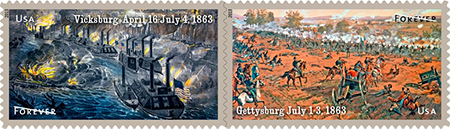
The ironclad fought at Forts Henry and Donelson , Island No. 10, and Memphis, and was badly damaged in a close action duel with the Confederate ironclad CSS Arkansas on the Yazoo River.  She was repaired in time to run the guns at Vicksburg in April 1863 (see U.S. Postage stamp shown below), and was also part of the Red River Fiasco (represented in the game by CSN Card 76).


USS Carondelet survived that disaster, and went back up the Cumberland in December 1864 to duel with Rebel artillery during the Nashville campaign – and later pouring heavy fire into the flank of John Bell Hood’s army when General Thomas counterattacked.  (Hood and his last, desperate effort to turn the tide are represented by CSN Card 89, which bear’s the luckless general’s name).


Saturday, July 20, 2013

The Ships of Rebel Raiders - The Ironclads

Rebel Raiders on the High Seas is a strategic game of the Civil War which focuses on the role of the navies on the rivers, along the coasts and on the oceans.  While most ships are represented by generic counters for Ironclads, Blockade Runners, Gunboats, Screw Sloops and, of course Raiders, there are cards and corresponding counters for many individual vessels.  This series presents those cards and offers a glimpse into the history of these storied ships.

Part III – The  Rebel Ironclads: CSS Virginia

…and why the iconic duel with the USS Monitor was such a “dud”


“The CSS Virginia was not the first ironclad warship in history, nor in the Civil War, nor even in the Confederacy,” notes historian James McPherson in his new book War Upon the Waters, but she is the most famous.  CSS Virginia, which is represented in Rebel Raiders by its own counter and card (CSN Card 70) is best known for being the Confederate side in the first duel of ironclad warships (her opponent being the USS Monitor – also represented in Rebel Raiders by a counter and card (USN Card 19).

Built up from the captured bones of the USS Merrimack in Norfolk, the CSS Virginia mounted six 9-inch Dahlgren smoothbores (three per side) and four Brooke rifles (a pair of 7-inchers forward, a pair of 6.4-inchers aft).  The iron casemate, which was rolled out in a single piece at Tredegar Iron Works (represented in Rebel Raiders by the production rules and CSN Card 95) was bolted onto the hull and then pierced to allow the placement of the guns. She also mounted a seven-foot iron ram (which nearly proved her undoing when it got stuck into the USS Cumberland whom she rammed in the Battle of Hampton Roads in March 1862).

“A novelty in naval construction,” as Confederate Secretary of the Navy Stephen R. Mallory called her (Mallory is also in Rebel Raiders as CSN Card 78) she took on the Union blockading fleet in Hampton Roads, sinking the USS Cumberland, compelling the USS Congress to strike her colors and forcing the USS Minnesota to run aground.  It was upon returning the next day to finish off the last of those when she met the USS Monitor

Unfortunately (or, rather, fortunately for the crews) neither ship was at her best in that fight.  The Union shells were charged with only 15 pounds of powder out of fear they would blow up in the guns (later tests showed they could handle three times that amount) and the Confederates brought only explosive shell, not solid shot or iron bolts, as they expected to face only wooden warships.  As a result although they battered away at each other, scoring hit after hit, neither could inflict any serious damage on the other.

Although technically a draw, CSS Virginia did retire to port – never to fight again.  She was burned by the Rebels to prevent her capture by Union forces advancing on Norfolk.


Tuesday, June 4, 2013

Rebel Raiders Replay  (Turn  5)
Designer Mark McLaughlin as CSA; Naval Historian Brandon Musler as USA

When we left off last time, the Union had gained its first big victories, taking the port of St. Augustine and the fort space at Island No. 10…

Turn 5 – August 1862…Blockade Runner Captains Rethinking Career Choices…

Six Blockade Runners are caught in the Union net! Four of them loaded!  The Francis Bonneau card   comes out again, giving the South a much needed free Blockade Runner.  Even with Bonneau, only 8 VP of cargo make it through.  A desperate attempt to clear out the Blockade Station at Norfolk in a one-on-one gunboat sortie fails, and the Blockade Runner in the port has to take its chances getting out – and is promptly intercepted by the Union.

At least now the growing fleet of Raiders is taking a toll – sweeping up 10 VP for the South. 

Batteries are placed in Memphis and Nashville in response to the Union push down the River to Island No. 10.   The new Ironclad appears in Memphis, along with a Gunboat.  Three Blockade Runners and a Raider are built, and 20 VP is spent to place a Battery in Savannah

The Rebel spy A Rose by Any Other Name (Card 82) allows Mark a sneak peak at two cards from the Union hand, and Mark chooses to discard the Engine Breakdown  (Card 47) which can immobilize Rebel Ironclads, as this could seriously hamper his defense of Memphis, which now has two Ironclads and two Gunboats with its Batteries.  

...Be Vewy, Vewy Quiet, Wewe Hunting Webel Waiders...eh eh eh eh eh

The Union, its blockade now solid on the Atlantic Coast and with gunboats filtering around into the Gulf ports as well, decides it has such as surfeit of Screw Sloops that it can afford to go hunting Raiders.    Brandon has been sending out single sloops to search for and sit beside Raiders (this later tactic means the South can not just sit in one spot and raid-raid-raid, as it would be subject to increasingly better searches, but must move and thus give up at least one of those raid attempts).   Now he is send out stacks to hunt them…no luck at first, but the “happy time” for Raiders is drawing to its end.

Rather than take on the massive force at Memphis, Brandon sends his river fleet to Henry & Donelson, where he destroys the battery but TWICE fails the attack rolls, leaving it in Rebel hands.  (See Illustration Below).

 Brandon builds two more Ironclads, a Gunboat and two Screw Sloops.


To be continued…..


Saturday, June 1, 2013

Rebel Raiders Replay  (Turn 3)
Designer Mark McLaughlin as CSA; Naval Historian Brandon Musler as USA

When we last left our intrepid gamers, the Union had been rebuffed twice at Louisville, and the Confederacy was enjoying the first “happy time” running the blockade…


Turn 3 – December 1861

The “happy time” is no more.  The Thin Blue Line rounds up THREE Blockade Runners in the Caribbean (one fewer than the South built last turn), and all of those were stacked with cargo, so it is a double loss!  The remainder manage to unload a mere 7 VP – most of which is eaten up by the attrition roll in the Supply Phase – and the two Raiders contribute nothing, finding no targets to sink or ransom.

 (NB: The South wants VP to build extra ships and defenses, buy extra cards and counterattacks – but also needs VP to keep getting three cards a turn).

Fortunately the Tredegar Iron Works  (Card 95) gives the South an extra battery, one of which goes to setting down an Ironclad.  (The others are placed in Savannah and, as seems fitting, Richmond, where those Iron Works were situated).    The South also builds a Raider and 3 Blockade Runners (to replace the 3 it lost), and spends 20 VP to build an Ironclad.

Brandon, despite not liking the odds, decides to go for Louisville again.  The South wins but Brandon plays “Lack of Brains” (Card 7) forcing a re-roll.  This turns the battle around and the Union takes Louisville!

Heady with victory, Brandon decides to rush for Nashville, which has no Battery, so it is two Rebel to one Yankee die.  The Union rolls a “1” and the South a “6”, which instead of a loss of merely 5 VP is doubled to 10 by play of Card 102 - Matthew Brady. To add insult to injury, this card also requires the Union to discard a card at random from its hand as further penance for its battlefield loss.   

At the start of the Union Build Phase the Confederacy plays Corruption (Card 58) – increasing the cost to build Union ships this turn and forcing the discard of Yankee Guns (Card 3) – which gives the Union Screw Sloops and Ironclads some re-rolls.


The North builds 3 Screw Sloops….which cost 2 each not just 1 due to Corruption.


Friday, May 31, 2013

Rebel Raiders Replay  (Turn 2)
Designer Mark McLaughlin as CSA; Naval Historian Brandon Musler as USA

When we last left our plucky warriors, the South had taken Louisville and strengthened Wilmington, and had a fleet of Blockade Runners ready to race in to deliver their cargo…

Turn 2- August 1861

Although one Blockade Runner is caught, the rest scurry through to unload 16 VPs of cargo – truly an auspicious beginning to the Southern “happy time.”  (If the South can’t make the VP in these early turns, they never will). Confederate Batteries are placed in New Berne and Key West, an aptly named “key” port as it allows Blockade Runners from all directions a refuge – and is a short hop for in-and-out runs to the many nearby foreign ports. Four Blockade Runners and a Raider are built.

The North decides that despite the poor odds the Union will try to take Louisville:  even with the South rolling three dice (two for being Southern, one for the battery) vs. his one die, the first attack is a close run thing, but the Union loses by 1 and gives the South a VP.  Second attack, however, is a rout:  a difference of 5 on the dice – and a corresponding gain of 5 VP for the South.

Brandon takes this as corroborative evidence of his being correct in the initial assumption that attacking this early was not a good idea.   He spreads out some gunboats, sliding down the coast to set up the inshore blockade, with Screw Sloops in the outer blockade.  A thin line, but a lengthening lasso nevertheless, as there is now only one port on the entire Atlantic coast that does not have at least one Yankee ship in its Blockade Station.. 

Brandon plays Card 31 – John Dahlgren for free Screw Sloops and Yankee Guns – and builds 2 Ironclads and a gunboat.


To be continued…..


Sunday, May 26, 2013

This day 150 years ago in Rebel Raiders’ History

-Dedicated to Civil War episodes, battles, people and ships that also appear in my game, GMT’s Rebel Raiders on the High Seas,  

A Bad Day on the Mississippi....Union attacks repulsed; Ironclad USS Cincinnati sunk

May 27, 1863

            Historical Event:   Bad day on the Mississippi.   Bank’s ground assault on Port Hudson repulsed with heavy losses.  Porter’s fleet duels with Vicksburg batteries – USS Cincinnati sunk.
            May 27, 1863 was a bad day for the Union on the Mississippi River.  General Nathaniel Banks’s ill-conceived plan to rush the Rebel lines at Port Hudson resulted in the decimation of his army.  After losing nearly 1,850 dead and wounded, Banks called off the attack and resumed his siege.
            At Vicksburg, David Dixon Porter led a powerful force of ironclads to bombard Fort Hill, the city’s chief bastion on the water.  The at first inconclusive pounding turned to tragedy, as Rebel gunners sunk the USS Cincinnati  (pictured below, courtesy of  U.S. Naval Historical Center; the “action” shot is from the new stamp issued last week by the U.S. Postal Service).


            Game Connection:  Vicksburg is one of the key ports on the Mississippi the Union must take to win Rebel Raiders on the High Seas.  Due to the scale of the map Port Hudson itself is not shown, but is represented by the fort space at Baton Rouge, which incorporates both important locales between Vicksburg and New Orleans.
            Porter (USN Card No. 2) is represented as a leader and a card in the game, and counters represent his ironclads and other warships, as well as the Rebel ships and batteries, like that upon Fort Hill, with which they contended for mastery of the great river.